Bad Bunny’s Super Bowl Show Was Political Art at Its Best

It’s no wonder Donald Trump was enraged by Bad Bunny’s halftime show at the Super Bowl. The Puerto Rican trap star has grown into the role of political artist and the creativity of his music is an indictment of MAGA’s schlock-filled cultural wasteland.
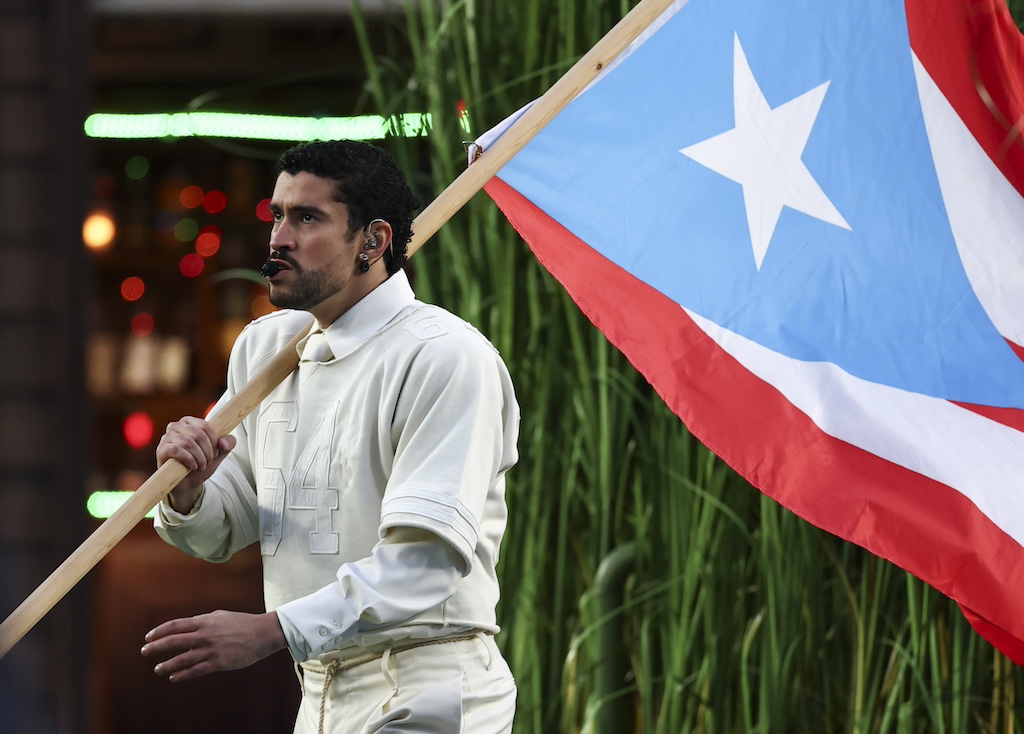
Bad Bunny’s performance at the Super Bowl was a gesture of defiance toward the xenophobia of Donald Trump’s base and a US government that dehumanizes Latin Americans. (Kevin Sabitus / Getty Images)

On Sunday night, millions of people across the United States and throughout Latin America tuned in to watch the National Football League’s (NFL) Super Bowl LX. Many of them were less interested in the game itself than in the highly anticipated halftime show of Puerto Rican pop king Bad Bunny.

Bad Bunny is the stage name of Benito Martínez Ocasio, who won the Grammy for best album the previous week. He delivered a show that lived up to the hype, speaking exclusively in Spanish and went through the major hits of his 2025 album, DeBÍ TiRAR MáS FOToS (“I Should Have Taken More Photos”), with an aesthetic evoking Puerto Rico and the island’s working-class New York diaspora.

Through the lyrics of his song “Lo Qué Le Pasó a Hawaii,” he used the platform to openly criticize US colonialism in Puerto Rico and he offered an ode to Puerto Rican working-class migrants with “NUEVAYoL.” Bad Bunny, surrounded by flags from throughout the continent, ended by saying “God Bless America” and then shouted out the names of every country in the Americas in true Bolivarian fashion.

The most political act was the performance in itself, a gesture of defiance toward the xenophobia of Donald Trump’s base and a US government that dehumanizes Latin Americans every chance it gets. Martínez Ocasio used the quintessential US sporting event to openly criticize an administration that has further militarized the US colony of Puerto Rico in order to attack other Latin American nations while continuing to deny Puerto Ricans the right to decide their future.

It’s no wonder that the halftime show enraged Trump, who took to his social media platform, Truth Social, to say that it was “absolutely terrible, one of the worst, EVER!” The US president, whose name appears in recent Department of Justice emails related to the notorious pedophile Jeffery Epstein, claimed that the dancing was “disgusting, especially for young children that are watching from throughout the USA,” and described Bad Bunny’s performance as a “‘slap in the face’ to our Country.”

Working-Class Hero

While Bad Bunny’s voice can now be heard in every corner of the globe, from senior centers in China to nightclubs in Scandinavia, barely a decade ago, he was working as a grocery store bagger in the town of Vega Baja (the supermarket where he worked has now become a tourist destination). Around the same time, he began his music career in the field of Latin trap, a genre that reflected the realities of working-class life for Puerto Ricans and Latinos in the United States.

Alternating between the hyperrealism of stories about quick money through drug dealing, crude sexual references, and fantasies of grandeur, Martínez Ocasio’s early lyrics were often similar to those of many others in the genre at the time like Anuel AA, Farruko, or Ñengo Flow. But his mastery of wit and subtle cultural references set him apart, evoking memories of reggaeton’s golden age in the early 2000s.

Bad Bunny’s rise in popularity also coincided with one of the most important events in recent Puerto Rican history, Hurricane Maria. The Category 5 hurricane touched down in Puerto Rico on September 20, 2017. It destroyed homes and infrastructure throughout the country, leaving the vast majority of the population without power for the weeks and months following. The incompetence of the delayed federal response to the hurricane, which left at least 4,645 people dead, exposed Puerto Rico’s colonial status to the world, including many US Americans who were unaware of their country’s colonial possession in the Caribbean.

Shortly after the hurricane, and Trump’s infamous visit to the island where he threw a roll of paper towels at a crowd, Bad Bunny made an appearance at a benefit concert wearing a T-shirt that said: “¿Tú eres tuitero o eres presidente?” (“Are you a Twitter troll or president?”). The font harkened back to the reggaetonero Residente’s multiple T-shirts calling for the independence of Puerto Rico and supporting progressive causes in Latin America a few years earlier.

This was a risky move for an artist who was just beginning to take off. It marked the start of the increasing politicization of Bad Bunny’s career. In July 2018, Martínez Ocasio released the song “Estamos Bien,” a ubiquitous anthem implicitly referring to Hurricane Maria. He appeared on The Tonight Show Starring Jimmy Fallon and condemned the continued abandonment of Puerto Rico by the federal government and the administration of then-governor Ricky Rosselló.

The Organic Intellectual

Bad Bunny’s performance on Jimmy Fallon and his willingness to speak out against US colonialism marked a turning point in both his career and political development. It was a step in his conversion into what Antonio Gramsci called the organic intellectual, a thinker who emerges from the masses to challenge the hegemony of the ruling classes. In summer 2019, there was a scandal after a series of chat messages revealed that Rosselló and his administration had been making fun of those who died in the hurricane. This led Puerto Rico to erupt in protests. Bad Bunny was on the front lines, calling for the governor to resign.

In 2022, Martínez Ocasio released the song “El Apagón” (“The Blackout”) in his album Un Verano Sin Ti (“A Summer Without You”). It criticized the US response to Hurricane Maria, the ongoing gentrification of the island, and the privatization of the state power company, which has led to frequent blackouts on the island. The song was accompanied by a short documentary about the negative effects of gentrification featuring the independent Puerto Rican journalist Bianca Graulau.

With the release of his 2025 album, DtMF, Bad Bunny solidified his role as an organic intellectual of the Caribbean and Latin American diaspora in the United States. The album was explicitly political, with many of the songs incorporating anti-colonial themes.

In “LA MuDANZA,” for example, Martínez Ocasio shows his support for independence with the lyrics “Y pongan un tema mío el día que traigan a Hostos, en la caja, la bandera azul clarito” (“Put one of my songs on when they bring back Hostos, in the coffin, with a light-blue flag”). This is a reference to the Puerto Rican independence leader Eugenio María de Hostos, who is buried in the Dominican Republic. Before his death in 1903, he requested that his body be returned when Puerto Rico was free. The “light-blue flag” is the symbol of independence — the same one that Martínez Ocasio used at the Super Bowl.

Martínez Ocasio also took the opportunity to raise awareness about the threat posed by the relocation of US Americans to the island by including a short film, codirected with the Puerto Rican director Arí Maniel Cruz. The film presents a dystopian future where Puerto Ricans have turned into a minority in their own country, displaced by Anglo-Americans. Martínez Ocasio also released YouTube videos to accompany the album’s songs with information about Puerto Rican history created by Jorell Meléndez-Badillo, a Puerto Rican historian and author of the critically acclaimed book Puerto Rico: A National History.

With his Super Bowl performance, Martínez Ocasio has solidified his role as one of the primary figures opposing Trump’s agenda on the global stage. His unapologetic deployment of Pan-American nationalism, at a time when many are retreating into submission to the “Donroe Doctrine,” is a vital rallying cry for resistance. His popularity is also bringing new life to the independence movement in Puerto Rico and shows that despite the difficulties of the world’s current geopolitical environment, we may see independence and true liberation in our lifetimes.