Motorists’ Party Brings MAGA to Czech Politics
The Czech Republic’s new environment minister is leader of a pro–fossil fuel party called Motorists for Themselves. It’s part of a right-wing backlash in Europe, moving to kill off the EU’s Green Deal.
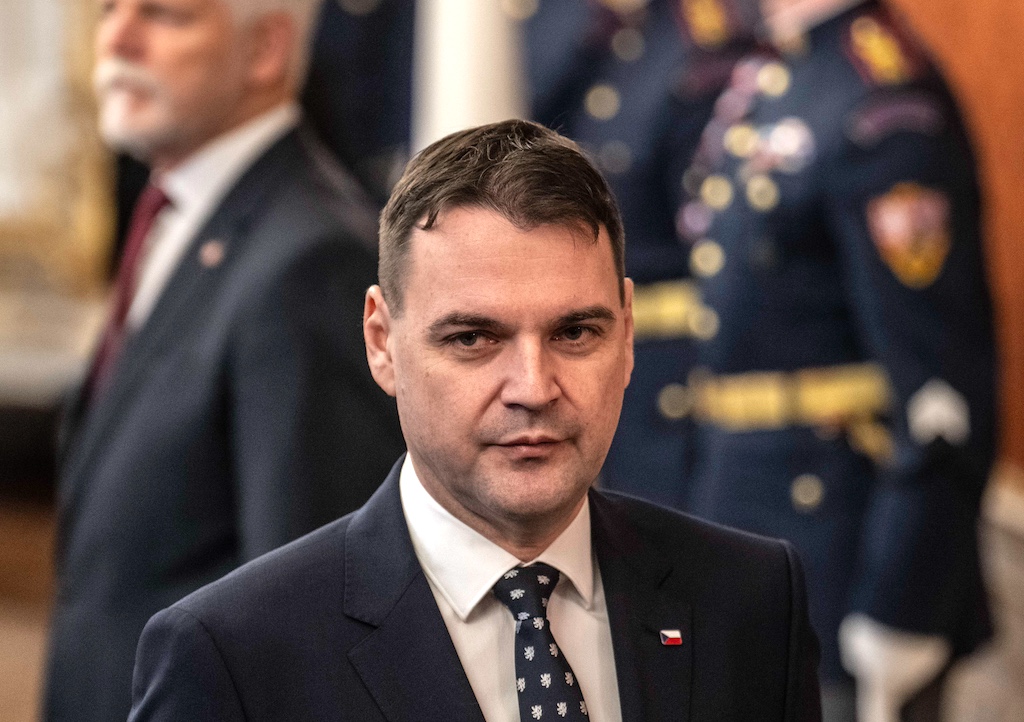
Petr Macinka has described the Ministry of the Environment as the main obstacle to the Czech Republic’s prosperity. (Milan Jaros / Bloomberg via Getty Images)
“For there to be any change for the better, a ruthless counterrevolution is needed at the Ministry of the Environment,” proclaimed Petr Macinka, chairman of the Motorists for Themselves party, in December 2024. He described the ministry as the main obstacle to the Czech Republic’s prosperity.
A few months earlier, the Motorists had surprisingly gained two seats in the European Parliament. However, it was not clear whether this young party would also succeed in the parliamentary elections slated for October 2025. It long hovered around the 5 percent threshold required to enter the Czech Chamber of Deputies.
Nevertheless, Macinka was already confident: the Motorists wanted to rule. His inspiration from the incoming Trump administration was clear. This was a moment when Donald Trump’s then-ally, Elon Musk, was talking up his new unit for government efficiency (which became the Department of Government Efficiency, or DOGE). Like Musk, the Motorists wanted to use “efficiency” and economic stimulus as a pretext to hobble public institutions that defended the public interest against the interests of a ruthless oligarchy.
In preelection discussions among liberal circles, however, the Motorists and their ideology — culturally conservative, economically strongly right-wing, and markedly climate-skeptical — were not considered the main bogeyman. That role was played primarily by the far-right Freedom and Direct Democracy (SPD) and the conservative-left Stačilo! (“Enough!”). The then-ruling parties, which espoused a prodemocratic and pro-Ukrainian ethos, portrayed these two parties as the main threat to the Czech Republic’s geopolitical direction, and in the latter case, as bearers of the condemned communist ideology.
There was a widespread discussion at the time about whether either Freedom and Direct Democracy or Stačilo! joining government would lead the Czech Republic out of the European Union. Motorists, meanwhile, presented themselves as the less “extremist” choice. They did not want to leave the EU. Rather, they sold themselves as a compromise between the outgoing government bloc, which disappointed its right-wing voters; its main opponent, the opportunist billionaire Andrej Babiš; and extremes of both Left and Right.
In retrospect, fears of “communism” or leaving the EU were misdirected. They don’t reflect the current political zeitgeist, where a far-right brand of conservatism has become hegemonic, and where Euroskeptic parties don’t want to leave the EU but to change it from within to suit their own agenda. That means pushing deregulation, especially on climate and digital issues, and a tough migration policy, while letting individual nation-states put their interests first.
The Motorists are members of the biggest Euroskeptic party in the European Parliament, the Patriots for Europe. They sit there together with Babiš’s ANO as well as parties like Hungarian premier Viktor Orbán’s Fidesz and Marine Le Pen’s Rassemblement National in France.
In line with its new National Security Strategy, the US government supports the members of Patriots for Europe as bearers of “true democracy in the EU.” This is because maintaining a weak, dependent and fragmented EU naturally suits Trump’s interests.
Preying on the Environment
The Motorists received a little under 7 percent of the vote in October’s parliamentary elections, while the much-feared Stačilo! party did not even make it into the Chamber of Deputies.
Babiš, who returned as prime minister after scoring an impressive 35 percent, gave the Motorists and their other coalition partners, Freedom and Direct Democracy, half of the posts in his cabinet. This generosity can probably be explained by the fact that Babiš needs his coalition partners in the vote on immunity from criminal prosecution, which he faces in connection with subsidy fraud in the so-called Čapí hnízdo case.
As promised, the Motorists immediately pounced on the Ministry of the Environment. “The climate crisis is over,” Motorists leader Macinka declared last month as he was appointed foreign minister and temporary environment minister. According to Macinka, this office should focus on “nature conservation” and stop “fighting the climate [sic].” In line with this stance, he abolished the climate protection section. A number of other ministerial experts left the office voluntarily.
Macinka wanted this ministry despite — or perhaps because of — the fact that he had worked for ten years at the institute of former Czech president Václav Klaus, who had established himself as a leading climate skeptic on the global stage. He took this ministry despite having described environmental organizations as potential terrorists. And despite the fact that the Motorists had the worst preelection program not only in terms of climate protection but also nature conservation in general. It is thus clear that the Motorists had their sights set on the ministry not to fulfill its statutory mission of protecting nature but to weaken and destroy it, thereby helping their sponsors.
These include, in particular, one of the richest Czechs, coal baron Pavel Tykač. Before the elections, he called for national disobedience to Brussels and its green policies. At the same time, in 2024 — when Macinka was working there — Tykač was the largest sponsor of the Václav Klaus Institute, to which he sent ten million Czech crowns (about $500,000).
As with US oligarchs lining up behind Trump, we can imagine this move may soon pay off for Tykač, given the Motorists’ success. Before the elections, the Ministry of the Environment negotiated with the coal baron about how much he should pay to municipalities in northern Bohemia for the reclamation of his mines. Tykač wants to pay half a billion crowns (around $25 million) less than the state expected. In addition, the Ministry of the Environment oversees the distribution of billions of crowns from the European budget for decarbonization. Under Macinka’s leadership, these could flow to Czech energy oligarchs even faster than they have so far.
Grown-Up Boy, the Foreign Minister
In January 2025, the influencer and newly minted Motorists MEP Filip Turek was the only Czech to receive a personal invitation from Trump’s team to the presidential inauguration. During his next trip to the United States, for last February’s Conservative Political Action Conference (CPAC), the MEP even met with Musk. He reportedly talked to him about the need to fight the “deep state” and Brussels bureaucracy and thanked him for cutting off the United States Agency for International Development (USAID) money flow to “mainstream media and green and rainbow NGOs.”
Afterward, Turek lavished praise on Musk — describing the world’s richest man, but also himself, with disarming honesty. “Elon comes across as a grown-up boy in the best sense of the word, his behavior does not correspond to his real age at all — which reminds me of myself. He uses exaggeration and double meanings in every sentence and has a perfect sense of humor.”
The fact that he simply behaves like a fifteen-year-old boy with self-control issues is probably the most forgiving perspective from which to view Turek’s numerous scandals. These include photos with his right arm raised and other Nazi symbols, celebratory posts about the murder of environmental activists, approval of the burning of a two-year-old Roma girl in 2009, dangerous speeding on the highway, and accusations that he beat his partner.
Despite these scandals, the Motorists originally wanted to install Turek as foreign minister. In Turek’s words, he was suitable for the position thanks to his superior relations with the Trump administration, among other things.
The Motorists party described Turek’s social media posts as “youthful recklessness,” even though the forty-year-old wrote some of them as recently as 2023. As part of their defense, they also accused former government minister Ivan Bartoš of “seriously participating in the activities of the terrorist organization Antifa.”
However, the defense was not enough for President Petr Pavel, who is a nonpartisan figure in Czech politics. He refused to appoint Turek as foreign minister. Macinka thus had to temporarily take over two ministries. Motorists are currently discussing who else to fill their ministries with. They are also wondering what to do with Turek, who left his lucrative position as an MEP in Brussels to become an ordinary member of the Czech Parliament.
“I Drink Bleach”
The president’s decision is a problem for the party because Turek is by far the most popular member of the Motorists. Before becoming a politician, he was famous as an influencer with hundreds of thousands of followers, which is no small feat in the Czech Republic. In the Central Bohemian Region, where he headed his party’s list of candidates, a third of Motorists voters gave their preferential vote specifically to him.
As Turek’s image as a tough guy with an expensive taste in cars shows, Motorists mainly represent younger men living in smaller towns, often dependent on cars and the automotive industry.
As the party is mostly popular among the young, it also boasts one of the biggest youth organizations among Czech parties, Motorgen.
The group’s representatives often praise self-discipline, healthy lifestyles, and entrepreneurship. However, Motorgen also has its darker undertones. Notably, its members strive to carry out a conservative counterrevolution in Czech universities, where they try to disrupt events about gender or green issues.
“I drink bleach”; “I am a certified racist”; or “Every communist must hang,” read slogans used by young Motorgen members in a widely shared post in late 2024. Like Turek’s or Musk’s interventions, these edgy comments are meant ironically.
The Motorists, however, are not merely a party of inexperienced young men. They enjoy the support of venerable and influential figures in Czech politics. These include, in particular, the aforementioned former president and architect of Czech privatization in the 1990s, Václav Klaus. With him, they share right-wing ideas of a small state, low taxes, and deregulation as well as strong climate skepticism.
The Green Deal Backlash
In addition to clear inspiration from the manosphere, the rise of Motorists can also be seen as a reflection of concerns about the impact of the European Green Deal on living standards.
The EU’s original ban on the sale of new cars with combustion engines from 2035 was extremely unpopular in Czechia. This cannot be blamed solely on the rhetoric of Czech politicians and the media — often owned by fossil fuel oligarchs, including Pavel Tykač — who are essentially unanimous in their criticism of the Green Deal.
The automotive industry accounts for approximately one-tenth of Czech GDP. The Czech Republic’s scattered villages (it has the most municipalities per capita of all OECD countries) are difficult to connect by public transport. Cars are thus a necessity in the Czech countryside, where public infrastructure has been in decline for a long time.
It is no surprise that the Czech Republic, even under the previous government led by conventional right-wing parties, pushed for a softening of the combustion-engine ban. Last month, the EU did scale back the plan, partly due to strong German political and industry pressure.
The neglect of social considerations in the architecture of the European Green Deal has thus contributed to the growth of a party that is far more extreme on climate issues than the typical Czech outlook. Despite the gradual increase in climate-skeptical attitudes, most Czechs still believe that climate change is man-made and that something needs to be done about it, such as building infrastructure for renewable energy sources.
Only time will tell whether the Motorists will maintain or even expand their influence after the recent election period. Propelled by the Czech fossil oligarchy, some traditional politicians, angry young men, and social media algorithms, they can also benefit from changes in the global context — and, more specifically, the situation in the world’s most powerful country.
As the United States has transformed from a neoliberal hegemon to a hegemon of national conservatism, it has begun to inspire forces in the Czech Republic and beyond who look up to this same ideology. They learn from MAGA, but at the same time skillfully exploit national specifics, such as, in the Czech case, dependence on the traditional auto industry.
Like Trump, the Motorists want to destroy institutions in the interests of oligarchs, deny the reality of climate change, and strive to carry out a conservative counterrevolution in Prague. In today’s world, such movements can be optimistic about the future.