Something Weird Is Happening in the Housing Market

After the pandemic, many younger Americans were encouraged to buy housing in “starter cities.” But now the homes are losing value, and property taxes are soaring, pitching the housing market into crisis.
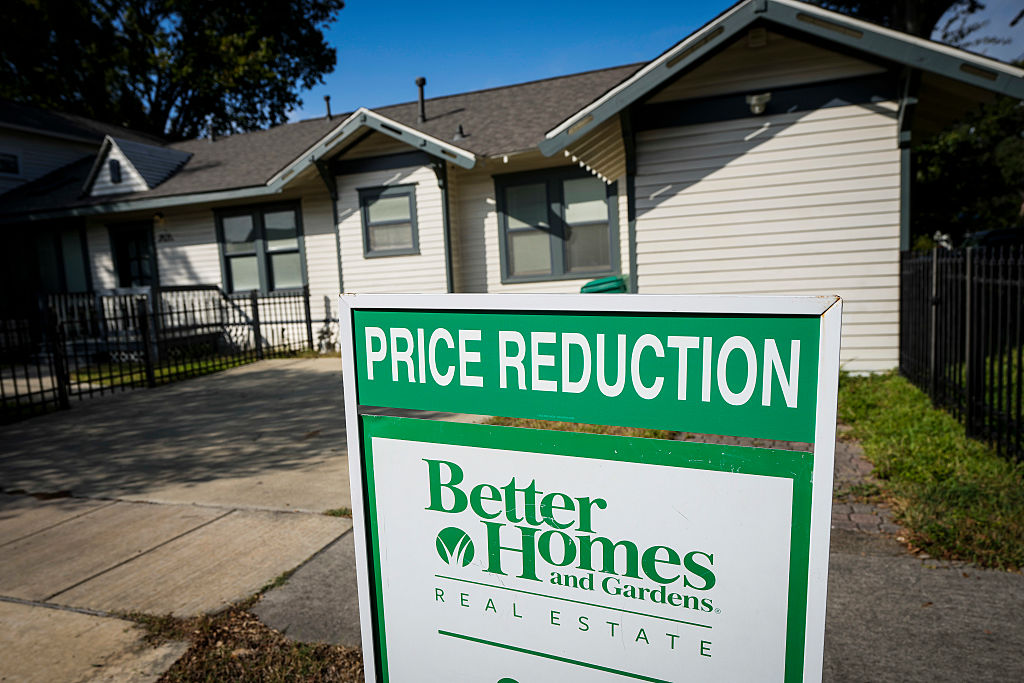
Last year, home sales fell to their lowest level since the Great Recession. While the Trump administration boasts of good economic news, average Americans are increasingly feeling under pressure. (Brett Coomer / Houston Chronicle via Getty Images)

A year ago, the New York Times released a list of cities that had seen the sharpest rise in property taxes in recent years. Indianapolis, Atlanta, Jacksonville, Tampa, Miami, Orlando, Dallas, Denver, and Fort Worth topped the list. All of the cities saw around a 45–65 percent increase since 2019 in their median property tax bill. On a monthly basis, for most, that means three-digit increases. Outpacing taxes, somehow, is home insurance costs. Nationwide, policy premiums are up 70 percent percent since 2021; if inflation is the “silent killer,” these are the silent inflations.

If that weren’t enough to keep homeowners up at night, try tacking on the likelihood of lost value. Zillow recently published a report that found 53 percent of homes nationwide lost value (according to the site’s “Zestimate”) between 2024 and 2025, with the average drawdown at 9 percent. And as has become axiomatic in recent reporting on the economy, this is the largest move down since the Great Recession. The losses come as a shock to the system cognitively but aren’t being realized yet at scale, as sellers are delisting homes at record rates, refusing to negotiate on price, or refusing to move despite a desire to do so.

Real estate transactions have tanked to the point where the real estate profession itself is undergoing an existential crisis. Agents can’t close, buyers don’t want to pay their fees, and sellers are stuck in a psychedelic state induced by the post-pandemic frenzy, when bidding wars were the norm and institutional buyers were — quite literally — door-knocking with a wad of cash. Now sellers outnumber buyers by a half a million, and sales are taking place at their slowest rate since — you guessed it — the tail end of the Great Recession. Once that protracted process has run its course and seller meets buyer, home sales are getting canceled at record highs: around one in seven fall through.

So, what does this mean when taken together? We have a nationwide housing crisis playing out along a network of mid-tier cities with several common attributes. All the maps look the same. Larger hubs like Boston, New York, Chicago, and Los Angeles all have their own particular issues. This is a story about something else: the Florida–Texas matrix with West and East Coast appendages in Newark/Philadelphia, the Carolinas, and Denver/Salt Lake City. They aren’t the great cities, or the “global cities” articulated by Saskia Sassen, Peter Marcuse, and others. They aren’t the “old and cold” centers of development and an international, highly educated workforce. Nor is it Richard Florida and his “creative class” airball regarding the revitalization of Rust Belt cities.

There isn’t any single arrow to connect the United States’ top ten cities for every measure of the Housing Crisis 2.0. Yet there are some common threads.

Much like the fallout amid the foreclosure crisis, these cities are marked by higher shares of black and Latino residents, in particular homeowners. Let’s list some of the top twenty cities for the rate of homeownership among black residents: Houston, Orlando, Jacksonville, Miami, Dallas, Atlanta, and Philadelphia. Now a few of the top twenty cities for Latinos: San Antonio, Houston, Dallas, Tampa, Miami, Orlando, Atlanta, Salt Lake City, and Denver.

It seems like everything is the same as the Great Recession all over again, but different. A list of the cities with the worst foreclosure rates back then would look pretty similar to this list, with one major caveat — trade out the smattering of California cities for the Texas Triangle.

Not everything can be reduced to racial dynamics, however. These cities are all, also, what we could call the “starter cities.” You or your friends probably moved to, or back to, one of them after college in search of a job, a partner, a home, or all three. The sticker price felt affordable given the surge in hiring post-COVID-19 and the dream of increasing property values at once-in-a-lifetime interest rates. If you were under thirty at the time, chances are your family helped out as well. Around 80 percent of Gen Z and millennial home buyers used family savings to cover or contribute to down payments. That doesn’t necessarily make it simply a “nepo market,” as some have dubbed it; for many, it just makes it an intergenerationally leveraged one.

Here are some questions I’m left with after rounding up the data.

Where were the financial experts and neighborhood organizers telling young people in these starter-city magnets that just because you can afford the mortgage doesn’t mean you can afford the home? How many people were enticed into this market with the zeitgeist of forever increasing home prices? How has racially coded talk of empowering minority populations to buy real estate been used to prop up homeownership regimes that fail to pass down the hard truths on expenses? And finally, how are relatively stable regional constellations (the Florida Corridor and the Texas Triangle) operating on a modern method of mono-cropping — a place that profits from the cyclical planting of the same crop, until the material bases for growth are eroded away?

If for the crisis last time around the trip-wire mechanism was the adjustable-rate mortgage, this time it’s looking like a reassessment crisis ran into a climate one. The experience for the homeowner, materially, is much the same. You sign on to a $2,000 mortgage for a $250,000 home — expensive but affordable — and your first year or two is great. Reassessments take place on a three-to-five-year schedule, so at some point you hit your first road bump. Your annual property tax bill went from $1,500 to $3,500, moving your monthly cost from $125 to $300. That’s one more big trip to the grocery store for three, per month. Throw in a nearby natural disaster and another $1,500 annually on home insurance . . . you get the point. If you can’t afford your monthly mortgage times 1.5, you’re probably in big trouble.

To complicate matters, a lot of recent homebuyers in these troubled markets are moving into new builds — costs in the preexisting market are so high, new builds look cheap in many places. You start off paying artificially low “land taxes,” and the fact of the structure you’re living in has yet to hit the bill. Two years later, and your taxes triple without a forewarning from the old agent. All of this assumes you’ve yet to have a single issue in the house — God forbid the roof, or the plumbing. Now, where are the most new builds, you might ask . . . in Dallas, Houston, San Antonio, Orlando, Tampa, Jacksonville, and the cities of the Carolinas.

The past five years have been characterized by multiple Biden-era safeguards against a housing crisis. Loss mitigation, loan restructuring, payment supplements, and foreclosure moratoriums all should have us worried that there is any increase in foreclosure starts. Instead, we are into month ten of an already nine-month-long increase in the cyclically adjusted numbers, clustered in this same set of cities. Last April, Donald Trump signaled a sunsetting of the Federal Housing Administration (FHA) programs to keep homeowners in their houses by 2026. Back in 2024, the Wall Street Journal reported, “Of the 52,531 FHA loans last year that went seriously delinquent within their first year, only nine resulted in foreclosure.”

Those days are behind us. More than two-thirds of new FHA loan recipients have a debt-to-income ratio (your total monthly debt obligations over gross monthly income) above the industry threshold of 45 percent. In 2007, the number was less than one-third. In the conventional mortgage markets, for context, the standard of affordability is much tighter, around 35 percent debt to income.

Something to consider is the role of urban sociologists during this time. A lot of what’s happening sounds like David Harvey’s old “second circuit of capital” operating freely in a post-devaluation landscape. When capital overaccumulation plateaus in areas of production, it gets recycled through land-development processes. And here we find John Logan and Harvey Molotch’s showdown between the use values and exchange values of our homes. This is not a new concept for academics, or really for ordinary people either: we buy homes to live in, and developers produce them as investment vehicles. We need to be prepared for two bad outcomes: either home prices fall and young people start selling short, knocking $50,000 to $100,000 off of purchase price and flooding the rental market; or they continue to rise, but only serve as a marker of currency debasement, not value attainment.

The future is bleak in the capitalist housing conundrum. But the future after that could be another post-Trump, federal intervention into the cities; a redo of Model Cities and the Great Society but without its tragic ending under Richard Nixon’s defunding. Who knows what the future holds, but we need not wait for the stock markets to crash to call it what it is: a housing crisis. A housing crisis even capitalists would recognize, not just what socialists would describe as the omnipresent housing crisis under capitalism.