Historians Have a Duty to Condemn Scholasticide in Gaza
An overwhelming majority of American Historical Association members voted earlier this month to condemn scholasticide in Gaza. AHA leaders overruled members to block the measure, opting for cowardice over ethical clarity.
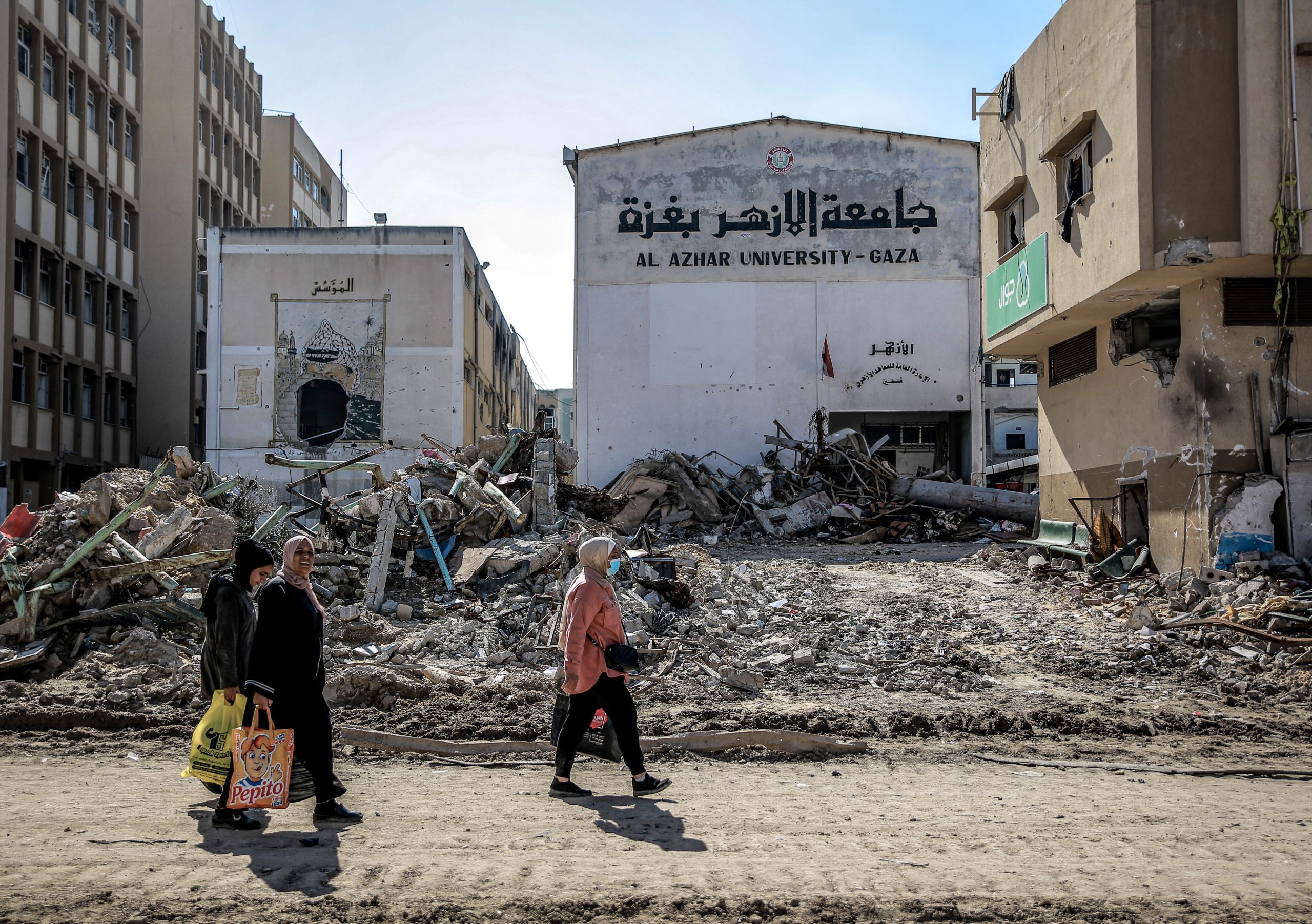
By refusing even a symbolic defense of academic freedom in Gaza, the AHA aligns itself not with its most vulnerable colleagues but with the structures that seek to silence us. (Omar Ishaq / picture alliance via Getty Images)
Earlier this month, the American Historical Association’s (AHA) leadership once again overruled its own members, blocking a resolution on scholasticide in Gaza and vetoing a second resolution concerning the escalating repression of scholars in the United States — particularly those who have spoken out about this destruction.
The votes were not close. Nearly 80 percent of attendees to the AHA’s annual conference on January 8–11 supported these measures after debate and direct appeals from Palestinian colleagues whose universities, archives, and libraries have been reduced to rubble.
This decision is not merely disappointing. It is antidemocratic and morally evasive, and it reflects a racist viewpoint: the AHA’s defense of historical inquiry weakens when the subjects are Palestinian and the politics are therefore deemed too dangerous.
Professional associations derive their legitimacy and authority from their members. When an elected council repeatedly nullifies decisive votes, it converts shared governance into procedural theater. The council’s justification — that these resolutions fall outside the association’s proper scope — is unconvincing on its face. Israel has systematically destroyed Gaza’s universities, libraries, archives, and cultural institutions. Hundreds of our colleagues and tens of thousands of their students have been deprived of any meaningful access to education.
As the AHA’s own constitution states, the purpose of the association
shall be the promotion of historical studies through the encouragement of research, teaching, and publication; the collection and preservation of historical documents and artifacts; the dissemination of historical records and information; the broadening of historical knowledge among the general public; and the pursuit of kindred activities in the interest of history.
If the defense of our Palestinian colleagues and students does not fall within this remit, it is hard to imagine what does.
The council’s veto sends a chilling message to historians already navigating an increasingly punitive academic environment. Faculty and students who speak about Palestine face harassment, job loss, blacklisting, and institutional discipline. By refusing even a symbolic defense of academic freedom in Gaza, the AHA aligns itself not with its most vulnerable colleagues but with the structures that seek to silence us.
This is not neutrality. It is abdication.
The AHA’s timidity is especially striking when placed alongside its past actions. The association has condemned Russia’s misuse of history to justify its war on Ukraine, rightly identifying the destruction of archives and the repression of scholars as threats to the discipline itself. In that context, the council recognized that historians have obligations that extend beyond national borders.
Palestine, it seems, is the exception.
This double standard reflects a long-standing Orientalist bias within the historical profession that treats Palestinian suffering as regrettable but politically radioactive, and therefore unsuitable for scholarly concern. Palestinian institutions are rendered perpetually exceptional, their destruction somehow too complex, too controversial, or too dangerous to name.
This selectivity undermines the AHA’s credibility and reinforces a hierarchy of whose histories — and whose lives — are worth defending. When historians refuse to apply their principles consistently, we reproduce the asymmetries of power and knowledge we otherwise critique.
There is a further, less acknowledged dimension to this failure. Alongside the overt anti-Palestinian racism, the council’s actions also reveal a latent antisemitism embedded in its institutional caution. By preemptively retreating in the face of anticipated accusations of antisemitism, by shrinking in fear at attacks made on academic associations by groups such as the Anti-Defamation League, the AHA treats Jews as a monolithic bloc whose presumed outrage must be appeased rather than engaged.
This is not protection. It is stereotyping.
Many of the historians supporting these resolutions are Jewish. Many are scholars of Jewish history, antisemitism, and the Holocaust. The resolutions themselves explicitly rejected antisemitism and opposed its instrumentalization. Yet the council’s veto suggests a belief that Jewish anger is both inevitable and uniquely threatening, and that the safest course is silence.
This logic echoes older antisemitic tropes about Jewish power and volatility, even as it claims to act in Jews’ defense. It also legitimizes the cynical weaponization of antisemitism accusations to shut down debate, a practice that ultimately weakens the fight against real anti-Jewish hatred.
To refuse to speak about Palestinian scholasticide out of fear of a “Jewish backlash” is not solidarity with Jews. It is an institutional failure to recognize the diversity of Jewish voices and commitments, including those rooted in anti-racism, internationalism, and historical responsibility.
The AHA council has chosen procedural insulation over democratic accountability, selective outrage over universal principle, and cowardice over ethical clarity. Historians know where such choices lead. Authoritarian regimes depend on self-censorship and the silencing of moral objection. As we teach our students, silence rationalized as prudence is never neutral in moments of genocide.
The membership has now spoken twice, and Palestinian scholars have asked for solidarity. The record is clear. What remains is whether historians will accept an organization that refuses to live up to its own discipline — or engage in the work to transform the AHA into an organization that defends democratic decision-making and academic freedom against fear, bias, and coercion.