Attacks on Journalist Seth Harp Are Attacks on Free Speech

Seth Harp’s reporting on nonclassified information about the US’s attack on Venezuela has led to attacks from Congress on his — and everyone’s — basic First Amendment rights.
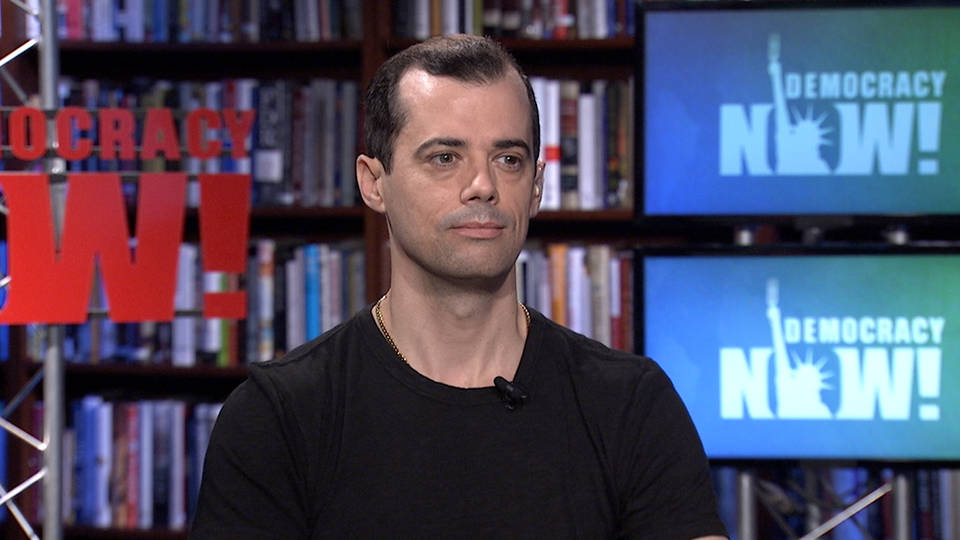
No existing law criminalizes journalist Seth Harp’s recent reporting on US military action in Venezuela. (Democracy Now!)

After 10:30 p.m. on January 2, 2026, Donald Trump was at Mar-a-Lago when he received an anticipated phone call from his aides. For months, Trump had been saber-rattling against Venezuela, amassing US warships off the coast, illegally seizing Venezuelan oil tankers, carrying out extrajudicial executions of purported drug traffickers on the high seas, and even carrying out a drone strike within Venezuelan territory.

Trump had also publicly announced he authorized the CIA to engage in covert action in the country. Since August, the CIA had been tracking the movements of Venezuelan president Nicolás Maduro. And earlier that month, Trump had decided they would use the US military to abduct the sovereign head of state. The only question was when. Weather conditions delayed the rendition. But that night, Trump gave the go-ahead.

US Delta Forces, an elite US Special Forces unit that is part of the Joint Special Operations Command, invaded Venezuela to kidnap its leader under the pretext of arresting him to stand trial in New York City for highly questionable charges. The United States began its aggression with a cyberattack, cutting power to parts of Venezuela. The invasion also involved 150 aircraft, including both bombers and drones. When bombing the country, the United States not only took out Venezuela’s air defense but also struck a civilian residence, murdering Rosa Gonzalez, an eighty-year-old woman.

According to reporting by Semafor, both the New York Times and the Washington Post  knew about the raid in advance, something the US Congress did not. Both papers opted not to publish information about the impending act of aggression, a move Semafor described as “keeping with long-standing American journalistic traditions.” But not every journalist was so amicable to the US government’s acts of war.

After the raid, investigative reporter Seth Harp posted to X, “This is the commander of Delta Force, whose men just invaded a sovereign country, killed a bunch of innocent people, and kidnapped the rightful president.” Harp’s post then included an official portrait of a high-ranking colonel taken from a Duke University website. The photo remains on Duke’s website, but the colonel’s biography has now been severely truncated.

The individual was alleged by Harp to have a command role in Delta Forces and was thus responsible for the illegal, unconstitutional military raid. He was not believed to have been an on-the-ground participant in the raid. Harp’s post also included a parenthetical about the legality of reporters’ sharing classified information, though as Harp has repeatedly stressed, none of the information was classified.

Harp is the author of The Fort Bragg Cartel: Drug Trafficking and Murder in the Special Forces. The book takes as its starting point a rash of strange, mostly drug-related crimes carried out at Fort Bragg, weaving them in with the history of how the US Special Forces came to carry out a policy of assassinations during the global “war on terror.” The scathing exposé makes the case that this stateside crime spree connected to US Special Forces operators is part of the domestic blowback of our out-of-control foreign policy. The book has become a bestseller in no small part due to support from the independent media. And its success suggests the real hunger across the ideological spectrum people have for serious, critical reporting on US foreign policy.

While Harp’s work has won praise, revealing the dark side of US foreign policy puts a target on one’s back. Especially visceral in their dislike of Harp has been an online community of current and former members of the US Special Forces. Harp’s post incensed many of his critics, who flooded his replies with allegations of doxxing, breaking the law, and endangering lives. As a result of the pile-on, X locked Harp’s account until he deleted the offending post.

If the brouhaha had merely stayed on social media, the story wouldn’t be as dire. But it wasn’t just loudmouths on social media with no impact on the real world who targeted Harp. Some of those loudmouths also serve in the US Congress.

Congress Versus the First Amendment

Rep. Anna Paulina Luna (R-FL) announced on social media she would motion for the House Oversight Committee to subpoena Harp. In doing so, she made clear her animus toward not just Harp but the media writ large. She wrote, “The media has gotten away with too much for too long and I’m sick of it. Bring him in.”

Subpoenaing a journalist to compel them to testify about their reporting is an incredible affront to press freedom. Congress is aware of this. In 2024, the House of Representatives unanimously passed the Protect Reporters from Exploitative State Spying (PRESS) Act to prevent the federal government from subpoenaing reporters about their sources or newsgathering. Although it likely would have passed in the Senate, it died when Senate majority leader Chuck Schumer declined to bring it to the Senate floor for a vote.

Given this, one might have thought the move to subpoena a reporter to hold him “accountable” for reporting that a member of Congress disliked might have generated vocal opposition. Instead, the ranking Democrat on the committee, Robert Garcia, proposed an amendment to add a subpoena for the executors of the Jeffrey Epstein estate. Luna accepted it. The motion then passed on a voice vote. According to someone I spoke with who works on the Hill, there were audible no votes. This means the vote was not unanimous, as Representative Luna has falsely claimed on social media.

While there was no recorded vote, it does seem many Democratic members of the committee did vote for the subpoena. Garcia would tell MS NOW’s Eugene Daniels that “Democrats made the decision — if they’re going to subpoena this reporter, which was not our choice, then we’re going to attach these Epstein subpoenas to that vote, and that’s how we got the Epstein subpoenas.” When asked by Daniels if he was concerned about the precedent this might set, Garcia answered, “Absolutely. I mean, look, it’s not a subpoena that we agree with. Either we were going to — either that subpoena was going to go through with no Epstein subpoenas or we were going to attach the Epstein subpoenas to them.”

Following the passage of the bill, the Oversight Committee’s Democratic members released a press release from Garcia patting himself on the back for securing the Epstein subpoena votes. While it does mention this was achieved through amending motions put forward by Luna, the release makes no reference to Harp. Given that the vote to subpoena Harp has been condemned by nearly every press freedom group, it’s unsurprising this detail was omitted.

While congressional Democrats are trying to avoid ownership of the subpoena, Harp’s congressional critics are escalating. After the committee voted to subpoena Harp, Luna then turned toward lobbying the Department of Justice to criminally investigate the reporter. Luna’s “criminal referral” shared on social media lists a number of statutes, none of which apply to the facts of what Harp did. Most do not even apply to what Luna inaccurately alleges Harp did. For example, Luna bizarrely cites statutes about the disclosure of classified communications intelligence, something widely understood to refer to the activities of the National Security Administration, computer hacking, and witness tampering. Even if Harp had exposed the classified identity of a covert operative, which he did not, such statutes would not apply.

Unsurprisingly, Luna cites the overly broad provisions of the Espionage Act, which criminalize the unauthorized disclosure of national defense information. While Harp’s sharing of information obtainable via an official biography or a Freedom of Information Act request are not covered even by the extremely broad Espionage Act, Luna’s calling for Harp to be investigated under the draconian World War I–era law is notable.

Under the Trump and Biden administrations, the Department of Justice prosecuted journalist Julian Assange for publishing classified information. Luna was one of fourteen members of Congress to sponsor a resolution condemning the prosecution on the basis that Assange had engaged in “regular journalistic activities” protected by the First Amendment. As someone who wrote extensively on Assange’s merciless persecution at the hands of the US government, I can say that Luna was correct, a sentiment I wrote to her office expressing at the time. But it is impossible to square Luna’s past views on the First Amendment with her attempts to imprison Harp.

Other congressional critics of Harp seem to be aware that he broke no laws — and some are trying to change that. Or they are at least pretending to. Rep. Pat Harrigan (R-NC) has introduced the “Special Operator Protection Act.” A press release announcing the bill did not mention Harp by name but stated it was in “direct response to recent US Special Operations missions in Venezuela that resulted in the capture of Nicolás Maduro, after which individuals attempted to publicly identify and expose the operators involved.”

The bill’s target is clear. In the press release and social media promotion, Harrigan claims broadly that his bill criminalizes publishing the names of special forces operators. The text of the bill, however, requires one to have the intent to threaten, intimidate, or incite a crime of violence, or the intent for the knowledge to be used for those ends. While this should not cover Harp’s actions, the bill is clearly designed to be vague enough to chill speech broadly. And it is being publicly promoted as criminalizing Harp’s actions, clearly with intent of heightening its chilling effect.

Either way, the bill’s sponsors claim it deals with a “dangerous gap in existing law that leaves Special Operators vulnerable once missions become public.” This is clear acknowledgement that no existing law criminalizes Harp’s actions.

War Abroad, Censorship at Home

Calls to subpoena or prosecute Harp, or even change the law around protecting Special Force operators’ identities, must be considered within two contexts. First, these efforts are being pushed by proponents of the lawless, reckless US foreign policy Harp criticizes. This is unsurprising. The Espionage Act was passed during World War I to silence critics of US participation. It was expanded during the Cold War. And during the Vietnam War, it was first used to prosecute a whistleblower. The law was ratified as the go-to weapon against whistleblowers and used to prosecute a journalist for the first time during the war on terror. Donald Trump’s return to a more naked form of imperialism sets the stage for more repression of critical reporting.

There is also increased pressure on the Right to shield state agents from scrutiny. This has led to an increasingly elastic definition of “doxxing” that is applied to those who publish the identities of public officials. Elon Musk, Charlie Kirk, and then-acting US attorney for the District of Columbia Ed Martin claimed Wired engaged in doxxing or breaking the law by publishing an article about Department of Government Efficiency (DOGE) employees.

As ICE agents have terrorized communities across America, they have anonymized themselves by wearing masks. Right-wing commentators and administration officials have claimed attempts to identify those public officers of the law committing abuses constitutes doxxing. Trump’s National Security Presidential Memorandum-7, a blueprint to crush the Left, equates identifying public officials with domestic terrorism.

Whether Harp is actually served with a subpoena remains to be seen. It is entirely possible that, under public pressure, the committee quietly chooses not to issue the subpoena. But the attacks on Harp are part of a dangerous trend. Social media platforms, demagogic politicians, and the national security state are colluding with one another to drastically roll back the protections of the First Amendment.