The Promised Land Is One of the Great Films About Capitalism
Fifty years ago, Polish director Andrzej Wajda produced one of the most astonishing films about the rise of capitalism ever made. The Promised Land is an unforgettable picture of early industrial exploitation that still feels contemporary.
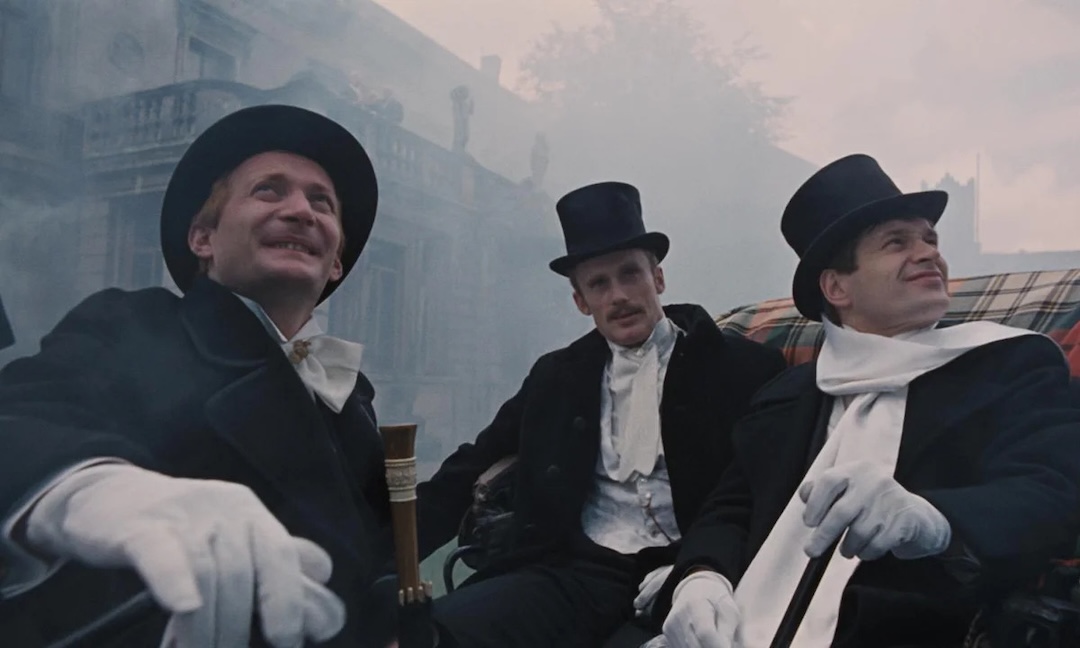
You won’t find a better film about the rise of industrial capitalism, bringing all of its transformative energy and all of its exploitative ruthlessness to life on screen, than Andrzej Wajda’s The Promised Land, which turned 50 this year. (Klassiki)
Andrzej Wajda’s film The Promised Land became an instant classic of Polish cinema after its release in 1975. It received an Oscar nomination in the category for best foreign-language film, and cinema historians still name it as one of the best Polish movies of all time. It is also exceptional in Wajda’s wider oeuvre as the only film he made about capitalism and money.
In The Promised Land, Wajda is concerned primarily with the challenges that a new capitalist and commercial civilization creates for the dominant form of Polish culture, with its values stemming from the ethos of the Polish nobility. At the same time, we can also read the film as a coded commentary on Poland during the 1970s.
Satanic Mills
The Promised Land is set in the mid-1880s in the town of Łódź. Known as the “Polish Manchester,” Łódź was the main industrial center in the part of Poland that was under tsarist rule. Its economy was based on textile production for the vast Russian market.
In 1820, Łódź was still a small town with a population of about eight hundred people. In the space of just sixty years, it filled with factories, warehouses, banks, and credit unions. There were lavish palaces for its titans of industry and slums for its working class.
Three friends — Maks Baum, Karol Borowiecki, and Moryc Welt — dream about getting their own share of Łódź’s industrial economy. In one of the first scenes, we can see them on a misty morning, just after dawn.
They’re strolling through woodland, counting their steps — this is the place where they’re going to build their factory. None of them has any capital for the investment, but all three have the determination, ingenuity, and ruthlessness necessary to fulfill their dream.
Maks is an engineer, son of a German industrialist who failed to mechanize production in his handloom factory and was driven out of business. Moryc is an aspiring financier from a Jewish family. Karol is an industrial chemist who is working as a managing engineer in the factory of Bucholz, one of the most powerful industrial titans in the city; he belongs to the minor Polish nobility. Łódź at the time was a melting pot (or perhaps we should say cauldron) of different social classes, nationalities, and creeds.
In the next scene, we can see how the city is waking to the sound of its factory sirens. The wealthy are starting their day in the luxury of palatial interiors, the workers are in their shabby homes, and the unemployed are desperately queuing at the factory gates in hope of a day’s casual labor. Wilczek, an upwardly mobile moneylender, starts his day with a Catholic prayer, brought to Łódź from the cottage of his peasant parents; Bucholz, a Lutheran, prays in his somber German; and the rich financier Grynszpan sings his prayers in Hebrew, dressed in ritual attire.
Wajda looks upon the burgeoning capitalism of Łódź with a profound sense of ambiguity, equally appalled and fascinated by it. He presents the city as a land of dark, satanic mills, where the workers are ruthlessly exploited, sexually as well as economically.
In one scene, the industrialist Kessler strolls through his factory, lewdly appraising the bodies of his female employees. He picks one girl, probably still in her teens, and “invites” her to the orgy he organizes in his palace — the girl has no choice, or she will lose her job.
The director recreates all the ugliness, violence, and cruelty of this world in naturalistic detail, making use of dynamic editing techniques and handheld cameras. The historical drama often feels like a documentary.
In the early stages of production, Wajda considered interrupting the narrative with boards containing quotes from the Communist Manifesto to help the audience understand the movie’s social and economic realities. He wrote to the Polish cartoonist Jan Lenica, commissioning him to prepare the artwork. Lenica was interested, but Wajda ultimately decided that his boards wouldn’t be needed after all, since the naturalistic images of Łódź were working so well.
At the same time, Wajda is visibly fascinated with the energy, both destructive and creative, of industrial capitalism, and the productivity, innovation, and social mobility it unleashed. He is also fascinated by the people who are building this world — even if this goes against his better judgment.
When he was beginning to think about making a movie based on Władysław Reymont’s 1899 novel, Wajda jotted down a note about its “evil, hideous, great characters.” Later, in his autobiography, Wajda expanded on that comment as he described the industrialists from Reymont’s work:
They were usually self-made men, the first in their families to have any real money. Before they made it, they were working as weavers, foremen, small-scale merchants. If they made it that far, they had to have strong characters and personalities. They were ruthless, rapacious, but also full of innovative ideas.
Eternal Polishness
The frenetic reality of Łódź contrasts with the world of Kurów, Borowiecki’s family estate, to which Karol and his friends pay a visit. Wajda depicts the Kurów manor as a pastoral arcadia, with its house as a symbol of “eternal Polishness,” filled with the family heirlooms that bear witness to four hundred years of Borowiecki history. Maks, having been brought up in an austere Lutheran household, is clearly stunned, but Karol dismisses it as a “mummified form” of Polish noble culture.
Borowiecki knows that the world of his childhood cannot survive in the new landscape of rapidly developing industrial capitalism. The estate is heavily indebted, and Borowiecki is forced to sell it to Kaczmarek, a self-made businessman from Łódź who grew up near Kurów in a peasant family. A few decades earlier, he would only have been admitted to the Borowiecki manor through the tradesman’s entrance.
If Karol resents the changes that are making his class obsolete, he rarely shows it. He wants to ride the wave of change, convinced that he can exploit the opportunities it presents for his own aims. The novel comes with a moralistic ending: Karol has made a huge fortune but struggles with a feeling that he has lost his soul in the process. Yet its real moral seems to be that Karol is right: Poles must learn how to become successful men of business.
Reymont, who came from a modest peasant background, was politically connected with the right-wing nationalist National Democracy movement. There is even speculation that Roman Dmowski, the spiritual leader of Poland’s nationalist right, encouraged him to write The Promised Land.
Dmowski believed that it was vital for Poland to become a modern, capitalist nation. He also considered the strength of the Jewish bourgeoisie in Polish cities to be an obstacle to the development of an ethnically Polish capitalist class and saw that antisemitism could be a very convenient political tool with which to win mass support for his nationalist program.
Reymont’s novel reverberates with similar beliefs, clearly suggesting that capitalism in Łódź would be far more just and humane were it not for the Jews. Wajda didn’t share Reymont’s outlook and sought to downplay the antisemitism of his source material. The movie still faced accusations of perpetuating antisemitic stereotypes when it was screened in the United States.
Wajda emphasizes, even more strongly than Reymont did, the paradoxical nature of Borowiecki’s career. His ability to make it in Łódź owes more to his personal qualities as an attractive Polish man of noble pedigree than it does to his entrepreneurial spirit.
He gains access to crucial insider information about tariffs thanks to his affair with the wife of a Jewish industrialist. Later when it seems that Borowiecki and his partners have lost everything, Karol saves himself and secures a place at the summit of the economic elite by marrying the daughter of a German self-made millionaire, Müller.
Müller’s daughter Mada, who Wajda portrays as a ridiculously vulgar and ignorant figure, fancies herself as a Polish lady, and her father is happy to marry his daughter into nobility, even if her new husband is penniless. He also gladly takes him on at his firm, since he is quite competent as a chemical engineer and manager. Karol breaks off an engagement with his fiancée, Anka, a cultured, compassionate young woman, who like him comes from an impoverished noble family.
In the last scene, we see Karol presiding over a gathering in the mansion of his father-in-law. He is carrying a young child, dressed in the traditional attire of the Polish nobility — a tradition that has now been reduced to a purely ornamental function. Instead of building Polish national capitalism, Karol and the city’s other captains of industry call in the tsar’s Cossacks to repress striking workers, most of whom are Polish like him.
Karol has made it to the top. But his cold, lifeless face, seen in close-up after he says “Let them shoot,” shows us that he has also lost something valuable in the process.
Gierek’s Promised Land
According to Polish film historian Tadeusz Lubelski, the news that Wajda was making an adaption of The Promised Land confused his fellow filmmakers and his audience. Wajda had a rather “dissident” image as a filmmaker — someone who took on topics that were problematic for Poland’s communist government. Now it seemed he was going to make a movie about the evils of industrial capitalism, which would be aligned with the official ideology of the ruling party.
The authorities were also confused, but happy. The official censorship office handed down an order to silence criticism of the new movie and use it to create a rift between Wajda and dissident sections of the Polish film industry.
At the same time, if we look at the Polish cinema of the 1970s, we can see that the most expensive state-funded productions did not offer depictions of revolutionary struggle or a social critique of capitalism. Filmmakers and the authorities that supervised them were more interested in lavish adaptations of popular literary classics, often depicting Polish history as the history of the nobility (or the intelligentsia that descended from its ranks).
This “socialist heritage cinema” was part of the ideological package while Edward Gierek ruled Poland as the ruling party’s first secretary. It was intended to show that the party cared about national heritage and national culture. In a similar vein, Gierek approved the reconstruction of the royal castle in Warsaw that had been in ruins since the war.
Gierek’s ideological package also relied upon the idea of technocratic modernization to build a socialist society of abundant consumption. In the Stalinist period, official culture celebrated the figure of the worker. Now it was a specialist, especially an engineer, who enjoyed the same prestige.
Three months after the premiere of The Promised Land, Polish state television started to show a popular series called Being Forty. It was a comedy about the everyday problems of a goofy engineer called Stefan Karwowski. On the one hand, he struggles with a midlife crisis; on the other, he modernizes Warsaw by supervising the construction of a new road and (in the second season) a new railway station.
We can also read The Promised Land as a parable about Gierek’s own “promised land” turning sour. The film critic Adam Garbicz detects clear parallels between the avaricious, money-obsessed world of nineteenth-century Łódź and the emptiness of Gierek’s Poland, obsessed with material abundance and rising consumption. In his reading, Borowiecki’s act of “selling his soul” to Müller makes him a spiritual forefather to the opportunistic careerists of the Gierek era.
Wajda struggled for a long time with the ending of the movie, trying out different ideas. In one scenario, Karol was supposed to go to Moscow, where his Russian business partners would greet him at the railway station. Wajda writes in his autobiography that he wanted to film that scene to make it look like a meeting between Polish and Soviet leaders. If the movie had ended that way, it would clearly have been understood as a critique of Poland’s latter-day elites.
Instead, the movie ends with a strike and the spectacle of capitalists calling in the army to help suppress it. That ending disturbingly anticipates the events of the following year in Poland, when workers in Radom and Ursus took to the streets to protest against price rises, to be met with brutal police violence. Looking at that scene, the public might also have been thinking about the strikes of 1970 on the Polish coast, crushed by the military after receiving orders from Gierek’s predecessor, Władysław Gomułka.
After the Promised Land
Interestingly, the Łódź textile industry was never treated very well in communist Poland. The wages for its strongly feminized workforce were significantly lower than those available in more strategic branches of industry such as coal mining, and the factories suffered from chronic underinvestment. Wajda didn’t even have to build sets for The Promised Land — he could find plenty of factories that still looked the way they had back in the 1880s.
After 1989 and the return of the market economy, most of the textile firms went bust. The city was plagued with unemployment, and many people left. In 1989, Łódź was Poland’s second-largest city, with a population close to a million; today it is the fourth-largest, with fewer than 650,000 inhabitants.
In 1992, the Tribune newspaper, connected with Poland’s postcommunist social democratic party, urged Wajda to make a contemporary movie about poverty and other social problems in Łódź. Wajda sent a letter to the paper in which he declined, blaming the city’s problems on the policy of the Communist Party, which should have modernized the textile industry when there was still time.
After 1989, Wajda never made another movie about contemporary social issues, concentrating on historical topics instead. While critics have regularly named The Promised Land as one of the greatest Polish movies, the film’s critical image of capitalism has been downplayed in its public reception.
Today, when it is clear that capitalism is once again creating vast inequalities and unleashing socially destructive technological revolutions, Wajda’s critique seems timelier than ever. The movie brilliantly shows how the promised land can easily turn into a wasteland — material, social, and spiritual — in ways that are intertwined and sometimes hardly distinguishable.