Squeezing Water From the Rubble in Syria
Reporting from Yarmouk — the devastated Palestinian refugee district on the edge of Damascus — Jacobin follows the Palestinian House, a grassroots reconstruction initiative, as it leads efforts to dig wells and restore water in a camp abandoned by the state.
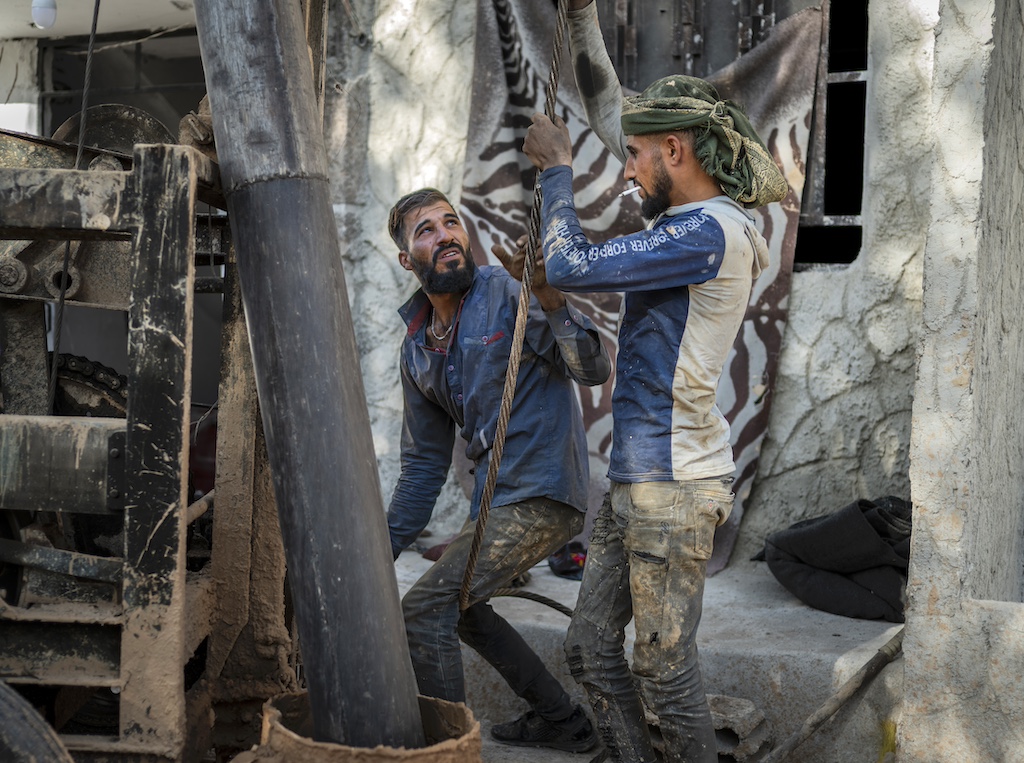
A crew of workers dig a new borehole in Yarmouk using aging equipment and improvised techniques. (Santiago Montag /Jacobin)
“This is pure gold,” says Khaldoun al-Mallah, holding up two bottles of cold water he bought in a shop rebuilt from the ruins of a neighborhood still struggling to recover, where electricity is scarce and the heat is relentless. With no fan to cool the room, Khaldoun spends hours in his office planning strategies to deal with the socio-environmental collapse weighing on the Palestinian refugee camp of Yarmouk — often compared to Gaza. Located south of Damascus, the camp was founded in 1957 by Palestinians displaced by the Nakba. For decades the community prospered, but the Syrian War that began in 2011 dragged Yarmouk into a deep abyss. Nearly a year after the fall of Bashar al-Assad, the country is still far from resolving its main structural problems under the new government of Ahmed al-Sharaa. The most pressing matter of all is water.
Khaldoun was the last surgeon to remain in the camp during the challenging years of the Yarmouk siege. After six years of exile in Idlib, he returned to help found the Palestinian House, a local organization that aims to rebuild the neighborhood and bring the community back to life.
“I feel responsible for rebuilding our Little Palestine from the ruins,” says the forty-three-year-old Palestinian surgeon, whose reputation has been forged in years of hardship and resistance. The roar of machinery fills the air, replacing the thunder of bombs that once coated the camp with dust and rubble. “Without water, there is no life,” he tells Jacobin. “If we restore access to water, we will take a huge step toward reviving our homes.” For him, this is no longer just a project, but a purpose. The camp is no longer officially off-limits, but the devastation has rendered it uninhabitable. “I never imagined finding the city in such a pitiful state,” he says. “The infrastructure no longer works. We are completely disconnected from the drinking water network, and the damaged sewage pipes are contaminating the extraction and purification lines.”