Neoliberal Globalization Never Abolished the Nation-State

Philip Cunliffe’s analysis of world politics after globalization takes the phony rhetoric of leaders like Tony Blair at face value instead of digging deeper. As a result, he can’t make sense of what globalism actually was or what is going to replace it.
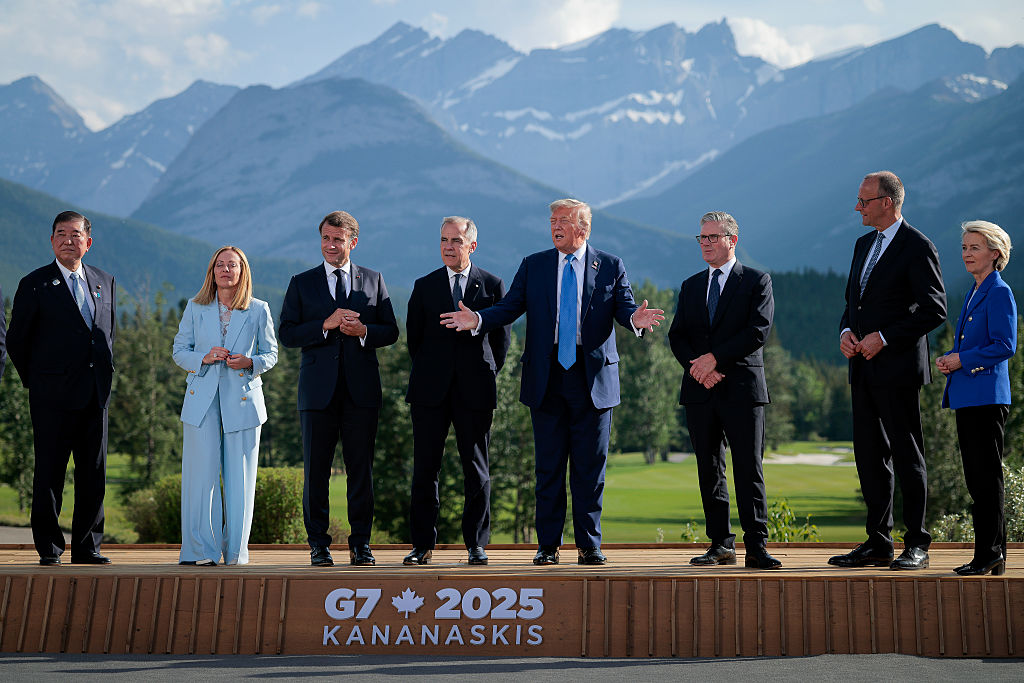
Philip Cunliffe claims that globalization obliterated the “political basis for nationhood.” But this doesn’t match the reality of modern European politics, where countries pursued different geopolitical strategies in line with their own needs. (Chip Somodevilla / Getty Images)

Philip Cunliffe is an associate professor of international relations at University College London, an academic supporter of Brexit, and a prominent contributor to the contrarian right-wing comment site Unherd.

His new book, The National Interest: Politics After Globalization, argues that globalism has hollowed out the nation-state, stripping sovereign institutions of their domestic legitimacy and opening up a potentially terminal rift in Western democracies, with rulers (transnational elites) pitched on one side against the ruled (geographically anchored electorates) on the other.

Cunliffe’s solution to this crisis of representation is for political leaders to embrace the post-global moment to revive “the national interest” as the unifying “lodestar” of twenty-first-century democracy. But what is the national interest, precisely, and how might politicians go about reviving it?

Believing Blair

Cunliffe doesn’t say. Instead, he offers a string of conceptual nonspecifics. The national interest, he suggests, isn’t “a thing” but “a way of doing politics,” a “rhetoric of accountability” that enables “ordinary citizens” to exercise “the most political agency, both individually and collectively.”

What does this mean and how are we, as readers, meant to process such verbiage? It’s not clear; clarity isn’t one of Cunliffe’s strengths. And yet, from here, somehow, things get muddier still. Cunliffe sees globalism everywhere — even, or especially, where there is none.

Secessionist movements are globalist, he writes, because they weaken the power of centralized states. Environmentalism is globalist because it casts climate change as a matter of “human survival.” Even the leftist anti-globalization campaigns of the late 1990s and early 2000s were globalist because they advocated “greater integration precipitated by economic growth.”

Cunliffe’s anti-global fetish reaches fever pitch in his treatment of the West’s 9/11 wars, which he appears genuinely to believe were fought for “altruistic” reasons, to “spread democracy” and “defend human rights” in Afghanistan and Iraq. During the high point of US hegemony, Cunliffe writes, “war became the mark of humanitarian virtue.”

Did it, though? In his response to the findings of the 2016 Chilcot Inquiry, Tony Blair justified his support for the Iraq War with reference to 9/11. Under Saddam Hussein, Blair argued, Iraq possessed chemical weapons, had routinely flouted UN sanctions, and was prone to “aggressive, unpredictable, catastrophic actions.”

“Put yourselves in my shoes as prime minister,” Blair wrote at the time, “barely more than a year on from 9/11. You are seeing the intelligence mount up on WMD. You are doing so in a changed context of mass casualties caused by a new and virulent form of terrorism. And your primary responsibility as PM is to protect your country.”

Is this the logic of a leader dedicated to the realization of Iraqi human rights? Or is it the logic of a leader who believed — delusionally — that toppling Hussein was necessary for Britain’s national security? The answer is obvious. Yet Cunliffe, supposedly a foreign policy realist, takes at face value the humanitarian grandstanding of Western states.

Sovereignty and Statecraft

Cunliffe’s primary target, of course, is the European Union. In his view, the EU is a quasi-imperial entity built not just to limit the political autonomy of sovereign countries but to negate the daily grind of national democratic politics itself.

His enthusiasm for Brexit stems from this critique. Britain’s “secession” from the EU was an “audacious” assertion of national priorities over global ones, he says. It was a revolt against liberal technocratic rule that thrust questions of identity, sovereignty, and belonging “back to the forefront of British political life.”

But such questions never left the forefront of British political life. With the kind of intellectual concision conspicuously absent from Cunliffe’s text, Tom McTague, in his book Between the Waves: The History of a Very British Revolution: 1945–2016, shows how the arguments in favor of Britain’s entry into the European Economic Community (EEC) in the 1970s followed a ruthlessly pragmatic logic.

According to McTague, of all the politicians who campaigned for British membership, only Ted Heath, a romantic Europhile, was drawn to the Franco-German dream of a federal European superstate. The rest, from Harold Wilson to Margaret Thatcher, were less sentimental in their assessments.

The consensus among British elites at the time, McTague writes, was that membership of the EEC would bolster Britain’s security — Thatcher envisioned an anti-Soviet “alliance of free states” — and help modernize the country’s industrial economy.

In the decades that followed, British governments consistently took an arm’s length approach to European federalism. In the late 1980s, Thatcher warned against ever-deeper integration into Europe’s burgeoning “socialist” bureaucracy. In the late 1990s, Gordon Brown said Britain would join the European single currency only if Europe could pass five stringent economic tests. In the run up to the 2016 Brexit vote, David Cameron sought — admittedly, with limited success — to secure a slate of UK-only carve outs from EU legislation.

Indeed, far from progressively ceding sovereignty to Brussels, it could be argued that British policymakers have for more than half a century practiced exactly the kind of careful national statecraft that Cunliffe advocates. Cunliffe, however, acknowledges none of it.

Thinking Globally

He also does not acknowledge the capacity small and medium-sized states had during the peak years of globalism to exercise their sovereignty through supranational institutions.

Cunliffe’s thesis rests on the idea that globalization obliterated the “political basis for nationhood,” establishing in its place a sprawling transnational system centred around “global trade, global rights, global [everything].” Political elites, keen to elevate themselves above clawing national electorates, were complicit in this process, he says, and, eventually, the sovereign autonomy of nation-states simply “faded away.”

But this narrative doesn’t match the reality of modern European politics. After the fall of the USSR, different European countries, including many former Soviet republics, pursued different geopolitical strategies in line with their specific national and political needs.

As a result, today Norway is a member of NATO but not the EU, Ireland is a member of the EU but not NATO, Portugal is a member of NATO and the EU, and Switzerland is a member of neither. Likewise, Norway and Switzerland maintain their own currencies while Ireland and Portugal do not.

Such diversity would not have been possible in a world where the flattening effects of globalization were as absolute as Cunliffe claims. Yet, for Cunliffe, sovereignty is a singular property: either you have it or you don’t.

Matters are not helped by the fact that Cunliffe’s analysis of globalization feels so heavily annexed from other writers. In his 1997 book, False Dawn, the British philosopher John Gray cautioned from a conservative perspective against the socially corrosive effects of “utopian” liberal ideals. Joseph Stiglitz, a New Deal Democrat, published Globalization and its Discontents in 2003. Naomi Klein, a Canadian socialist, published The Shock Doctrine four years later.

These books detailed the antidemocratic nature of the global capitalist economy at the height of its powers between the fall of the Berlin Wall in 1989 and the 2008 financial crisis. Since then, the arguments they set out — that the end of communism was not the end of history; that deregulated markets are inherently self-destructive; that privatization and austerity immiserate the public realm — have become mainstream to the point of cliché.

England, His England

In The National Interest, Cunliffe adds nothing new to the anti-globalist position, beyond, perhaps, a few distempered broadsides against millennial identity politics and liberal virtue signaling. (Cunliffe views any expression of transnational solidarity, from fair trade to pro-Palestinian protests on campus, as symptomatic of the global woke mind virus.)

Even his claim that the nation-state is the only political unit capable of true democracy builds on the work of the conservative English intellectual Roger Scruton, who wrote a pamphlet in 2004 arguing that “territorial loyalty” formed the basis of free government.

Scruton’s pamphlet — England and the Need for Nations, published by the right-wing think tank Civitas — railed against the growth of “transnational governance,” specifically in the guise of the EU, the UN, and international human rights law.

“Every expansion of jurisdiction beyond the frontiers of the nation-state leads to a decline in accountability,” Scruton wrote more than two decades ago. “We only have to observe the workings of the EU to observe that, without the constant invocation of national identity, free speech could be abolished as easily as honest accounting.”

Replace the legible phrase “national identity” in this sentence with the less legible one “national interest” and it could be Cunliffe’s. The difference, however, is that Scruton — a Shire Tory metaphysically attached to his Englishness (he died in 2020) — was honest about the nation to which he was referring. Cunliffe, by contrast, hides his Anglocentrism beneath a thicket of republican political theory and mangled IR rhetoric.

Yet Anglocentric he is. Cunliffe either ignores the growth of nationalism in Scotland and Wales over the past forty years or dismisses substate nationalist movements as unwitting conduits of globalism. Big states are strong, he argues, and small ones are weak, incapable of managing global capital flows or resisting the bullying demands of transnational bureaucrats.

Stuck in the Shallows

The irony here is that, in Britain, London is the bullying transnational bureaucrat. Since at least the mid-1980s, the British state has acted as the chief conduit of globalism — in the form, primarily, of national industrial asset sales and financialization — throughout the UK. Meanwhile, the Scottish and Welsh parliaments, established in 1999, have functioned periodically as centers of social democratic resistance to Westminster’s Thatcherite consensus.

Cunliffe could embrace small-state nationalisms as potential new nodes of opposition to globalist overreach or as democratizing projects aimed at bringing power closer to the people. By not doing so, he reveals his true goal: the emergence of a more muscular and conservative version of British statehood birthed by Brexit. The idea that Brexit has in fact weakened Britain — the Union may or may not survive Scotland’s efforts to rejoin the EU or Ireland’s attempts to reunify — doesn’t seem to have occurred to him.

The National Interest comes with endorsements from the Left and Right. Wolfgang Streeck calls the book “a brilliant rehabilitation” of nationality politics that leaves “the shallows of [neoliberalism] behind.” David Goodhart, a leading British critic of immigration and multiculturalism, says it offers a “vital account” of how “the nation might be revived.”

Both endorsements miss the point: the nation doesn’t need to be revived because neoliberalism never managed to eradicate it in the first place. Cunliffe is right to say that nationalism holds certain radical possibilities, for socialists as well as conservatives.

But his argument about the national interest — as far as it can be coherently pieced together — falls apart under the weight of two questions he cannot adequately answer: Which nation and whose interests?