Chicago’s Mayor Brandon Johnson Is Caught in a Trap

The challenges Chicago’s progressive mayor, Brandon Johnson, has faced demonstrate that Mayor Zohran Mamdani in New York will have to out-organize what’s soon to be a mighty opposition to his every move from finance, insurance, and real estate interests.
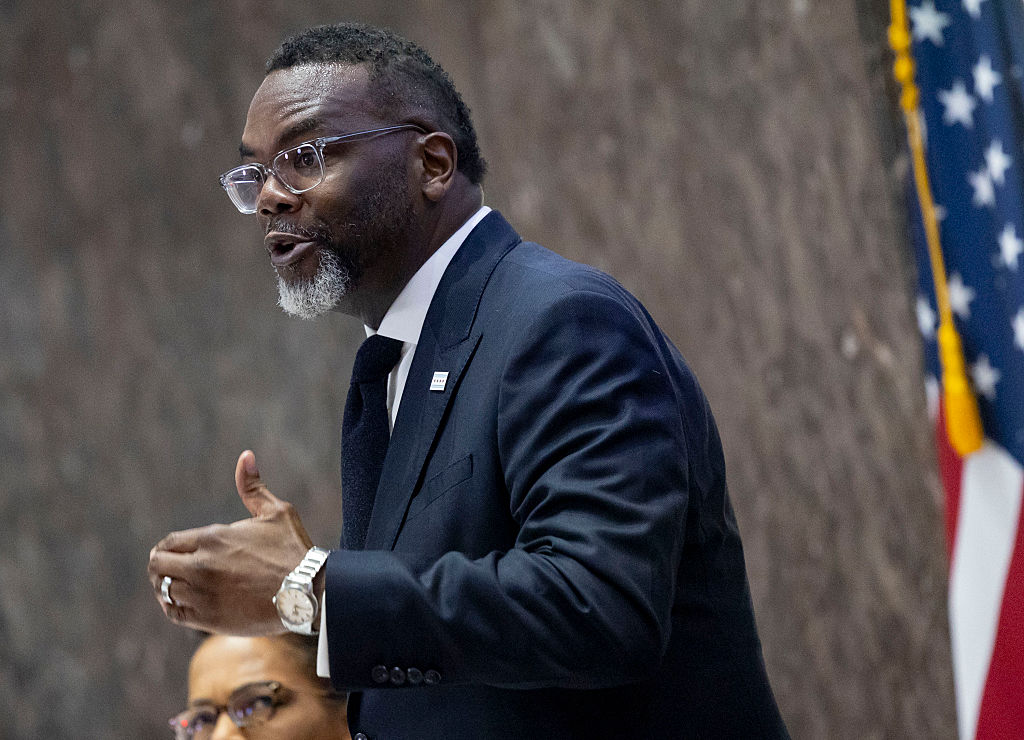
To make New York safe and affordable, Mamdani will have to confront and accommodate the power of finance, insurance, and real estate (FIRE). In a city dominated by FIRE like no other, the experience of Chicago Mayor Brandon Johnson hints at the fight ahead. (Brian Cassella / Chicago Tribune / Tribune News Service via Getty Images)

When labor activist Brandon Johnson upset Paul Vallas in Chicago’s 2023 runoff mayoral election, the Left had good cause for optimism. One of their own, a former Chicago Teachers Union (CTU) activist, had just won the highest elected office in the third largest city in the United States. And, even better, he did so with an explicit commitment to pursuing a racial and economic justice platform. After the Sanders 2020 campaign, it was a much-needed glimmer of hope for the American left.

And for a time it seemed that the hard work of local activists had finally paid off. Johnson’s victory was made possible by support from the United Working Families Party, founded as a coalition between the CTU and Service Employees International Union Health Care Indiana Illinois and now including a range of other progressive unions, along with the impressive get-out-the-vote efforts of community-based organizations. While Johnson’s assembly of a traditional electoral coalition of blacks, Latinos, and lakefront white liberals was certainly formidable, it would be the governing coalition that would determine whether or not he could fulfill his social democratic agenda. Inevitably, this would mean working with real estate developers and the corporate class writ large to feed the growth machine with financial incentives and corporate subsidies.

This conundrum was hardly unique to Chicago. Brandon Johnson, like all progressive mayors, is caught in this contradiction of urban governance in America; he cannot govern without accommodating the financial, insurance, and real estate (FIRE) sectors. But he cannot accommodate the FIRE sectors and build “the safest, most affordable big city in America.” Examining the challenges confronting Brandon Johnson can help to anticipate the kind of governing constraints that Mayor Zohran Mamdani, who lacks the benefit of an activated institutional base such as the CTU, will soon face from the much more powerful FIRE sectors in New York. If Chicago was a battle, then New York will be nothing less than a full-scale war.

For Johnson, affordable housing wasn’t just one of many campaign promises — it was central to his run. And for good reason. Chicago faces a shortage of 119,000 affordable housing units, with the majority of renters spending more than 50 percent of their income on rent alone. So far, the Johnson administration has reached for many of the standard tools in the affordable housing tool box, including streamlining the permitting process for affordable housing development, supporting moderate-income homebuying, and leveraging taxes, fees, and municipal land to incentivize developers into building affordable rental housing units. At the same time, the Johnson administration has put into place the infrastructure for increasing affordable housing production in the long term through social housing, as reflected in his Green Social Housing (GSH) program.

Green Social Housing, which passed the city council in May 2025, is the signature program in Johnson’s affordable housing agenda. The goal is not simply a larger supply of affordable housing in general, but its availability in affluent neighborhoods like Lincoln Park. First, the ordinance creates the Residential Investment Corporation (RIC), an independent nonprofit housing developer, to work in partnership with private developers to produce affordable housing. The GSH ordinance requires publicly assisted developments to include a minimum of 30 percent of their rental units that are permanently affordable for households making no more than 80 percent of the area median income (AMI), or $89,700 for a family of four. Many alderpeople representing West and South Side wards contested this requirement, explaining that many of their working-class constituents would not be able to afford this supposedly “affordable” housing. Instead, they proposed development set aside for those making 30 percent of AMI, or roughly $36,000 for a family of four.

Second, RIC will administer a revolving loan fund which makes low-interest three- to five-year loans to nonprofit and for-profit developers to build mixed-income, environmentally sustainable, permanent affordable housing across the city. Once these loans are paid back, they will add to the fund, which will in turn be used to finance future affordable housing. The revolving loan fund will start out with $135 million distributed from the mayor’s $1.25 billion Housing and Economic Development Bond, passed by the city council a year earlier. This kind of public financing will allow the city to be less dependent on federal subsidies like Low-Income Housing Tax Credits or on private equity to fund affordable housing. Most crucially, the RIC — which aims to produce no less than four hundred affordable units annually — will have a majority stake in any development that draws on the loan fund.

At the passing of the GSH ordinance, the Johnson administration announced that “Chicago becomes the first major city in the country to implement this innovative model for developing permanent affordable housing.” Unlike means-tested public housing, GSH was created under the premise that housing should be affordable and sustainable for the vast majority of working people in the city. In addition, these housing units should not be segregated in low-income neighborhoods but made available in affluent neighborhoods. In today’s political climate, the addition of a GSH developer and revolving loan fund, with the government’s majority stake in publicly financed developments, is a significant step forward. However, it falls short of municipal ownership and the direct production of social housing by government, which is still necessary in order to meet the heavy demand for affordable rental housing. Such municipally owned social housing relies on capital grants and loans from the federal government, which is unlikely to happen under any Republican or Democratic administration.

Unfortunately, despite the promising start of GSH, the Johnson Administration’s efforts are still dependent on providing financial incentives to private developers. For example, the administration touts its “mixed-income model” that “leverages the efficiency of private sector development while creating permanent community benefits of affordable, healthy homes.” This sounds similar to the rhetoric of the Chicago Housing Authority’s disastrous Plan for Transformation, which promised to replace “obsolete” public housing with new, mixed-income communities. Instead, it razed most of the city’s public housing high rises, eliminating sixteen thousand affordable homes in twenty-two years, and left vast amounts of vacant undeveloped land around HOPE VI mixed-income developments on the South Side. Not surprisingly, mixed-income housing projects prioritize market-rate renters, eventually driving out low-income residents due to increased cost of living.

To be fair, the Johnson administration’s housing and economic development policies are attempting to rebound from the severe underinvestment and austerity that working-class neighborhoods have suffered for decades under the Daley, Emmanuel, and Lightfoot administrations. Also, GSH shares with mixed-income housing the self-financing model of cross-subsidization of affordable rents by market rents to avoid reliance on public subsidies to pay construction and maintenance costs. The key question here is proportion, and, currently, the Johnson administration relies too much on incentivizing private actors and not enough on direct public action. Green Social Housing will alter this calculus somewhat, but not nearly enough. Inevitably, reliance on private lenders and developers means the Johnson administration will not be able to deliver on his campaign promise of building an affordable city for working people.

A lot is riding on the success of Mayor Johnson’s efforts. The affordable housing deficit in the city is so vast that no administration alone can realistically fill the gap. The challenge for Johnson is to provide enough affordable housing and economic development benefits in order for citizens to see real, everyday improvements in the two remaining years of his first term. But this plan has its risks — both housing and commercial projects can take years to develop, let alone become noticed and credited by the public. Even more challenging, the Johnson administration has to contend with a hostile national and local political environment. Nationally, they have had to deal with a manufactured migrant crisis, President Donald Trump’s threat of sending in the National Guard under the pretense of runaway crime, and brutal Immigration and Customs Enforcement actions on the city’s streets. And of course the Johnson administration’s housing, economic development, and financing plans face local criticism from the city’s propertied class and corporate media.

In order to overcome this opposition, the Johnson administration has to be able to educate, organize, mobilize, and expand its base. They haven’t yet succeeded on this front, with the defeat of Johnson’s Bring Chicago Home referendum in his first year. This referendum, which called for an increase in the real estate transfer tax on properties valued over $1 million, would have provided a dedicated revenue stream to support the administration’s efforts to fight homelessness and support affordable housing. This defeat in a low-turnout referendum came after a legal back-and-forth that saw the measure kicked off the ballot before being put back on; still, it meant that Johnson’s forces were unable to sufficiently mobilize their progressive base, a worrying sign for the future of his administration.

Clearly, he sees the writing on the wall. An October poll showed Johnson’s approval at 31 percent — up five points from the summer before, but still abysmal. Mayor Johnson has recently spoken about the need to better communicate the achievements of his administration to his constituents. Unlike other progressive mayors of recent years, Johnson does have, in the CTU and the coalition of other unions, the institutional backing of a powerful section of organized labor. But he has to activate that progressive base at strategic moments, while expanding it to neighborhoods that could benefit from his housing and economic development policies. He needs to build and energize a governing majority in Chicago — and quickly. The success of social housing and the rest of his social democratic agenda depends on it.