Democratic Governance Depends on Stable, Affordable Housing
A population that cannot afford to stay in one place cannot build civic associations, and a society without civic associations cannot resist concentrated power.
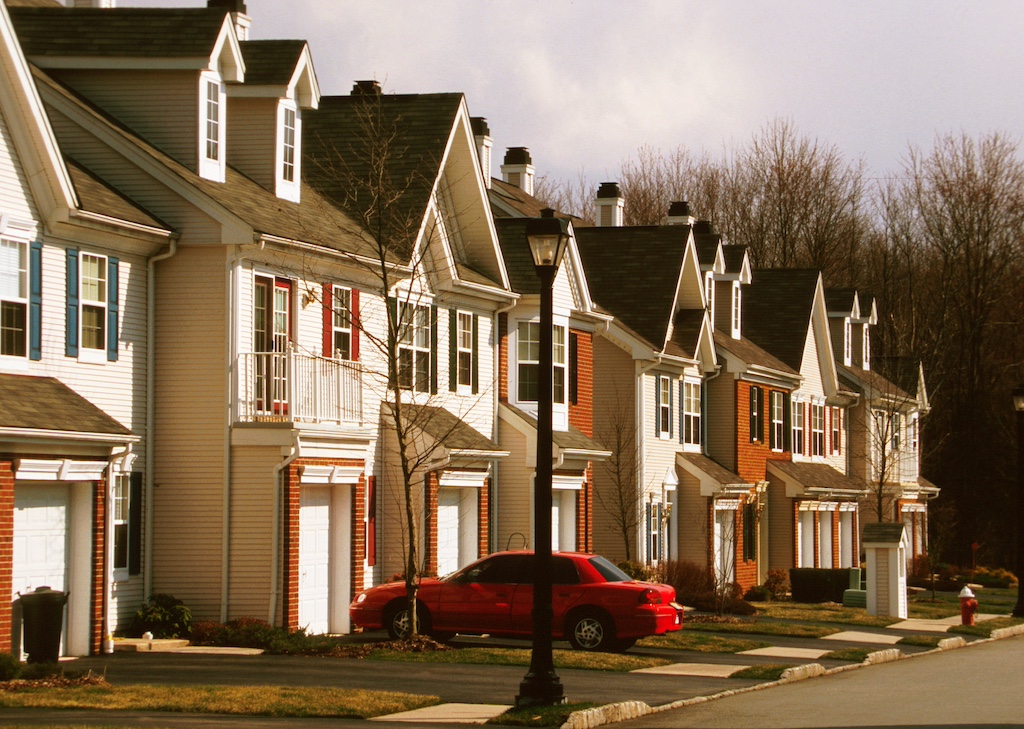
The crisis of affordable housing has severed the ties that the country’s founders thought necessary for democratic governance. (Jeff Greenberg / Universal Images Group via Getty Images)
Before Americans imagined a democracy 250 years ago, they demanded land — the material independence that made civic life and resistance to tyranny possible.
Thomas Jefferson believed that landownership was the foundation of a healthy republic, empowering citizens to act independently rather than rely on the will of a landlord or employer. For Jefferson, independence was not only an economic condition but a moral one. (Albeit only for white, male Europeans, and not North America’s indigenous peoples, from whom they forcibly took the land.)
He wrote, “Cultivators of the earth are the most valuable citizens. They are the most vigorous, the most independent, the most virtuous, and they are tied to their country, and wedded to its liberty and interests, by the most lasting bonds.”
French philosopher Alexis de Tocqueville, among the young nation’s first chroniclers, came to believe that Americans’ propensity to form civic associations created the lasting bonds that were the country’s real defense against tyranny. Without communal ties and shared responsibilities, Tocqueville feared individuals would fall prey to paternalistic “soft despotism,” in which top-down state administration replaces self-government.
In such an arrangement, he wrote, “Each [citizen], living apart, is as a stranger to the fate of all the rest . . . he exists but in himself and for himself alone; and if his kindred still remain to him, he may be said at any rate to have lost his country.”
In 2025, both Jefferson’s and Tocqueville’s warnings could not be more relevant. An all-powerful corporate state has robbed ordinary citizens of the ability to put down roots. Without a stable, affordable place to live, civic associations, and the bulwark they provide against tyranny, wither away. The housing crisis is thus a democracy crisis.
In 2024, US home prices reached an all-time high, with the median home now costing roughly five times the median household income. As a result, first-time buyers represent only two out of every ten sales, and the median age for all homebuyers has climbed to fifty-nine — prompting Business Insider to call this “the age of the geriatric homebuyer.”
The crisis of affordable housing has severed the ties that the country’s founders thought necessary for democratic governance. When people become rootless, they are more atomized, unable to fulfill social roles in communities.
Weekly attendance at church — the main way people came together during the Founding Fathers’ time — has declined from 42 percent of Americans in 2000 to 30 percent in 2023. Just a quarter of US adults report having more than six close friends, with 17 percent reporting none at all. And despite Americans reporting having greater faith in local government than Congress, only 20 percent vote in mayoral elections.
As we’ve become uprooted, passive, and isolated, the soft despots have seized control.
Today a corporate-fused state manages a housing system in which financial institutions quietly dictate where people can live, how they must work, and how secure their lives can be. The result is a great American untethering — a neo-feudal order in which a small group of elites control the basic means of life, an oppressive arrangement not unlike the one the founders sought to escape. A population that cannot afford to stay in one place cannot build civic associations, and a society without civic associations cannot resist concentrated power.
Housing Uprooted
Since America’s founding, housing initiatives have helped citizens to put down roots in the spirit of Republican self-governance. The Homestead Act of 1862, signed by President Abraham Lincoln, granted 160 acres of land to anyone willing to “improve” it, expanding small-scale property ownership across the newly settled frontier.
During the Great Depression, less than a century later, President Franklin D. Roosevelt, pushed by a formidable pre-“Red Scare” leftist movement, tied democratic renewal to economic reform. Roosevelt’s New Deal laid the groundwork for the thirty-year mortgage to expand (white) homeownership, spurred the construction of new homes, and used federal funds to back home loans.
In his 1937 State of the Union address, Roosevelt explicitly linked democracy to housing: “Many millions of Americans still live in habitations which not only fail to provide the physical benefits of modern civilization but breed disease and impair the health of future generations.”
But beginning in the 1970s, the country’s approach to fostering homeownership began to change.
America’s housing stock — once supported by strong public initiatives like the New Deal housing programs — was steadily financialized with the help of policymakers. Under the rhetoric of “individual choice” and the rise of neoliberal economics, public housing programs increasingly subsidized the private market.
The clearest example of this is the federal Section 8 voucher program, launched in 1974. The program required qualifying tenants to redeem affordable-housing vouchers in the private housing market. This allowed policymakers to back away from bold investments in public housing and hand responsibility instead to private actors.
In 2008, the neoliberal outsourcing of the housing market to Wall Street imploded the global financial system. As a result, millions of Americans lost their homes and were driven deeper into financial instability, as banks and private equity firms tightened their control over American life.
President Barack Obama inherited a collapsing economy, much as Roosevelt had seven decades prior. But instead of rescuing the common citizen — a mission central to Roosevelt’s response — Obama bailed out banking executives while offering struggling homeowners technocratic private sector solutions like the Home Affordable Modification Program, which sought to modify loans rather than provide direct relief.
As a result, private equity giants subsequently cashed in on the financial crisis by buying up hundreds of thousands of foreclosed homes to rent out for profit.
Now, instead of helping more people become rooted in their communities, housing is dominated by rentier capitalism: a system in which homes are treated not as places to own, nor to participate in democratic life, but as financial assets. Today a handful of consolidated private landlords dominate the rental market. The largest, Greystar Real Estate Partners, manages nearly a million rental units in the United States and was sued by the Federal Trade Commission earlier this year for allegedly burdening tenants with hidden junk fees.
Meanwhile, Blackstone — one of the world’s largest private equity firms, which owns rental company, Invitation Homes — even got help from the federal government to buy up foreclosed homes.
The financial elite, meanwhile, now shape housing policy from both inside and outside the government. BlackRock is the world’s largest asset manager and holds major investments in mortgage securities and residential housing developments. Its executives donate to both major political parties. That includes Michael Pyle, who has rotated between BlackRock jobs and top posts in the Obama administration and Vice President Kamala Harris’s operations.
This reality is not lost on voters. A majority say they rarely hear politicians talk about the high costs of housing and rent. Meanwhile, the atomization of society — individuals fending for themselves without the strong civic ties US leadership once saw as essential — has left Americans with little capacity to fight back.
BlackRock CEO Larry Fink recently admitted it “really doesn’t matter” who won the 2024 election, implying that either Harris or President Donald Trump would serve Wall Street’s bottom line. American democracy has been outsourced to the corporate-managerial order. It is this despotic order — not ordinary citizens — that now dictates the basic terms of life, beginning with whether and where people can afford to live.
Democracy Requires Affordability
“Our ideological fixation about democracy is just wrong,” social science researcher Sarah Stein Lubrano told me. Lubrano’s book, Don’t Talk About Politics: How to Change 21st-Century Minds, makes the case that social atrophy and democracy are more closely linked than we may believe.
She points to a contradiction at the heart of American life: we glorify voting, yet we live in a society that leaves people too isolated and economically squeezed to take part in democracy’s foundational tenet, civic life. It’s this realm, she argues, where people learn to negotiate differences, find common ground, and put in place solutions at the local level for the common good.
Lubrano believes that unaffordability breaks social bonds. “When you own a home, you are deeply embedded in a community, you’re gonna be there a long time,” she says. For her, organizing neighbors around planting more trees on their shared street is the epitome of a small but worthy civic democratic action. She continues, “When housing is not something we can afford, that’s a problem of democracy.”
Data shows that people are more likely to volunteer or join community groups the longer they’ve lived in one place, regardless of whether they rent or own. But longevity can be misleading. Many renters stay put not because they’re rooted, but because the cost of buying a home has become prohibitive.
What matters for democratic life is not simply whether someone owns property or how long they stay there, but whether they can stay or leave on their own terms.
The ability to be financially secure affects how Americans view democracy, with those who feel more stable reporting greater satisfaction with democracy. Untangling this from centuries of systemic, often racialized economic segregation is impossible, as neighborhoods plagued by poverty have long been denied access to the robust civic life that wealthier communities enjoy.
As researchers at Princeton University’s Eviction Lab have found, housing precarity erodes both stability and agency — forcing people to move when they don’t want to, or trapping them in place when they do. When the basic conditions for participating in civic life collapse, there’s little time to talk to neighbors and form social bonds. Studies have connected poverty with greater social and political isolation, undermining a community’s ability to organize and demand services and investment from the government. In poorer neighborhoods, there is even less time to oppose an extractive, autocratic state.
Under a corporate-fused state, individuals are too isolated to fight back. Recognizing that this arrangement is not natural or inevitable, but instead constructed by those in power, is the first step toward dismantling it.
Toward a Broader Conception of Democracy
The renowned scholar Noam Chomsky might have been channeling Tocqueville when he observed that for a system of “self-imposed totalitarianism” to work, “people have to be atomized and segregated and alone.” Fighting back is too overwhelming for any individual to face alone, he argued; the only remedy is civic association.
The opportunity to do so still exists.
Despite a corporate state that seeks to crush organized, community-based movements that challenge its power, many Americans have not been deterred from participating in civic life. The continued existence of community-supported radio, local solidarity networks, mutual-aid groups, and unions proves this. It will, however, require rebuilding civic life at a much larger scale to meaningfully dismantle the corporate-managed soft despotic rule unleashed by neoliberal housing policy.
Much of the elite class is counting on us to keep them in power under the cynical slogan of “protecting democracy.” But the idea that a public stripped of organization, stability, and civic power can defend democracy by submitting to the corporate state that manufactured its disempowerment is a dangerous fantasy.
We’d be far wiser to notice that democracy eroded long ago, when ordinary citizens lost the stability that allows them to act together. If we want to revive democratic life in the United States, we must start by restoring the conditions that make collective power possible — by ensuring that people can live, stay, and put down roots in the places they call home.
After all, without housing people can count on, there is no civic life. Without civic life, there is no democratic counterforce to concentrated power. Housing is not just a roof over one’s head; it’s the material foundation of self-governance.