William Goodell and the Science of Human Rights
A “flaming abolitionist” of lesser fame, William Goodell was praised by Frederick Douglass for being among the most important opponents of slavery in his time. He articulated a radical moral vision: a political theology of hope grounded in justice and reason.
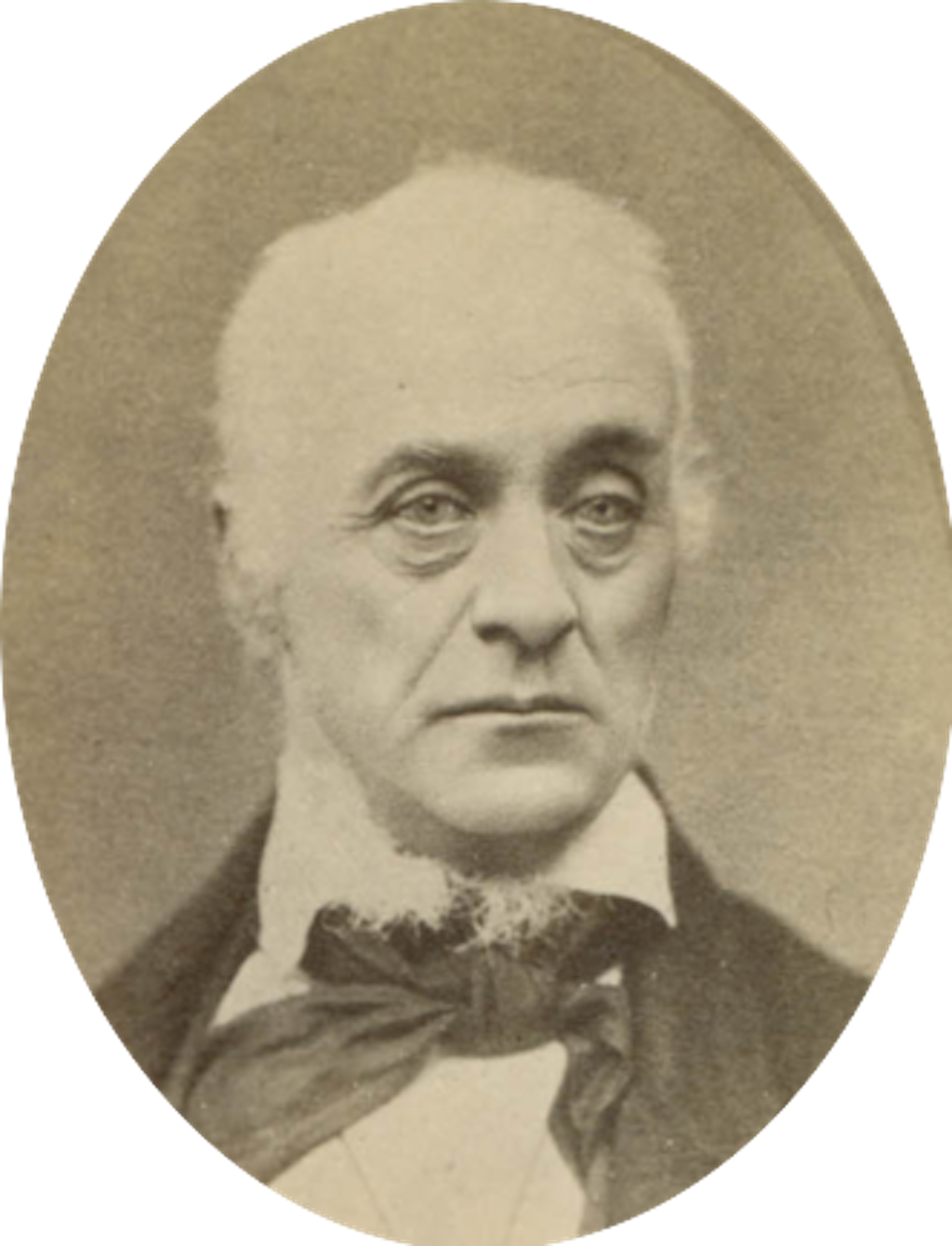
Abolitionist William Goodell saw slavery as a grave moral error. He also saw it as inextricable from class oppression, as it rested on and reaffirmed the belief that elites could do precisely as they wished with whatever they owned. (Portraits of American Abolitionists, Massachusetts Historical Society)
In the early 1830s, Asenath Nicholson’s boardinghouse in lower Manhattan was a favorite gathering spot for reformers of all stripes. One visitor described it as a “club des Jacobins” and identified William Goodell as one of the most outspoken of its “flaming abolitionists.” A leading antislavery journalist and activist from the 1820s through the end of the Civil War, Goodell is not nearly as well known as William Lloyd Garrison or Frederick Douglass. However, in 1863, Douglass himself called Goodell the person “to whom the cause of liberty in America is as much indebted as to any other one American citizen.” Over nearly a half-century as a prolific and indefatigable reformer, Goodell distinguished himself as one of the nation’s most astute critics of slavery and white supremacy, defenders of democracy, and champions of universal reform.
Orphaned in his early teens, Goodell embarked on adulthood with scant resources other than a relentless work ethic and a fine-tuned moral compass. As a young man, Goodell tried his hand at being a merchant, seaman, and bookkeeper, without achieving financial security or an intellectually satisfying position. Lacking the means to attend college, he was a devoted autodidact with an inveterate impulse to publish his ideas. His break came when an admirer of his letters and poems critiquing the Missouri Compromise in the Providence Gazette offered him the chance to edit a small religious journal. Goodell snatched the opportunity and never looked back. From the moment he traded the bookkeeper’s pen for the journalist’s typecase, he devoted his life to diagnosing the nation’s social pathologies.
As it was for many antebellum reformers, temperance was Goodell’s portal to the arena of social critique. However, he was never comfortable as a single-issue reformer. His antislavery sentiments were unwelcome in some corners of the temperance community and, by the early 1830s, abolition had become his chief cause. He was one of the founders of the American Anti-Slavery Society in 1833, and through much of the decade he collaborated closely with Garrison.
Addressing the New England Anti-Slavery Society at Boston’s historic Park Street Church in May of 1837, Goodell proclaimed that “abolitionism is the science of human rights.” Goodell’s use of “science” here signals his attention to the logical implications of first principles, a habit of mind often praised by his antislavery contemporaries. Although the concept of human rights is often considered to be a twentieth-century development, it pervades abolitionist thought and was a hallmark of Goodell’s expansive reform interventions.
Abolitionism in a New Key
In 1840, Goodell broke decisively with Garrison over matters of theology and politics. Goodell espoused what he called “radical orthodoxy,” which held that Christianity’s demand of impartial love had profound social implications. He believed Garrison’s focus on moral suasion — the effort to convince enslavers to liberate their human property — was incommensurate with the goal of eradicating the slave system. Slavery might be ameliorated by an appeal to conscience, but it could be eliminated only by political and legal means. This required abolitionism in a new key, which led Goodell to join others in forming the Liberty Party, whose sole aim was the eradication of slavery. It also convinced him to read the nation’s founding document with fresh eyes. His 1844 Views of American Constitutional Law, in Its Bearing upon American Slavery offered a radical abolitionist reading of the Constitution, which Frederick Douglass eventually adopted and described in “What to the Slave is the Fourth of July?”
By the mid-1840s, Goodell had become restive in a party whose platform had a single plank. Unearthing the Constitution’s liberatory potential coincided with Goodell’s developing vision of universal reform. As the Liberty Party diluted its anti-racism to broaden its electoral prospects, Goodell pushed to make it a comprehensive human rights party. His key ideas are most fully developed in the long convention addresses he delivered at Port Byron, New York, in 1845, and at Macedon Lock, New York, in 1847. The Port Byron address called for voting rights for black men, elimination of the Electoral College, free distribution of public lands to “temperate, industrious settlers,” resolution of international disputes through arbitration rather than arms, and proscription of policies that would restrict what people read, how they worshipped, or the disposition of their labor.
A third of the address dealt with structural inequity and oppression. He railed against the baneful effects of monopolies and tariffs on poor and working-class Americans. Advocating direct taxation based on property or income, Goodell called regressive duties on goods “one of the most gross and stupendous systems of deception and injustice ever inflicted upon the masses.” Instead of paying according to one’s means, he said, one pays “according to the number of mouths . . . that have to be fed — or the number of backs that have to be protected from the cold.” A concerted democratic assault on aristocratic power, the Port Byron address described a nation in thrall to structures of privilege — a “grand Bastille of American oppression” — erected on exploitative distinctions of color, caste, class, and conditions. His recommended remedy was a reformation of American democracy, root and branch.
Goodell’s keynote address at the Macedon Convention illustrates the inextricable connections between chattel slavery and other means of “grinding the faces of the poor.” At the heart of his argument was the right of self-ownership, which he unfolded to reveal a panoply of concomitant rights, including “the right of existence, of soil, and of free intercourse.” In addition to the abolition of slavery, he called for the elimination of monopolies and class-based legislation; distribution of public lands at nominal cost to the landless; exemption of homesteads against the claims of creditors; proscription of tariffs and other barriers to free trade; and robust defense of civil, political, and religious freedoms. Goodell maintained that these were entailed by the natural right of self-ownership, and that the violation of one threatened all the others. The tight linking of abolition with broader themes of economic justice attracted the attention of working-class and agrarian reformers from the National Industrial Congress and the National Reform Association.
Some critics of the Macedon address noted a glaring inconsistency in its call for equality under the law “irrespective of property, birth, nativity, avocation, color or condition.” Why is sex absent from the list? A few conventioneers followed the spirit rather than the letter of the document and voted for Lucretia Mott and Lydia Maria Child, respectively, on the final nominating ballot for president of the United States. In 1860, the Radical Abolition National Convention, a direct descendant of the Macedon Convention, finally included among its resolutions, “woman has as perfect social, property, and political rights as man.” After the Civil War, Goodell became a champion of voting rights for women, a cause that he promoted in Lucy Stone’s Woman’s Journal. He also supported his daughter Lavinia in her ultimately successful struggle to become the first woman admitted to the bar in the state of Wisconsin.
Between Property and Persons
In the 1830s, Goodell was a close associate of Theodore Weld, whose book Slavery as It Is (cowritten with Sarah and Angelina Grimké) compiled hundreds of newspaper clippings detailing outrages of the American slave system. Goodell mined an alternative body of documentary evidence to attack the peculiar institution of Southern slave codes. His investigation of the law of slavery extended from his 1835 article “Slavery Tested by Its Own Code” to his book The American Slave Code in Theory and Practice (1853). These works present an archaeology of the morally deforming legal and social relations between enslavers and the enslaved.
Published on the heels of Uncle Tom’s Cabin, Goodell’s American Slave Code is a powerful intellectual complement to Stowe’s heartrending narrative. Jurist William Jay praised the book in a letter to Goodell: “It is more easy to make than to refute a charge of exaggeration against a work of fiction like Mrs Stowe’s but your book is as impregnable against such a charge as is Euclid’s Geometry, since, like that, it consists of propositions and demonstrations.” Central to Goodell’s analysis is the metaphysical impossibility and thus logical absurdity of dissolving the difference between property and persons. Enslavers, of course, wanted it both ways. At their whim, putative owners could treat the enslaved as “things” devoid of rights and recourse. But when it suited their interests, enslavers lauded the honesty, loyalty, and acumen of their human property. This conveniently deprived the enslaved of freedom and agency but not of responsibility for their actions.
Enslavers could not fully repress the knowledge that the pieces of “property” that looked them in the eye and silently judged them were human beings. Thus, it was necessary to hold them in contempt as inferior beings whose subjugation was natural and therefore justified. Goodell noted that “the individuals and classes of men most wronged, are proverbially most hated by the wrongdoer.” Slavery produced a vicious cycle of contempt and rationalization driven by enslavers’ unchecked will to power, which resulted in the “unhumanizing of human beings.” This consequence was not an occasional lapse of typically humane enslavers; it was inherent in the very concept of chattelhood.
Oligarchic Power Hiding in Plain Sight
In 1859, Goodell took the helm of his final paper, the Principia, in which he relentlessly pressed Abraham Lincoln and the Republicans to implement more aggressive abolitionist policies. He was part of a three-person emissary who met with Lincoln for nearly an hour during the evening of December 31, 1862, to plead with him to make the Emancipation Proclamation scheduled for the next day a declaration of universal emancipation based on justice rather than piecemeal emancipation founded on military expediency.
In the Principia, Goodell continued his study of slavery and caste in a fifteen-part series titled “The American Oligarchy — Wherein Lies Its Strength?” These essays comprise his most sustained argument that slavery undermined the freedom of all Americans. The power of the American oligarchy, or the Slave Power, lay neither in wealth nor in the political advantage given to the South by the Electoral College and the Constitution’s three-fifths clause. These were effects, not causes, of its dominion. Oligarchic power might hide in plain sight. Intrinsic to the very idea of legally sanctioned human property was the right of enslavers to treat what was theirs with arbitrary authority and unfettered commercial freedom: “Only permit slavery to exist, and you concede all it can ask or desire.”
Slavery created a caste system out of race and class, with enslavers at the apex, Northern whites a rung below, followed by Southern white non-enslavers, free black people, and, finally, the enslaved. All Americans operated within a zone of social and political possibility based upon their position with respect to a system of racialized chattelhood. Catastrophic for those on the lowest tier of the hierarchy, caste compromised the freedom of all except the few at the top. Reclaiming the freedom promised by the nation’s founding charters required, Goodell insisted, radical caste-free democracy.
In Cannibals All! Or, Slaves without Masters, George Fitzhugh, a leading proponent of slavery as a positive good, castigates Goodell’s millennial vision of a just society as dangerous utopian folly. He calls Goodell a “progressive Christian socialist” on the road to free love, infidelity, and anarchy. Fitzhugh was prone to slippery slope arguments, and his conclusion missed by a mile. His label for Goodell, however, is not far off the mark. Unwilling to accept things as they are rather than as they ought to be, Goodell constructed a political theology of hope grounded in a commitment to justice for all.