Greece’s Broken Democracy Is a Warning for Europe
European authorities promote Greece as a postcrisis success story. Yet Kyriakos Mitsotakis’s right-wing government relies on spyware and the opaque use of EU subsidies — and is now overseeing a brutal cost-of-living crisis.
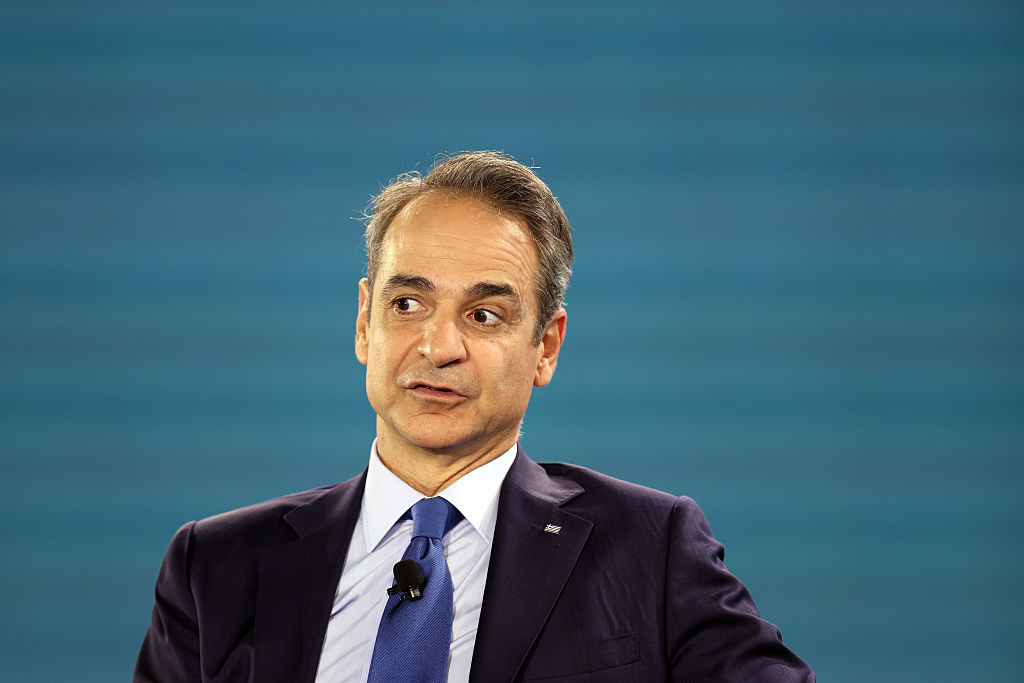
Greece’s conservative government under Kyriakos Mitsotakis has taken disturbing authoritarian measures against its opponents. It’s also ever less of an outlier, as Europe races toward a right-wing, increasingly militarized order. (Lionel Ng / Bloomberg via Getty Images)
On the night of his election victory on July 7, 2019, new prime minister Kyriakos Mitsotakis declared that Greece was “returning to normal.” Leader of the right-wing New Democracy party, Mitsotakis promised a government of the “best and brightest” and drew a line under the previous four years of Syriza rule, vowing to erase its legacy piece by piece.
More than six years on, that promised “normal” looks less like stability and more like a permanent state of managed scandal. Mitsotakis’s tenure has unfolded in a landscape marred by allegations of corruption, financial mismanagement, illegal surveillance, cover-ups, abuse of European Union funds, manipulation of the justice system, and a tightly controlled propaganda machine financed through state resources.
It’s something we hadn’t seen since the fall of the military dictatorship. In that half-century of democracy, there has been no comparable case of a governing party that so stubbornly refused to police its own ranks, shielded itself from scrutiny with such discipline, and retaliated so aggressively against anyone who dares challenge its record. This is made all the easier by a weakened opposition — and a wider left that has been disorganized for years. This has given New Democracy a virtually free hand to reshape Greek politics.
The Greek state in the postausterity era is starting to resemble a neoliberal authoritarian model of governance, in which market dogma and executive power march in lockstep while democratic accountability is treated as an optional extra. This has all been enabled and sanitized by the European Union, which today sells Greece as a model of responsible governance. In the current term, the European Parliament’s biggest bloc — the center-right European People’s Party (EPP), of which New Democracy is a member — has repeatedly moved to protect Mitsotakis and his government, blocking attempts to confront mounting evidence and allegations of systemic corruption — including those under investigation by Europe’s first chief prosecutor, Laura Kövesi.
Maintaining Tradition
New Democracy is not suddenly drowning in scandal; it has been swimming in these waters for years. Under Prime Minister Kostas Karamanlis between 2004 and 2009, it faced a rolling crisis of legitimacy: these years saw the “Greek Watergate” wiretapping affair, the Vatopedi land swap controversy, the Siemens bribery case, and murky financial deals involving pension funds and state assets. This all fed a sense of entrenched graft and impunity. None of this ever brought real accountability for those at the top, but it normalized a style of rule in which backroom deals, clientelism, and the protection of party networks were treated as the Greek state’s basic operating system.
Mitsotakis came to power promising to break with that past, but his premiership has extended it. The first major crack in his stage-managed image came in 2022, when the Predator spyware scandal blew open. Investigations showed hundreds of people — ordinary citizens, journalists, opposition figures, and even his own ministers, including reporter Thanasis Koukakis and PASOK leader Nikos Androulakis — under surveillance through a toxic mix of illegal spyware and “legal” wiretaps, just after he pulled the intelligence service under his direct control. The trail led straight to his office: his nephew and main fixer, Grigoris Dimitriadis, and the head of the National Intelligence Service resigned, but no political figures have been prosecuted, and the government hurriedly shut down the parliamentary inquiry in what the opposition called a staged whitewash.
Barely six months after the Predator revelations, the Tempe train crash on February 28, 2023, shattered what was left of Mitsotakis’s myth of competence. Fifty-eight people, mostly students, were killed when a passenger service slammed head-on into a freight train on the Athens–Thessaloniki line, Greece’s worst rail disaster in living memory. From the first hours, the government tried to shrink the story to a single “tragic human error,” throwing an overworked stationmaster to the wolves. Years of warnings about dead signaling systems, understaffing and stalled safety upgrades were brushed under the carpet.
Many objected. Families of the dead and railway workers spoke of missing evidence, tampering with the crash site, and leaked audio seemingly edited to keep the “human error” story alive. Why, they asked, did the state order the site to be bulldozed — covering wreckage and even human remains with rubble — while relatives desperate for answers were stonewalled? Parliament set up yet another inquiry into the transport minister, Kostas Achilleas Karamanlis (cousin of the former premier), but the New Democracy inquiry voted to clear him in April 2024. Nearly three years on: no prosecutions, no real consequences. The chain of responsibility ends exactly where the government chose.
European Subsidies
Yet this buildup of anger and grief did not translate into electoral punishment. In June 2023, New Democracy cruised to a second consecutive general election victory, crushing Syriza and accelerating that party’s collapse. Despite the government’s reputation and history of scandals, the Left was further weakened by internal divisions, poor communication, and a lack of unity ahead of the election, as well as the absence of a clear anti-government narrative. The message was clear: New Democracy was now the default party of government, its dominance apparently unassailable, even in former center-left bastions like Crete. Armed with this renewed mandate, Mitsotakis treated the result as a license to rule without restraint.
The OPEKEPE scandal — named after the state agency that channels EU farm subsidies — exposed a subsidy system riddled with made-up agricultural projects: invented livestock numbers, banana plantations on Mount Olympus, olive groves in military airports, even grazing land stretching out into the sea. Billions in EU funds were routed through this machinery while auditors were pushed aside and agency heads who questioned irregularities were removed.
A European investigation led by Kövesi’s office describes a systematic, organized fraud operation using OPEKEPE to siphon off Common Agricultural Policy (CAP) funds. Brussels has already hit Greece with a €392.2 million fine and a 5 percent cut to future farm subsidies for years of nonexistent oversight. Far from a handful of crafty villagers milking Brussels, the trail runs straight through the political class: New Democracy ministers and MPs, with especially thick clientelist webs in Crete — the same island flipped by the party in the June 2023 elections — as subsidy money washed through party-friendly intermediaries into safely fenced-off fiefdoms.
As the scandal widened, the government’s instinct was not to come clean but to amputate the evidence. Under pressure, Mitsotakis tossed a few heavyweights overboard: migration minister and former agriculture minister Makis Voridis — once a leading figure in the neo-Nazi National Political Union (EPEN) — resigned after being named a suspect, along with four other senior officials. The prime minister insisted these were just a few bad apples.
In Brussels, a parliamentary question by Irish MEP Ciaran Mullooly bluntly describes OPEKEPE as a tool for manipulating nepotistic networks and secretly distributing “billions of euros.” He suggested that the government’s plan to abolish the agency and fold it into the tax authority looks like an attempt to bury responsibility rather than confront it. On the ground, real farmers are now staring at a €600 million funding hole and months-long delays in payments as audits freeze disbursements; they are on the streets of Athens protesting for the subsidies on which their survival relies, while the bill for fraud committed in the name of “development” and party loyalty is dumped back onto people who never saw the money in the first place. Despite clear evidence and the involvement of New Democracy politicians and their local brokers in managing these funds, the justice system has not laid a finger on them. There have been no prosecutions.
Health minister Adonis Georgiadis — a former member of the far-right Popular Orthodox Rally (LAOS) and now the government’s loudest attack dog — spelled out the system with chilling honesty in July. When a prosecutor touches a case involving a minister, he boasted, the constitution forces them to send it “without delay” to parliament; the European public prosecutor can only say, “See if you want to check it.” Then he joined the dots: parliament means the majority, the majority is New Democracy, and New Democracy has decided its own ministers “must not be checked. Full stop.”
The Greek “Success Story”
As Kövesi methodically lays the groundwork for the next big Greek scandal — this time around the post-pandemic EU funds known as the Recovery and Resilience Facility (RRF), with contracts worth billions and the names of serving and former ministers under scrutiny — Mitsotakis has pulled off something rare even by European standards: governing through one scandal after another while dodging any personal responsibility. Allegations are dismissed as “toxicity” and attacks from “dark outside forces”; when that line wears thin, he claims he knew nothing, while his parliamentary majority is used as a shield to block investigations and keep ministers out of reach.
Instead, the government has boasted about its growth model. On paper, the story is dazzling: GDP rising by roughly 2–2.3 percent a year since 2023, comfortably ahead of the eurozone average; public debt ratios edging down; record tourism receipts; the EU, International Monetary Fund, and business groups hailing Greece as a “pillar of stability and growth” and a poster child for the RRF, which is funneling more than €35 billion in grants and loans into the economy. But this supposed model rests on low wages, aggressive labor deregulation, and a credit-fueled investment drive that overwhelmingly favors big firms via RRF loans handed out through the banks, while households are left to ride out a permanent cost-of-living shock.
Behind the headline figures, the class reality is brutal. Around one-quarter to one-third of the population remains at risk of poverty or social exclusion, one of the highest shares in the EU, and Greece still sits near the bottom of the European pay league, with average annual wages of about €18,000 and a statutory minimum of roughly €968 a month — levels that simply do not meet housing, food, and energy costs. In-work poverty hovers around 10 percent, while the government has pushed through labor laws allowing working days of up to thirteen hours and further weakening collective bargaining. Today ferries, trains, and flights are routinely shut down by nationwide strikes over pay.
At the same time, overtourism and real-estate speculation — turbocharged by golden visas, including to wealthy Israeli investors, and by short-term rentals — have driven rents and house prices through the roof, turning Athens and the islands into an investment platform for foreign and domestic capital. The result is that Athens has become prohibitively expensive for its own residents, where many Greeks can no longer afford a week’s holiday in their own country. What Mitsotakis sells as a “success story” is a classic regime of accumulation: EU money, cheap labor, and privatized public goods generate healthy returns for banks, construction conglomerates, and hotel chains, while the social wage is stripped back even further.
A Replicable Model
Across the EU, a system is congealing in which corruption is not an exception but part of the operating logic of power, and Mitsotakis sits comfortably inside it. Within the European People’s Party, governments that deliver growth on paper, lock down borders, and stay aligned with NATO are rewarded and shielded, regardless of what they do domestically. On top of that, the EPP is now unapologetically edging toward formal alliances with the far right. A right-wing bloc made up of the EPP, Giorgia Meloni’s European Conservatives and Reformists, and Patriots for Europe now dominates the European Parliament, giving the EU the most right-wing assembly in its history and normalizing collaboration with forces once considered beyond the pale. Qatargate and other lobbying scandals did not produce a serious cleanup; they signaled to the political class that influence is simply another commodity, to be traded so long as it stays behind closed doors.
Greece is the clearest example of how this works. A country once cast as the sick man of Europe, punished with memoranda and IMF supervision for its corrupt political class in 2010, is now paraded as a model. The same state that was disciplined for cooking the books is sold back to Europe as a star pupil to be copied, with Mitsotakis garlanded for an “economic miracle” and talked up in Brussels as a future European Commission president.
For years, European leaders warned of an external menace to democracy; yet ultimately, the coup came from within. Politically, that is the real danger of the Greek “miracle”: it hands Europe’s ruling class a handy manual that says you can gut labor protections, hollow out media pluralism, spy on opponents, dismiss deadly disasters, funnel public money to party clients, and talk up new weapons deals with an Israeli government that has committed genocide in Gaza — and still be hailed as a modernizing reformer, so long as bond yields stay calm and capital keeps cashing in.
For the Greek left, the task is not to firefight each new scandal but to confront the machine that produces them. That is hard enough when most left parties are wrecked, won’t work together, and in some cases have simply walked off the pitch. Into this rubble steps former prime minister Alexis Tsipras, plotting a 2026 comeback backed by billionaire Evangelos Marinakis, the same oligarch who spent 2015–2019 at war with Syriza over drug-smuggling allegations. Tsipras is not offering a reboot of the Left but another split from a man whose only real political legacy is wreckage and division.
Greece’s austerity era never really ended. Branded a “postausterity” country, it is in truth trapped in a permanent state of suspension: a managed, corrupted democracy in which centrist respectability, far-right politics, and hard-line support for Israel are fused into a single governing project. What is tested on the periphery today is exactly what Europe’s elites are preparing to roll out across the continent tomorrow.