US Journalists on Aid Flotillas Allege Israeli Soldier Abuse

A recent panel of three US journalists aboard the Gaza aid flotillas say they faced assault and threats from Israeli soldiers — and that the US government did little to help them.
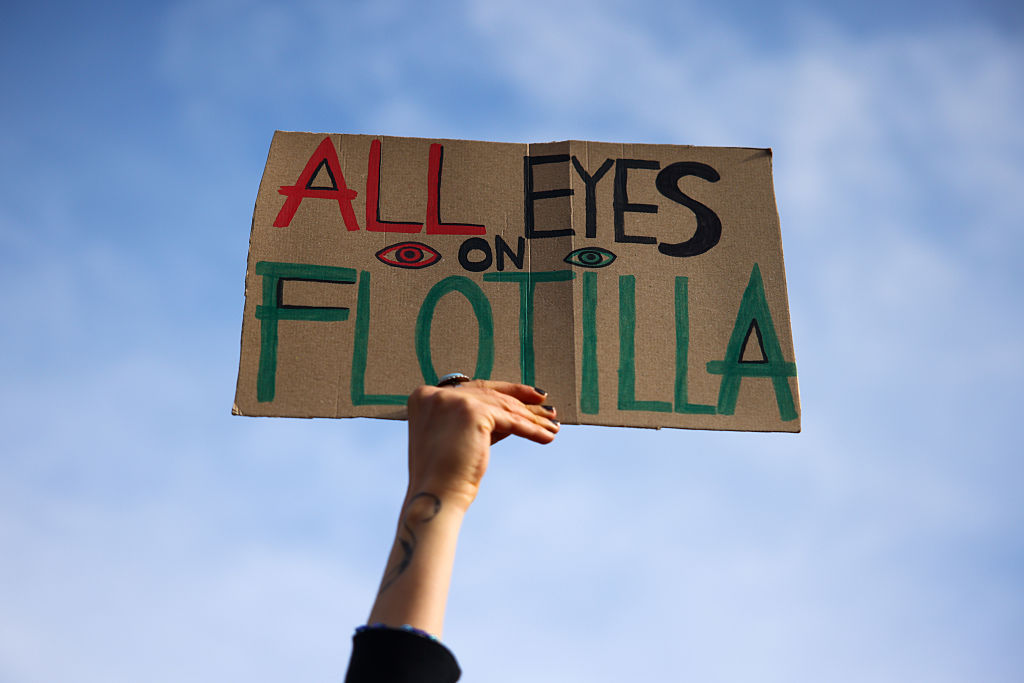
Three American captured and detained by Israel while covering the Gaza flotilla detailed how Israeli soldiers, who the reporters say ignored their press credentials, engaged in physical and psychological abuse, rape threats, and racist and misogynistic insults. (Beata Zawrzel / NurPhoto via Getty Images)

Three US journalists abducted and detained by Israel in international waters in October while covering Gaza-bound aid flotillas claimed they experienced beatings, humiliation, and US government indifference during a November 3 panel co-hosted by Freedom of the Press Foundation (FPF) and Defending Rights & Dissent (DRAD). The reporters — Alex Colston, Emily Wilder, and Noa Avishag Schnall — detailed how Israeli soldiers, who the reporters say ignored their press credentials, engaged in physical and psychological abuse, rape threats, and racist and misogynistic insults in violation of international human rights conventions.

“The abuses against us demonstrate how far [the Israeli] regime will go, how emboldened it’s been, and the absolute impunity they have to act this way,” said Wilder, a journalist with Jewish Currents who was aboard one of the flotilla ships.

Human rights organizations and international law experts said the interception violated international law. Israel claims the flotilla tried to breach its blockade and enter “an active combat zone,” while press freedom groups counter that journalists have a right to cover humanitarian missions and document and report on Israel’s grave human rights abuses.

The flotillas carried limited food and medical supplies to Gaza for a systematically starved population. Israel has killed at least 70,000 people in Gaza, injured 170,000, displaced 90 percent of residents, and destroyed roughly 90 percent of Gaza’s infrastructure. Since the October 10, 2025 ceasefire alone, Israel has destroyed over 1,500 buildings.

Colston, story editor at Drop Site News, joined the Global Sumud Flotilla (GSF), which left Barcelona in late August, to report on its mission. It was the largest maritime aid convoy to try to break the nearly twenty-year illegal Israeli blockade of Gaza and comprised forty vessels with around five hundred participants from more than forty countries, including at least thirty-two journalists.

The GSF vessels were repeatedly attacked by drones before Israeli forces intercepted most of them on October 1 about seventy nautical miles off Gaza’s coast, boarding the boats and detaining the journalists and volunteers. Drone attacks on September 8 and 9 were directly approved by Israeli prime minister Benjamin Netanyahu, according to CBS.

“Here are a bunch of unarmed people with baby formula on a ship, and then there’s this elite navy who are just armed to the f—ing teeth . . . there to intercept us,” Colston said. “It sounds absurd if you just report it straight.”

He and others were taken first to Ashdod port, about twenty-five miles south of Tel Aviv, then to the notorious Ktzi’ot prison in Naqab (Negev) Desert, dubbed “Israel’s Abu Ghraib.” Soldiers “were just aggressive and brutal with us the entire time,” he said.

Wilder and freelance journalist Noa Avishag Schnall, meanwhile, were aboard a separate vessel, the Conscience, which departed Otranto, Italy, later, on September 30, carrying approximately one hundred people from twenty-two countries, mainly journalists and medical workers. The Conscience caught up with the Thousand Madleens, another flotilla with the same mission, in the Mediterranean a few days later.

(Al Jazeera)

When the Conscience was intercepted on October 8, about 120 nautical miles from both Palestinian and Israeli waters, warships and helicopters surrounded the vessel, “drowning out [the occupants’] chants of ‘We are journalists. We are medics.’”

Israeli soldiers raided the ship from all sides, “pointing weapons” at those on board, Wilder said. She described a soldier carrying a camera who followed them with his lens and taunted them, calling them “terrorists.”

The detainees were again taken to Ashdod, then to the Ktzi’ot prison. “Violations of human rights [by the Israeli military] abound,” Wilder added.

“We were basically kidnapped from international waters,” Schnall told me.

FPF filed a Freedom of Information Act request with the US State Department for cable traffic among US embassies in eight Mediterranean countries to see what officials knew about the presence of US citizens, including journalists, on board, and when they knew it.

Brutal Detention Conditions

When marched out of the port, Wilder said she identified herself as press. A guard replied that she didn’t “give a fuck.” Then, Wilder says, another guard “pulled me by my hair across the port” and zip-tied her.

Some detainees’ medicine was withheld, and guards “singled out brown people and people they thought were Arab,” Wilder said. Others were forced to drink toilet water, embrace the Israeli flag, and deprived of sleep. A woman with a prosthetic leg was pushed over.

Schnall, who was aboard the same ship as Wilder and similarly detained in Ktzi’ot, was transferred to Givon Prison two days later. There she described being hung from metal shackles “on my wrists and ankles and beaten on my stomach, back, face, ear, and skull,” and that one of four male and female guards beating her sat on her neck and face, blocking her airways. She said she was left with a black eye, bruising on her wrists and ankles, visible bruising on her right eye, and numb hands.

Schnall described to me being yanked along the prison hallway while being pulled by her hair and shackled with metal handcuffs around her ankles and wrists and against the prison bricks, scraping her wrist and knees. “All of this is just a speckle of what’s happening to the Palestinians,” she said.

She spent most of her last day in solitary confinement at Neve Tirtza women’s prison in an extremely weak state — with lights on all day, the cell soundproofed so “no one hears your screaming,” and only a hole in the ground as a toilet.

This highlights “the brutality and the lack of care for human beings,” Schnall, a renounced Israeli citizen, said, noting that she is “someone who used to be considered part of [Israeli] society, in a place that’s supposed to be safe for Jews, of which I am one.”

Other detainees reported facing additional abuse because of their background.

Schnall’s cell was threatened with rape.

Like Wilder, guards were indifferent to Schnall being a member of the press. Both of them say they were denied legal representation despite requesting it repetitively. Wilder and Schnell were held for two and four days, respectively.

Both Wilder and Schnall described US officials who visited them during detention as indifferent, impatient, and “seemingly annoyed they even had to come,” according to Schnall.

Some of the detainees on the Conscience were released earlier after signing a form waiving their rights to appear before an immigration judge. After two days in detention, Wilder was flown from Eilat’s Ramon Airport to Istanbul, Turkey.

Others who refused to sign the waiver, like Schnall, were bussed separately through the occupied West Bank to Jordan.

When asked about the alleged abuse of detainees in its custody — including US journalists mentioned in this article — and whether it was responsible for the drone attacks on the flotillas, the Israeli military’s North American media desk didn’t answer any of our questions and instead referred us to the Israeli police and the Israel Prison Service. We emailed both; neither answered our questions. We also emailed the Israeli Ministry of Foreign Affairs and the media department of the consulate general in New York and received no response.

Minimal to No Consular Assistance

The three reporters said they had similar motivations for covering the flotilla. Colston said he’d joined to show solidarity with journalists in Gaza. Editing his Palestinian colleagues’ work from afar “felt insufficient,” so he decided to meet them “halfway,” he explained.

Wilder said that because the flotilla represented “an unprecedented global mobilization,” she feels it’s her duty “as a journalist to cover the genocide and to cover efforts to intervene.”

Schnall described it as “an extension of direct action in my responsibility to my journalistic colleagues who’ve been abandoned by our journalist community.”

US citizens detained by Israel said they received little to no help from US officials — “negative” was how two of the journalist panelists put it — unlike flotilla detainees from other nations, which quickly intervened and secured releases.

Upon arriving in Jordan after six days in detention, Colston says he was offered by a US diplomat in Amman a $5,000 loan to board a charter flight back home, warning his passport privileges would be suspended until repayment with interest. Colston says he felt like the diplomat was “blaming us for getting thrown in jail,” he said. The flotilla organizers arranged his trip back to the United States instead.

In Istanbul, Wilder noticed that while representations from other embassies “were there to receive their citizens,” there was one exception: The US. It was the same for Schnall, who said there was no US consular presence upon arriving on the Jordanian side.

Similarly for Schnall, there was no U.S. consular presence in sight when she arrived in Jordan, and the FCC organized her trip back to France, where she resides.

In mid-October, DRAD, FPF, and four other press freedom groups sent a letter to US secretary of state Marco Rubio criticizing the lack of official support for US journalists.

“It is the responsibility of the State Department to advocate for American journalists. Yet, the State Department has made no public condemnation of the unlawful detention of these reporters,” the coalition said. The State Department did not respond to our letter.

Neither the State Department nor the US embassy in Jordan responded to our multiple requests for comments for this article.

Israel’s Impunity, US Complicity

Since 2023, Israel has killed at least 200 journalists and media workers in Gaza, according to the Committee to Protect Journalists (CPJ), making it one of the deadliest conflicts for reporters ever recorded. Its military has even boasted about killing them on social media.

Israel’s record of complete impunity long predates 2023. In 2022, Al Jazeera correspondent Shireen Abu Akleh, a Palestinian American, was fatally shot in Jenin. Several news outlets and research groups concluded Abu Akleh was targeted by Israeli soldiers with the “intention to kill.” Investigations by Zeteo and the New York Times revealed that US officials “soft-pedaled” their conclusions to “appease Israel.”

No one has been held accountable for Abu Akleh’s murder. In fact, for more than two decades, Israel has never held anyone accountable for the killing of a journalist.

Israel is also one of the worst jailers of journalists worldwide. It has blocked foreign journalists from entering Gaza despite the supposed ceasefire; raided, destroyed, and shuttered media offices in both Gaza and the West Bank; and even banned outlets, most notably Al Jazeera.

It’s not just journalists in the crosshairs. A recent United Nations report described the “ongoing genocide in Gaza” as “a collective crime, sustained by the complicity of influential Third States,” calling it “an internationally enabled crime.”

Another UN report published last week, covering the past two years, stated that Israel has “a de facto State policy of organized and widespread torture.” The UN Committee Against Torture expressed “deep concern over allegations of repeated severe beatings, dog attacks, electrocution, waterboarding, use of prolonged stress positions, sexual violence, threats against [Palestinian] detainees and their family members.”

The United States, which supplies roughly two-thirds of Israel’s imported arms and has provided approximately $22 billion in military aid since 2023, is legally barred from arming nations that violate international law. Targeting journalists is a war crime.

FPF, where I work, has long called on Washington to end this double standard — to stop arming Israel with the weapons it uses to kill reporters and to hold it accountable for crimes against journalists.

“Patchy” Legacy Media Coverage

Despite the international journalistic community’s efforts to help Gaza journalists, the lack of media coverage of the flotillas was noticeable.

Reporting tended to “defer to Israeli press statements,” Colston told Columbia Journalism Review. “It just wouldn’t capture anything about the flotilla.”

The New York–based media watchdog Fairness and Accuracy in Reporting called the coverage “patchy and notably lacking in key details.”

“Establishment media omitted crucial context connecting this incident to earlier events [including Israel’s long-standing history of obstructing humanitarian flotillas], overlooked important legal conversations, both-sidesed the delivery of humanitarian aid during a famine, and largely ignored reports of mistreatment endured by detained activists and journalists,” FAIR said, adding that such framing “reflects a longstanding tendency . . . to normalize and rationalize the most extreme Israeli actions.”

Mainstream news organizations didn’t “dedicate that kind of coverage to . . . panels and events leading up to the departure of these ships,” Azmat Khan, a Columbia Journalism School professor and the director of the Li Center for Global Journalism at the school, told me. The “texture and context felt missing from a lot of these stories . . . in large part because they were not deployed to these places to cover them on the ground.”

“What is the argument against sending these reporters to go cover this mass mobilization, when it’s the largest global launch of an antiwar [flotilla] campaign to date?” Khan, who is also an FPF board member, asked. “I do really, really worry that so many Americans who are not steeped in these worlds are unaware of the extent to which . . . how unpopular this war is on a global level in unprecedented ways.”

Independent outlets such as Drop Site News and Jewish Currents, on the other side, have platformed Palestinian journalists. “Journalism should lead you into places you’ve never been . . . to think about people you’ve never thought about before, and to to understand others’ experiences,” Colston said. “That’s the best part of journalism.”