Far-Right Billionaire Vincent Bolloré Returns to Africa
Billionaire Vincent Bolloré is known for his use of his media empire to promote Islamophobic pundits in France. Now the corporation he controls is buying up TV broadcasting and film across Africa.
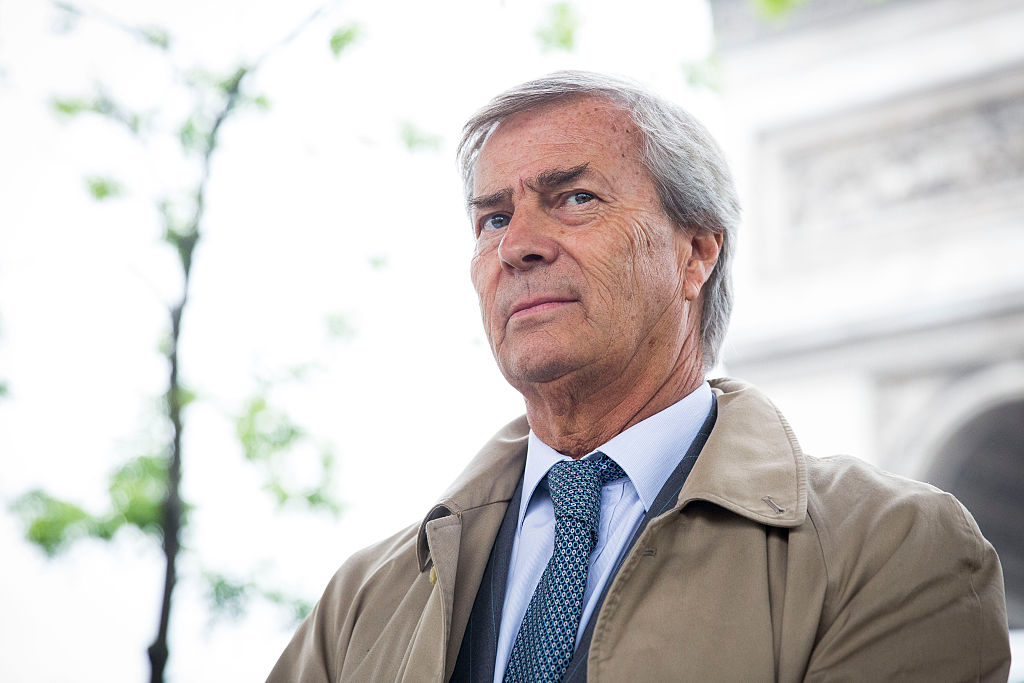
Billionaire tycoon Vincent Bolloré is a major face of Françafrique — France’s informal dominance in its ex-colonies. He faces a whole series of lawsuits over alleged misdeeds in Africa, but it’s not stopped him expanding his media empire there. (Christophe Morin / IP3 via Getty Images)
Canal+ S.A., a sprawling media and entertainment company controlled by French billionaire Vincent Bolloré, has launched a major expansion in the African market. In late September, Canal+ finalized the acquisition of South African company MultiChoice, the leading paid TV provider in English- and Portuguese-speaking Africa. Valued at €2.5 billion, it’s touted as the largest buyout in the history of Canal+.
The MultiChoice takeover puts Bolloré in a commanding position in a market destined for considerable growth in the coming years. With upward of eight million Canal+ subscribers in Francophone Africa, the company will add some twenty million paying MultiChoice users, most notably in South Africa and Nigeria. To that, it can add a web of partner news and entertainment channels and a near-monopoly on sports competition broadcasting: Canal+ anticipates reaching more than one hundred million subscribers in coming years, cementing its lead over Chinese-owned competitor StarTimes, which counts roughly thirteen million subscribers.
For Canal+ executives, the deal is key to building a global media company able to compete against American corporations like Netflix or Disney. “Our combined company is unique, a true global media and entertainment powerhouse,” said Canal+ CEO and longtime Bolloré confidante Maxime Saada in a September 22 press release.
Economies of Influence
The MultiChoice acquisition comes amid a rapid expansion back in France, as Bolloré — whose business interests were first centered on specialty paper manufacturing and ports — doubles down on his mid-2010s shift to media and entertainment. This fall, Canal+ acquired a 34 percent stake in major movie-theater chain UGC and is reportedly vying for a full takeover by 2028. The move tightens the group’s hold over the French film industry, with many critics worrying that Bolloré will use that power to bolster his ideological agenda.
In France, Bolloré’s vast media empire is relatively new. But in the span of just one decade, it has become an organized machine for the dissemination of far-right ideology. Though the seventy-three-year-old Bolloré formally handed over the reins to his children in recent years, he is widely viewed as still retaining ultimate control.
In the birth throes of his Canal+ takeover in the mid-2010s, Bolloré transformed the i>Télé news network into the around-the-clock reactionary organ CNews. Today the news channel is the uncontested French leader for hard-right coverage and commentary, broadcasting an all-encompassing story of a country overrun by migrants, crime, and left-wing “wokisme.” A launchpad for reactionary pundit Éric Zemmour’s presidential run in 2022, Bolloré’s holdings have since shifted their support behind Marine Le Pen, pushing for a “union” of right-wing and conservative forces behind the Rassemblement National.
Bolloré now has at his fingertips arguably France’s largest press and entertainment empire. In 2023, he finalized the acquisition of the Lagardère Group, bringing under his grip Hachette, France’s largest publishing company, the Europe 1 radio station, and a handful of print publications. With each takeover, Bolloré has steamrolled over employee and public opposition to impose a hard-right political line. This fall has seen speculation over Bolloré’s designs for the daily newspaper Le Parisien, whose current proprietor Bernard Arnault has purportedly looked to offload ownership.
Bolloré Strikes Back
African media may be at arm’s length from the twenty-four-hour civilizational war being waged by Bolloré’s French outlets. One immediate reason behind the MultiChoice acquisition is the pressure toward consolidation felt across the media and entertainment industry. Canal+ has been on an international buying spree: in 2024, it spent $300 million for a 36 percent stake in the Hong Kong–based video-on-demand service Viu.
But what sets the MultiChoice deal apart is that it has Bolloré back on familiar terrain, after what appeared to many as a strategic retreat from the African continent.
In fact, Bolloré’s original claim to fame and fortune largely derives from his decades-long domination over African shipping and logistics, most notably in France’s postcolonial sphere of influence. In a series of corporate raids in the 1980s and ’90s, he leveraged family ties in the Parisian business elite to buy up some of the choicest legacy assets of French colonial capitalism. At its height, Bolloré’s African holdings included stakes in dozens of ports, shipping container terminals, and rail transport lines — assets that he sold to the Swiss-Italian group Mediterranean Shipping Company (MSC) in 2022.
That departure was hardly disinterested. The leading corporate face of “Françafrique” — the nickname for France’s enduring clout in its former sub-Saharan colonies — Bolloré’s long predation in Africa had him facing a lengthy docket of lawsuits and accusations for corruption, influence peddling, and human rights violations.
“Is it time to abandon Africa?” the billionaire asked in a 2018 op-ed for the Journal du Dimanche — a once-prestigious weekly newspaper that he would acquire in the Lagardère takeover. Gulf and Chinese companies were carving out an economic foothold on African territory Bolloré might have seen as his own backyard. With the growing rejection of French-aligned regimes across the region, capped off in a slate of coups in the early 2020s, the climate has looked increasingly less inviting for a businessman so brazenly associated with French neocolonialism. (Alongside Canal+’s growing stake in African media, the Bolloré group still has agricultural investments via SocFin, a Luxembourg-based holding that owns palm oil and rubber plantations across the region.)
The story of Bolloré’s retreat was overblown. For Jean-Jacques Lumumba, a Congolese whistleblower and anti-corruption activist, this year’s MultiChoice deal is proof that the page never fully turned on Bolloré’s designs for the African continent. “Bolloré has not lost influence,” Lumumba told Jacobin. “He is simply changing his approach.”
This spring, Lumumba’s organization Restitution pour l’Afrique (RAF), an alliance of eleven West African anti-corruption NGOs, filed an influence trafficking and money laundering suit in Paris. Taking aim at the windfall €5.7 billion sale of Bolloré Africa Logistics to MSC, the plaintiffs hope to see those funds returned at least in part back to African communities.
“Bolloré made his fortune through corruption on the African continent and is now seeking to convert those profits back into media influence,” said Lumumba. “We want Africans, who have been plundered enough already, to be spared from falling victim tomorrow to a way of thinking, to propaganda by a clan that has been sufficiently proven of corruption.”
In Africa, the Bolloré empire has long been known for using its media and communications holdings to advance its business interests — and curry favor with power brokers whom it needs to have on its side. Last December, Jeune Afrique reported that Canal+ had suspended three opposition media outlets, acceding to the demands of the new Guinean government led by Mamady Doumbouya, the army officer that took power in a 2021 coup.
Through an underwriting scheme involving local subsidiaries and Havas, the publicity and communications agency he also controls, Bolloré is accused of illicitly financing and supporting the 2010 election campaigns of Faure Gnassingbé, the Togolese strongman who took power after the 2005 death of his father, Gnassingbé Eyadéma, and Alpha Condé, the president of Ghana from 2010 until his overthrow in 2021. At the time, Bolloré’s logistics arm was seeking an extension for its concessions of the countries’ ports at Lomé and Conakry.
In the Togolese case, French magistrates have rejected a 2021 plea deal between Bolloré and prosecutors. The accord, thrown out by a judge who deemed that the gravity of the case necessitated a trial, had Bolloré and leading associates admitting to having fomented a “corruption pact.”
For RAF, the 2010 affairs are just two examples of an organized “system” that allowed Bolloré’s shipping and logistics business to siphon off funds from local governments and communities, where public contracts are often handed out through favoritism. In 2021, Africa Confidential estimated that the 2014 port concession in Tema, Ghana — granted to Bolloré and partner company Maersk — resulted in over $4 billion in lost revenue for the West African state. Beyond any specific case of cronyism, the RAF suit hopes to litigate the broader harm wrought by Bolloré’s first African empire.
The “Smiling Killer”
Whatever the Bolloré Group is planning on next in its old stomping ground, it will now have a far stronger media operation to back it up. Infamous in France for using his outlets to push right-wing politics, Bolloré is, however, largely an unknown quantity in South Africa. That in part explains the little attention that the MultiChoice acquisition attracted when a South African competition tribunal rubber-stamped the purchase this July.
“Our media sector is facing an existential crisis,” said William Bird, director of Media Monitoring Africa, a South Africa–based NGO. With declining profits pointing to a broader weakening in the global media market, MultiChoice’s eventual absorption by a new group appeared to be a matter of time. Confronted with a fait accompli, the civil society organizations that followed the case devoted much of their efforts to ensuring that the new mega group agreed to public interest commitments like maintaining investment in local producers and suppliers.
Such promises may be fragile. In late October, the Johannesburg-based Sunday Times reported that Canal+ demanded that local contractors agree to a 20 percent discount on all charges. “If that’s a symptom of what’s to come, then we’re going to have our hands full battling these people,” Bird told Jacobin.
Coming from a group owned by the “smiling killer,” as Bolloré is often called in the French business press, it’s a first display of monopoly power.