Food Assistance for All
Economic insecurity is rampant in the United States. A program of universal grocery subsidies could help working-class families deal with the cost of living — and be wildly popular.
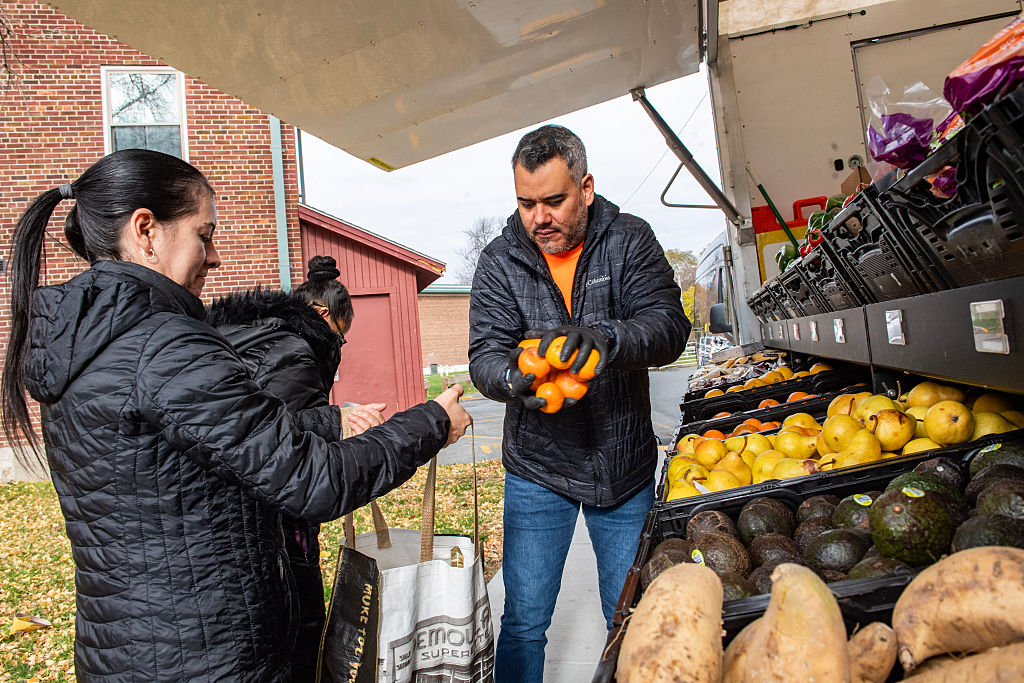
Whereas free cash is widely perceived as an undeserved luxury, free food is not; it is more often seen as a basic human right. (Joseph Prezioso / AFP via Getty Images)
Economic insecurity is rampant and devastating. In Canada, a minimum-wage worker working full-time cannot afford a one-bedroom apartment in fifty-three of the country’s sixty-two urban regions. In the UK, 74 percent of parents find it difficult to meet childcare costs, and 10 percent are food insecure. In the United States, things are even worse: 770,000 people experience homelessness every night, and 40 percent of households are only three paychecks away from falling below the poverty line.
Not only is economic insecurity devastating to people’s lives — it is also a major force spurring the expansion of the far right, which has grown in leaps and bounds from a vote share of 3 percent across Europe in 2004, to over 25 percent today — higher rates than any time since the 1930s. The trajectory is clear and terrifying.
A universal basic income (UBI) is frequently proposed as a powerful antidote. Unfortunately, it remains quite unpopular with regular citizens on the (very questionable) grounds that it would disincentivize work, or be spent on drugs and alcohol. In the United States, support for a UBI ranges from about 38 percent to 45 percent of the population, and support is only slightly higher in Canada and the UK. Moreover, these survey results probably overestimate the true level of support for a UBI, because asking a person if they “support” something in the abstract doesn’t necessarily mean that, when push comes to shove, they would actually vote for it.