Reckoning With Empire at Britain’s Imperial War Museum
An exhibition at London’s Imperial War Museum offers a welcome corrective to the nostalgia for empire common among Britain’s elites.
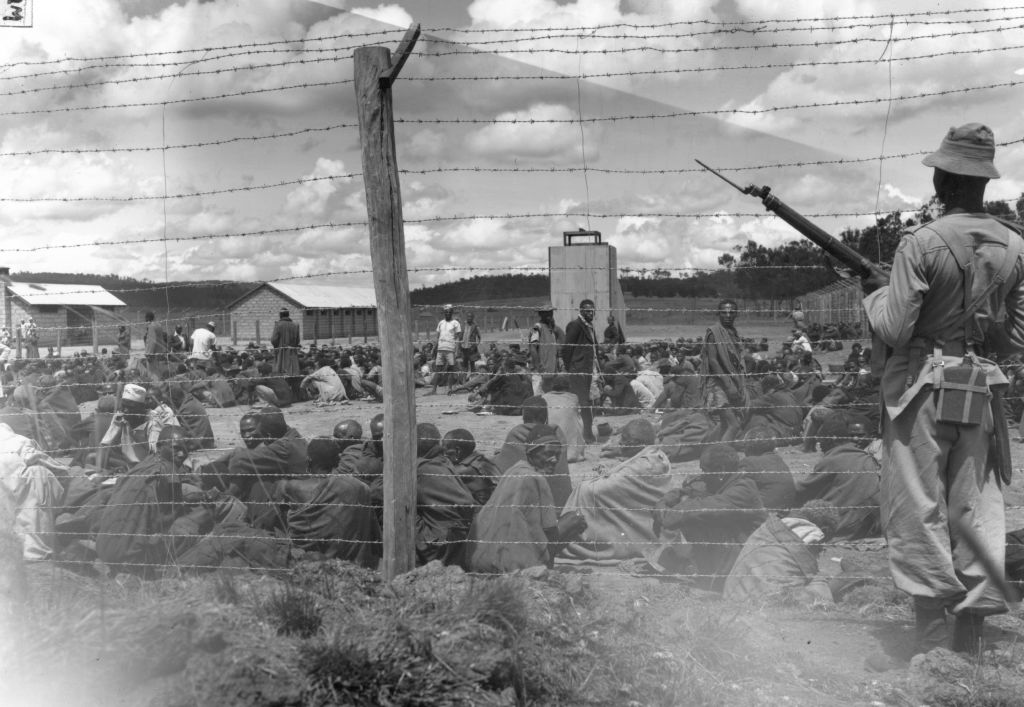
In Kenya, tens of thousands of men and women were held for years without trial, subjected to forced labor and, in some cases, to the most sadistic tortures imaginable, all in the name of suppressing the insurgency known as Mau Mau. (Evening Standard / Getty Images)
All nations have an excess of history. But none more so than the nation-states that were once nation-empires. The 1960s marked a critical moment for the nationalization of history in the Western European societies confronting the loss of their colonies. In response to the ruptures and humiliations of decolonization, both the political right and left embraced narrower, more provincial visions of the collective past. Memories of empire were treated as personal and familial rather than public and institutional; textbooks, memorials, and museums left “overseas” history largely out of sight.
In recent years, however, the code of silence around imperial history has been weakening. In Britain, once the heart of the biggest empire of all, change has come from multiple directions. First, academic researchers turned to long-neglected sources, such as the records of British slave ownership, while discerning a resurgence of empire in the forever wars of the post-9/11 era. Second, a novel litigation strategy — suing the British government, in British courts, for human rights violations committed by imperial authorities decades earlier — achieved spectacular results.
In 2013, Kenyans who had been tortured in British detention camps during the counterinsurgency of the 1950s won a financial settlement of roughly £20 million and a formal acknowledgment of wrongdoing by the foreign secretary. Third, successive waves of protest targeted imperialist symbols as props of a tenacious systemic racism. The Rhodes Must Fall campaign, seeking the removal of the Cecil Rhodes statue at Oriel College, Oxford, took off in 2015. Then during the Black Lives Matter summer of 2020, the Winston Churchill statue in London’s Parliament Square was defaced with graffiti, while a crowd in Bristol toppled a statue of slave trader Edward Colston and dumped it into the city’s harbor.