Jean Jaurès, an Iconic Leader of International Socialism
One of France’s leading socialists, Jean Jaurès was assassinated just days before the outbreak of World War I. An impassioned defender of working-class internationalism, his murder signaled Europe’s descent into war.
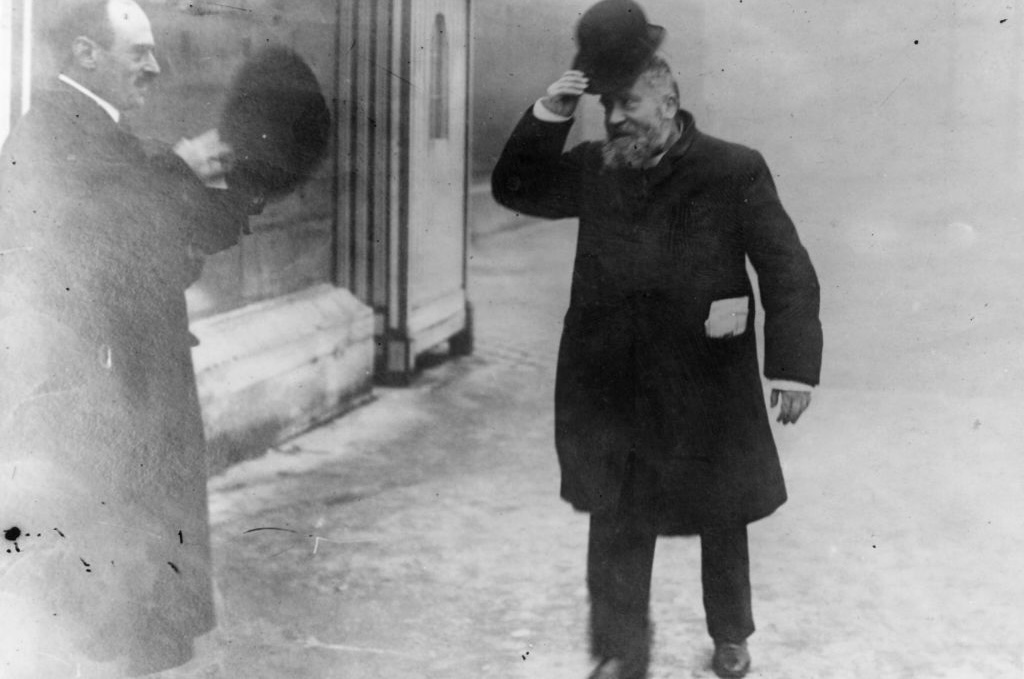
In Leon Trotsky’s words, Jean Jaurès was both one of the “two most outstanding representatives of the Second International” of socialist parties and the “greatest man of France’s Third Republic.” (Topical Press Agency / Getty Images)
In the years before World War I, Jean Jaurès was one of the leaders of the international workers’ movement — and he was assassinated on July 31, 1914, because of his courageous stand against the looming bloodbath. A martyr for peace, Jaurès was soon canonized both by Communists for his internationalism and by Socialists for his democratic vision of social change. In Leon Trotsky’s words, Jaurès was both one of the “two most outstanding representatives of the Second International” of socialist parties and the “greatest man of France’s Third Republic.” Founder of the newspaper l’Humanité, Jaurès’s name still has a monumental place in French public life. Yet he is today less renowned abroad than contemporary socialists such as Karl Kautsky.
Born in 1859, Jaurès began his political life as a republican and fought many battles to defend the French republic from reactionary and monarchist forces. From the 1880s, he increasingly did so as a socialist, inspired by both the radical traditions of the French Revolution and the rising labor movement. Compared to more doctrinally Marxist figures like Jules Guesde, Jaurès’s approach was more “possibilist” about gradual change within the republic’s institutions. In this vein, he took a stand in defense of army captain Alfred Dreyfus, the victim of an antisemitic smear campaign that polarized French politics between Dreyfusards and anti-Dreyfusards at the turn of the century. At the same time, Jaurès was the champion of a united socialist party, and together with Guesde founded the French Section of the Workers’ International (SFIO) in 1905.
For a century after his assassination, few of Jean Jaurès’s works appeared in English. Yet this has begun to change, with the publication of his Socialist History of the French Revolution and, most recently, a collection of his Selected Writings, “On Socialism, Pacifism and Marxism,” edited by Jean-Numa Ducange and Elisa Marcobelli. Jacobin’s David Broder, who translated the Selected Writings, interviewed the editors about Jaurès’s role in French republican history, the impact of Marxism on his thinking, and his lasting influence on the socialist movement.