The Strange and Wonderful Subcultures of 1960s New York
Before planners and property developers turned Manhattan into a sterile playground for the wealthy, it was the site of extraordinarily creative art and music scenes. Critic J. Hoberman shows us how New York thrived in the shadow of nuclear war.
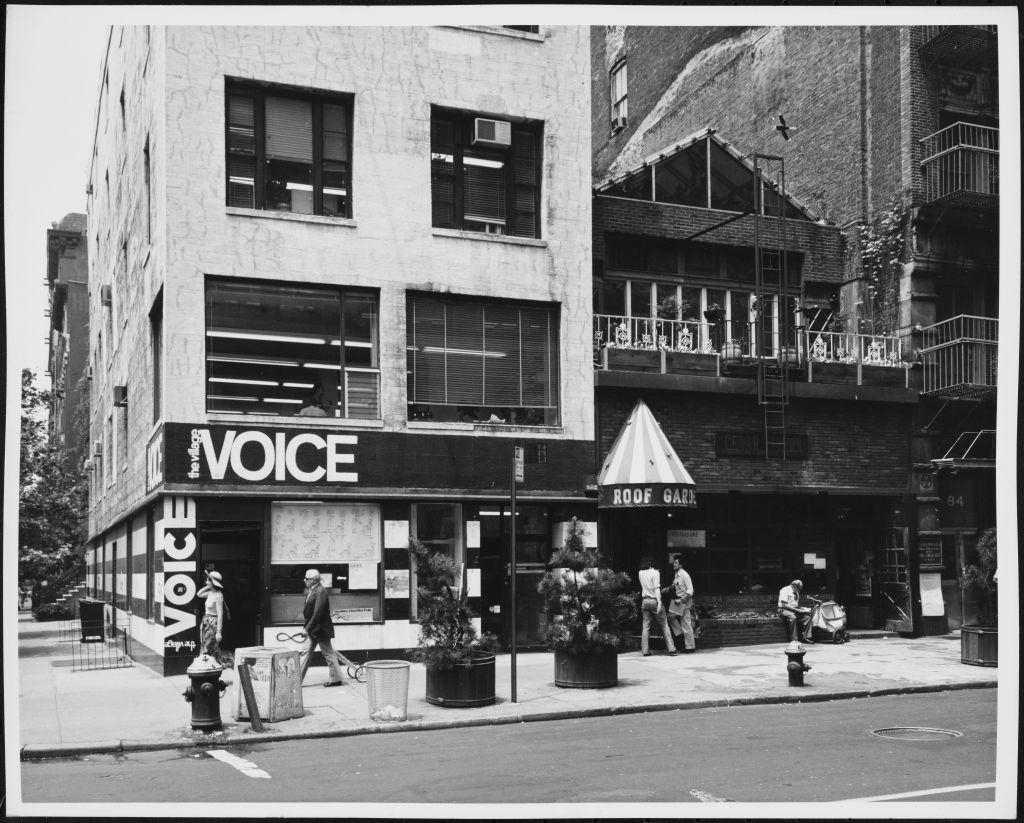
The former Village Voice offices, here photographed circa 1975, were situated in the heart of Greenwich Village, at Sheridan Square, New York, New York. (Edmund Vincent Gillon / Museum of the City of New York / Getty Images)
For fifteen years New York City — and specifically Manhattan — was understood to be the Prime Target and hence Ground Zero in a nuclear war. “The intimation of mortality is part of New York now,” E. B. White wrote in 1949; it was present “in the sound of jets overhead, in the black headlines of the latest edition.” Children entering kindergarten were issued dog tags. (I was one.)
Ruins were already present. Since the end of World War II, huge chunks of Manhattan had been leveled in the name of urban renewal, the new term for “slum clearance.” Buildings, entire blocks, even whole neighborhoods might disappear as if overnight, often rebuilt in the form of brutalist public housing projects. Many of these were on the Lower East Side.
Breaking Eggs
In the 1950s, a red brick palisade of high-rise public housing went up along Avenue D. Many Lower East Side residents, arrived since the war, were Puerto Rican; the area’s remaining Jews were mostly concentrated in older, less monumental public housing south of Delancey Street. “They were tearing down block after block,” the artist Aldo Tambellini recalled. “It looked like a bombed-out area from World War II.” Tambellini found inspiration in the rubble: “I vividly remember a dismembered wall remaining standing from an old synagogue with a big mural of the Lion of Judah.”