Romania’s Election Isn’t Just About Geopolitics
After Romania’s election was canceled, both the far-right candidate and his liberal opponent wrote to Donald Trump to seek his backing. The country’s political leadership class remains strongly deferential to Washington.
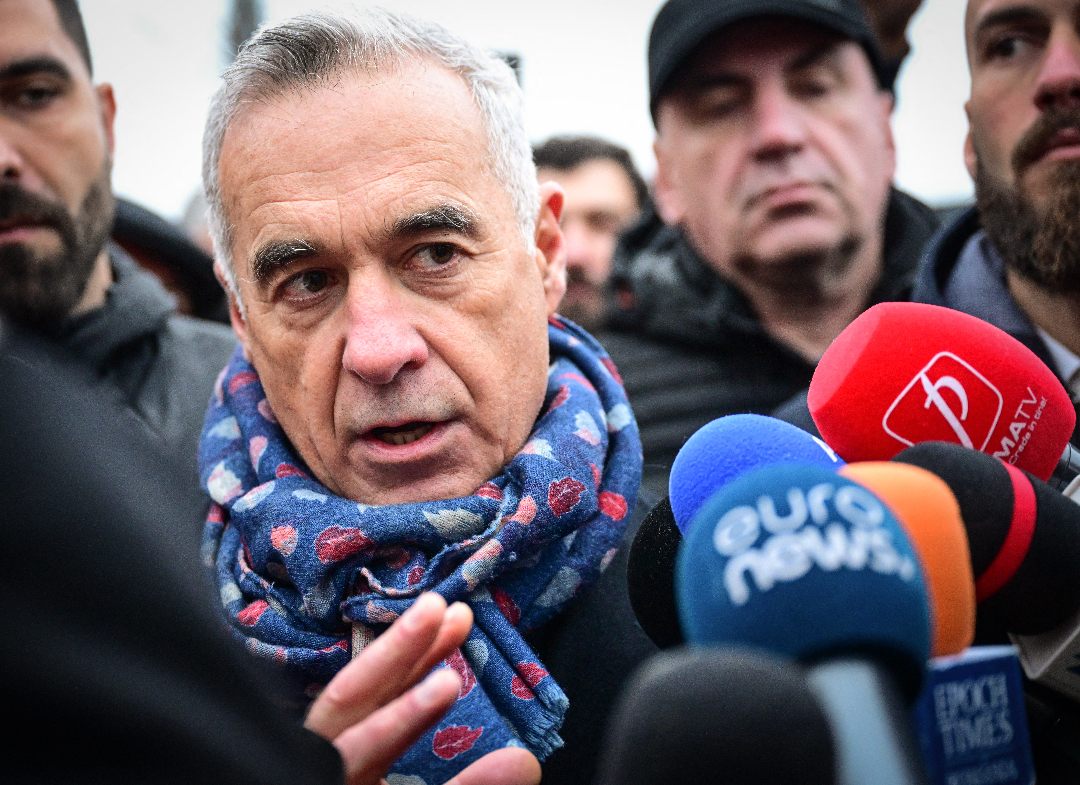
Far-right presidential candidate Călin Georgescu speaks to the media upon arrival at a protest against the nullification of the presidential elections outside a voting station in Mogosoaia, near Bucharest, on December 8, 2024. (Daniel Mihailescu / AFP via Getty Images)
There are whole decades when nothing happens — and then days when Romanian elections happen. The last few weeks in Romania have been tumultuous even by 2020s standards: after the first round of presidential elections on November 24 was won by Călin Georgescu, a far-right, Vladimir Putin–curious independent who seemingly came out of nowhere, the parliamentary elections on December 1 saw (another) far-right party, the Alliance for the Union of Romanians (AUR), come in second place. The result: to force all mainstream parties into negotiations for a “government of national unity.” More than ever, Romanian society has become polarized between the “sovereigntist” camp (including AUR) rallying behind Georgescu, and the pro-Western bulk of the political establishment and civil society. In effect, it’s a battle between the nationalist right and the neoliberal right.
But last Friday, the Constitutional Court delivered a fresh plot twist less than forty-eight hours before the planned second round of the presidential elections: the nullification of the first round and a complete rerun of the whole electoral process, with the vote likely to take place sometime next spring. The decision was based on evidence of electoral law violations by Georgescu’s campaign, including the failure to report campaign expenses and to label electoral advertising accordingly. Nevertheless, the over two million votes received by Georgescu were themselves genuine. Had they not been seen as a threat to Romania’s “Western path” (read: unconditional subordination), the highly politicized Constitutional Court would probably not have made this decision.
Surprisingly, both Georgescu and the pro-Western candidate who had made it into the second round, Elena Lasconi from the neoliberal Save Romania Union (USR), criticized the decision. So did Donald Trump Jr, who deplored this “[George] Soros/Marxist attempt at rigging the outcome and denying the will of the people.” This compelled both candidates to write to his dad and argue their case, like schoolchildren in front of the headmaster. Lasconi — ostensibly the candidate defending democracy, the rule of law, and all the rest — started by praising Trump “for the great things you have done, and will continue to do, to put America first and for your continuous fight for the American people.” Georgescu went as far as suggesting that this is in fact a plot to drag NATO into the war in Ukraine and thereby block Trump’s investiture in January. His characterization of Trump echoed the old Wallachian delegations kowtowing to the sultan: “They want to stop the Peace-Maker Donald Trump from keeping world peace.”