In Ireland’s Election, Sinn Féin Didn’t Shine
Ireland’s election saw little enthusiasm for the ruling parties — but also a weakened score for opposition force Sinn Féin. Its message on housing hardened its youth support, but it was unable to build out its base across Irish society.
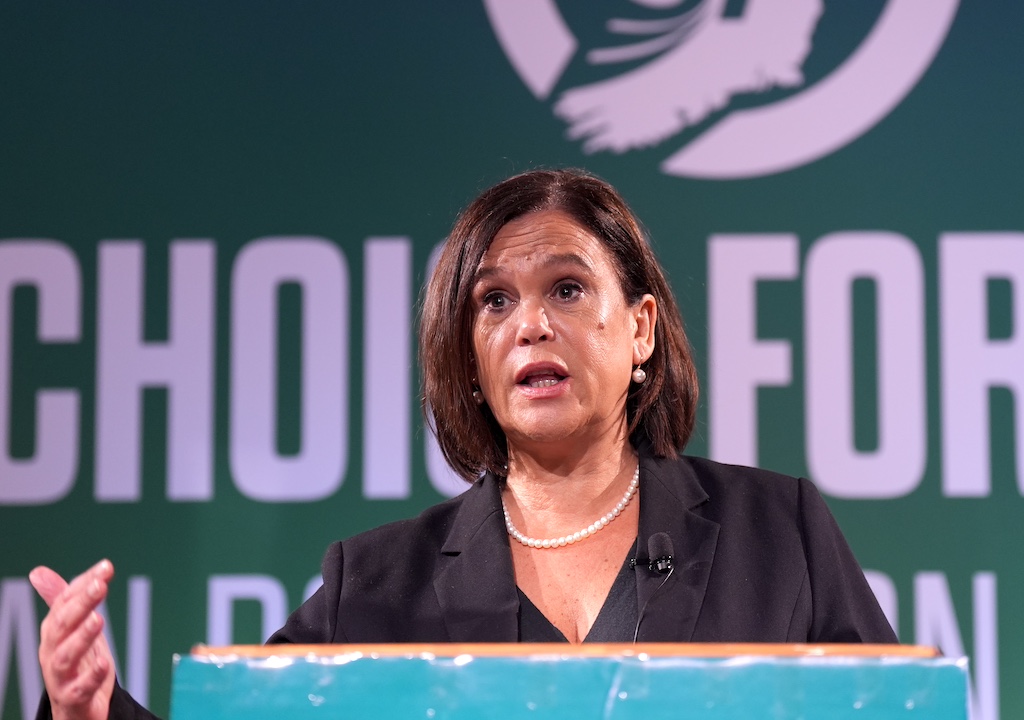
Sinn Féin president Mary Lou McDonald at the launch of the party’s manifesto for the general election on November 29, in Dublin on November 19, 2024. (Niall Carson / PA Images via Getty Images)
Most recent elections around the West have seen voters punish incumbents for rising inflation and the end of pandemic-era support programs. Ireland’s election last Friday was thus something of a relief for ruling parties Fianna Fáil and Fine Gael. Their popular vote (21.9 percent and 20.8, respectively) wasn’t great: indeed, a new historic low, on the poorest turnout in over a century. Added together, these two parties had over 70 percent of the vote share before the financial crisis, but soon suffered a collapse similar to that of once-mass parties in France, Italy, and beyond. Yet on Friday, the Fianna Fáil and Fine Gael vote ticked down just marginally compared to the last contest in 2020. The real losers were elsewhere: the junior party in the ruling coalition, the Greens (losing eleven of twelve seats, collapsing from 7.1 to 3 percent), and, most importantly, opposition party Sinn Féin (falling from 24.5 to 19 percent).
The Greens’ failure was unsurprising. It echoed their previous anemic period in government from 2007 to 2011, when — having enforced brutal austerity alongside Fianna Fáil — they ended up losing all their seats. There was a difference this time: while this “progressive” party’s base was again disillusioned by its non-impact on a center-right government, the generally older, middle-class supporters of Fianna Fáil and Fine Gael turned out more satisfied. In coalition since 2020, the two parties had a “job share,” swapping the role of taoiseach (head of government). In preelection TV debates, their respective leaders, Micheál Martin and Simon Harris, often appeared not as rivals but as a grey double act, issuing doom-laden warnings that Sinn Féin leader Mary Lou McDonald’s promises of mass investment in housebuilding were utopian folly.
If substantially similar in their impulses — a mix of Christian democracy, deference to tax-dodging corporate giants, and, increasingly, chipping away at the Irish state’s pretense of military neutrality — Fianna Fáil and Fine Gael were through the twentieth century staunchly opposed, partly as a legacy of the Civil War of the 1920s. But, enfeebled ever since the 2008 crisis, they have huddled together for warmth, especially faced with Sinn Féin’s rise. It now seems most likely that they will again join in coalition, perhaps with Social Democrats, Labour, or so-called “independents” (often local business chiefs claiming a “common sense” mantle for a habitually low-tax, high-subsidy, anti-green agenda).