How US Trade Unionists Opposed the Dirty War in El Salvador
The Reagan administration enlisted the AFL-CIO to provide cover for its bloody campaign against the Left in Central America. But progressive forces in US labor took a stand in solidarity with trade unionists facing murderous repression in El Salvador.
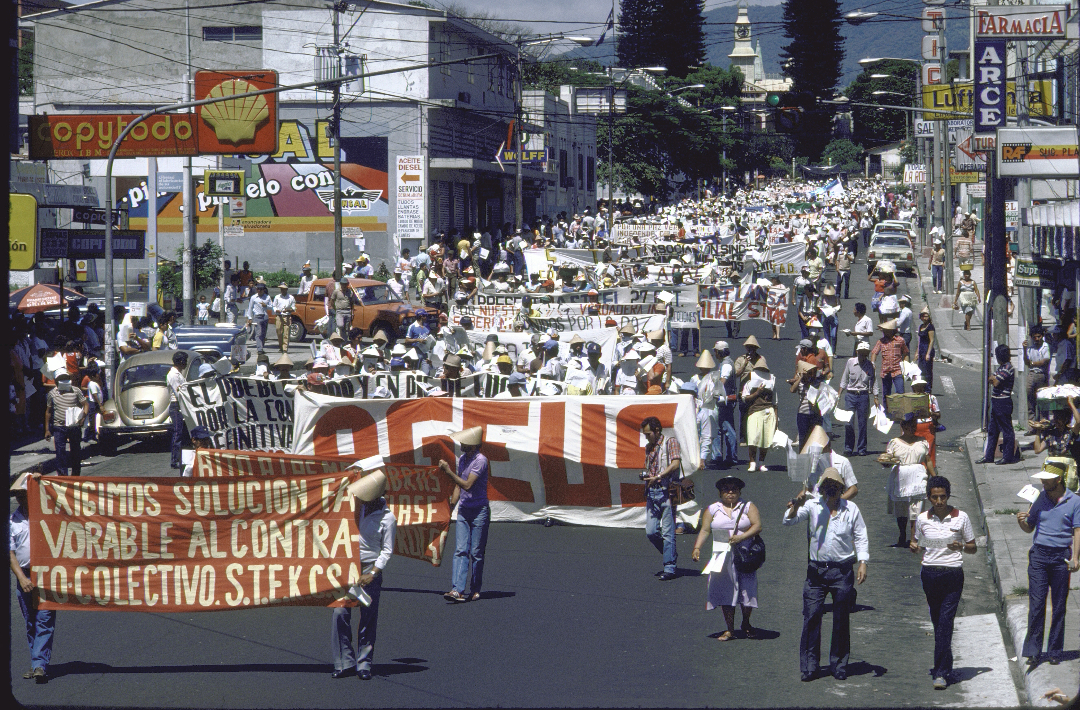
Students, labor unions, and others rally in opposition to the US-backed government of El Salvador in San Salvador, the country’s capital, on September 1, 1985. (Cindy Karp / Getty Images)
Working in close coordination, the State Department and the AFL-CIO’s American Institute for Free Labor Development (AIFLD) stepped up their presence in El Salvador after a group of reformist military officers seized control of the government in October 1979. Supported by the United States, the new junta aimed to keep El Salvador from going the way of revolutionary Nicaragua.
Both the State Department and AIFLD endorsed a counterinsurgency strategy that hinged upon propping up political centrists in El Salvador, a venture doomed to fail as the country’s Left and Right became ever more polarized. Resenting even token attempts at social and economic reform, the Salvadoran right mobilized death squads that murdered with impunity, while the Left — faced with escalating repression — became convinced that armed struggle was the only way to topple the country’s elites.
By late 1980, El Salvador was in the grip of a bloody civil war. Determined to deny victory to the leftist guerillas, the incoming Reagan administration resolved to increase military assistance to the Salvadoran government, ensuring that the conflict would drag on throughout the ’80s and ultimately leave some eighty thousand people dead.