Steve Albini Believed in a Democratic Music Industry
The musician and audio engineer Steve Albini, who died this week, defended art from the music industry’s greed. Working with famous bands and indie acts alike, he fought for every artist’s right to realize their unique sound and earn a decent living.
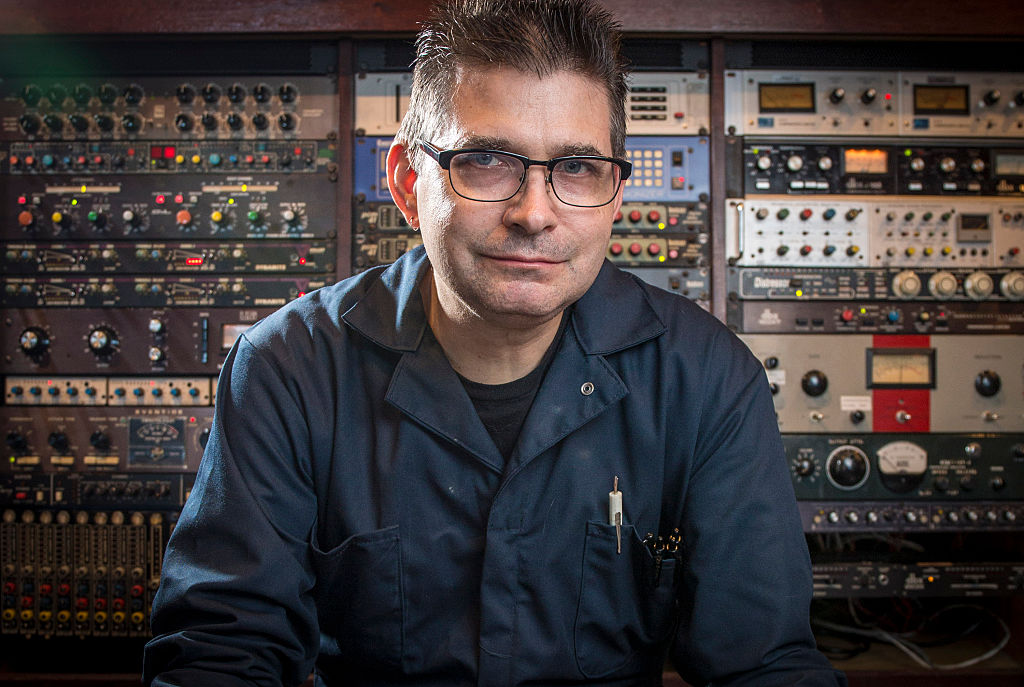
Steve Albini (1962–2024) poses for a portrait in his studio on July 24, 2014, in Chicago, Illinois. (Brian Cassella / Chicago Tribune / Tribune News Service via Getty Images)
Bands came to Steve Albini to sound like themselves. The engineer — who died this week of a heart attack, aged sixty-one — outlined his approach to Nirvana in a letter before he recorded In Utero, stating that he was only interested in capturing the band exactly as they were, right then and there. “If you will commit yourselves to that as a tenet of the recording methodology,” he wrote, “then I will bust my ass for you. I’ll work circles around you. I’ll rap your head with a ratchet.” Like many of the “couple thousand” records he recorded over a four-decade-plus career, In Utero had no filter. Instead of forcing himself in between the listener and the band with production tricks and tampering, he closed the gap and brought the songs closer to us.
Albini — who also fronted his own uniformly excellent bands Shellac (whose now final album To All Trains is scheduled for release next week), Big Black, and the unfortunately named Rapeman — was egalitarian in both practical and philosophical terms. He famously refused royalties for In Utero, and he duly kept his prices low throughout his career: in 2023, his day rate was $900, plus tape costs and studio hire. He was willing to travel, but he largely worked from Electrical Audio, the analog recording studio that he established in Chicago in 1997. Anyone could book a session with Albini, no demos required, so any band or artist with the budget could access the same recording expertise as Nirvana. In the same year that he oversaw Jimmy Page and Robert Plant’s post–Led Zeppelin comeback album, he also cut records with little-known Irish punk bands and underground performance artist Vaginal Davis.
He may have liked a lot of the music he worked on, but an Albini credit wasn’t a cosign or a status symbol like those of so many celebrity producers today. He was a gun for hire, but he was pretty much the best gun a few thousand bucks could buy. He was blunt and straightforward in the studio, committed to making every client he worked with make the best possible record, which meant the truest record, embracing their limitations and leaving accidents on the tape. His records are characterful, unfussy, and real. He never called himself a “producer,” instead preferring the more practical “engineer.” He was a mirror that talked back, a documentarian gently guiding the action. More than anything, he was a facilitator.