Why Raphael Samuel Matters
Raphael Samuel, one of Britain’s most brilliant historians of the popular classes, was a contemporary of E. P. Thompson and Stuart Hall but never enjoyed their level of fame. He practiced a form of history from below that gave agency to the working class.
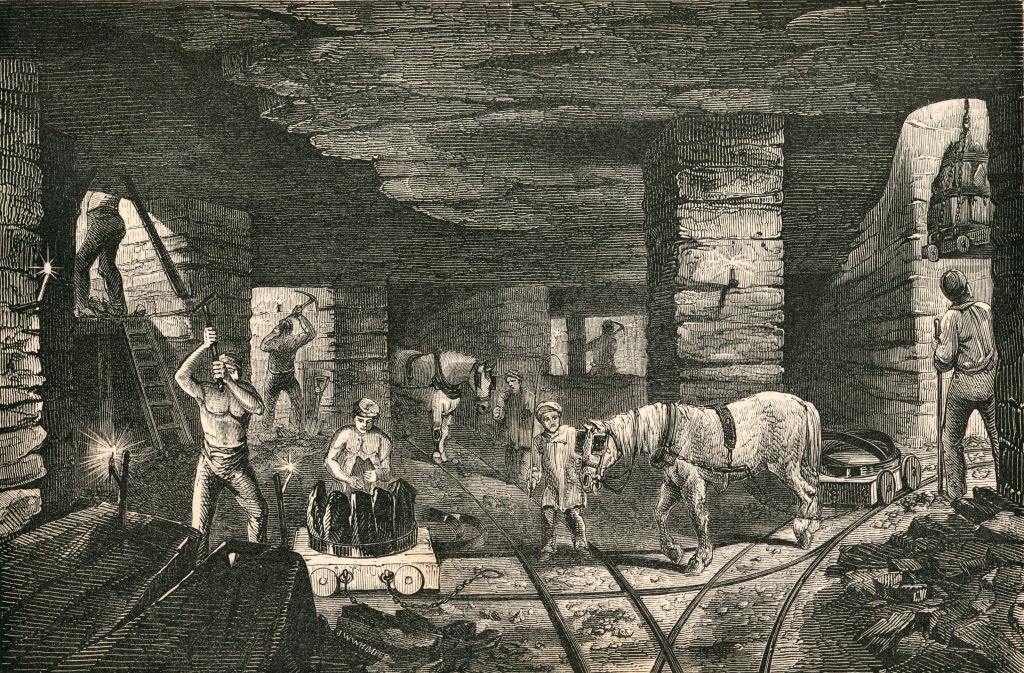
Nineteenth-century illustration of Bradley Coal Mine, near Bilston, England. (Universal History Archive / Universal Images Group via Getty Images)
It is perhaps a unique feature of British intellectual culture that its greatest Marxists have more often been essayists than authors of lengthy theoretical treatises. The self-contained responses to a specific political or historical problem, or the witty corrective to dominant orthodoxies, are well suited to a nation whose intellectual elite are as closed and coherent as Britain’s. When E. P. Thompson wrote “The Peculiarities of the English,” his breathless polemic seeking to correct a dismissive attitude to the radicalism of his country’s history found in the work of the Marxist writers Perry Anderson and Tom Nairn, he was pitting himself against two thinkers whom he knew personally and who edited a journal to which he, too, had contributed.
More recently, in an exchange with the Dutch historian Luuk van Middelaar in the letters pages of the London Review of Books, Anderson responded convivially to accusations of gaps in his knowledge by inviting his interlocutor to discuss issues further “over a glass of wine.” In such an environment, “the Bildungslücke is easily remedied.” It is the essay’s role as a preliminary response to an issue — think of the much-repeated remark that essay means “attempt” — that has tied it so intimately to the closed English sodalities of the twentieth-century academic left. There the messy business of political clarification can be carried on in an almost familial setting.
The English historian Raphael Samuel, whose newly collected essays, Workshop of the World: Essays in People’s History, have recently been published by Verso, always existed awkwardly within this context. Four years the senior of Anderson, and from the same intellectual milieu that produced figures like Thompson, Stuart Hall, Tariq Ali, and the communist historians Christopher Hill and Eric Hobsbawm, his work sought to turn the essay into a window into the lives of the popular classes.