Americans Across the Political Divide Want a Federal Job Guarantee
A look at all the available survey data on public support for a job guarantee shows consistently strong support for the idea. It’s a winning idea for the Left.
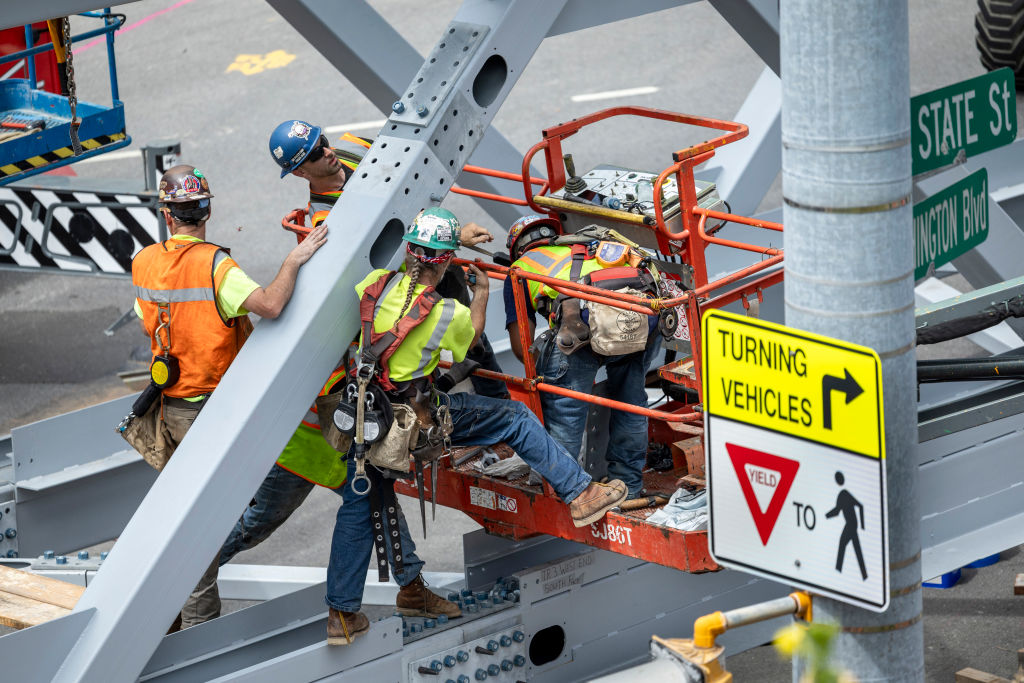
Workers prepare to lift a new pedestrian bridge into place at the Stamford Transportation Center on August 26, 2023 in Stamford, Connecticut. (John Moore / Getty Images)
There has been steadily increasing interest in a federal job guarantee since Bernie Sanders reintroduced the concept to the American public in the wake of the 2016 presidential primaries.
The idea of a job guarantee is to provide a public option for struggling workers to find gainful employment — especially contributing to badly needed public infrastructure projects but also a wide range of other service-based work in education, health, recreation, and the arts. The idea has a long history in the United States going back to the large-scale job creation programs of the New Deal in the 1930s to the lesser-known Comprehensive Employment and Training Act (CETA) that, by 1978, had put 725,000 people into public sector employment.
Beginning in 2018, the idea of a job guarantee began to gain traction once again, in large part because politicians started to see it as good politics. Senator Kirsten Gillibrand, a New York Democrat, for instance — far from a darling of the Left — tweeted in April 2018, “If Republicans could give $1.5 trillion in tax cuts to corporations . . . why can’t we invest a similar amount in a guaranteed jobs plan for regular Americans who are unemployed and willing to work to better their local community?” Senator Corey Booker, a New Jersey Democrat, also took up the cause of a job guarantee, arguing: “The federal jobs guarantee is an idea that demands to be taken seriously. . . . Creating an employment guarantee would give all Americans a shot at a day’s work and, by introducing competition into the labor market, raise wages and improve benefits for all workers.”