Workers Can Halt the War Machine
In 1974, Scottish workers refused to fix the fighter jets of Chilean dictator Augusto Pinochet. As the West continues to supply Israel with arms, unionized workers could again refuse to stop the flow of weapons of mass murder.
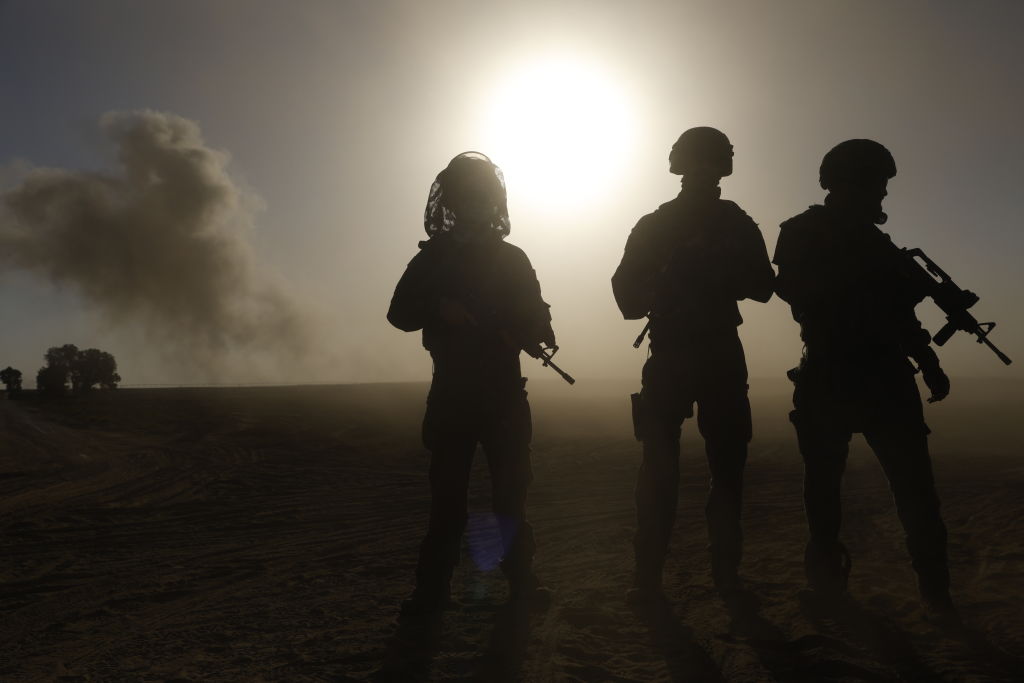
Soldiers with the Israel Defense Forces stand with weapons as smoke rises from bombardments on Gaza on March 4, 2024, in southern Israel near the border with Gaza. (Amir Levy / Getty Images)
History is often understood through the stories of “great men,” reflecting capitalism’s encouragement of the individual and suspicion of the collective. Socialists, understandably, have traditionally sought to reject such narratives; a famous example is in the final address of Salvador Allende, the socialist president of Chile who, before his death in Augusto Pinochet’s 1973 coup, assured listeners that “history is ours, and the people make history.”
The postindustrial area of Nerston, East Kilbride, echoes this sentiment half a century on. This town on the outskirts of Glasgow is not known for its monuments to famous generals or statesmen; instead, there is a humbler tribute to an alternative history that was, until recently, largely forgotten. In 1974, six months after Pinochet’s coup against Allende’s elected government, three thousand members of the Amalgamated Union of Engineering Workers (AUEW) in the Rolls Royce plant in Nerston, led by Communist Party member Bob Fulton, “blacked” a batch of Hawker Hunter jet engines that were to be returned to Chile after repair. Nowhere else were engineers qualified to repair those engines.
At a union branch meeting, the workers had already voted to condemn the coup. “The people being tortured and murdered, they were just like us — trade unionists,” explained Stuart Barrie in a 2018 interview with the Guardian. In the same interview, John Keenan outlined how crucial organization was to AUEW members at Rolls Royce, who had a history of taking political action: “The only reason we could do what we did was because we were organized. We took strike action for the [National Health Service], the Shrewsbury pickets, you name it.”