Formulas for Socialist Painting
In the 1960s, artists in Britain and Yugoslavia imagined that the art of socialism might be made with — or even by — computers.
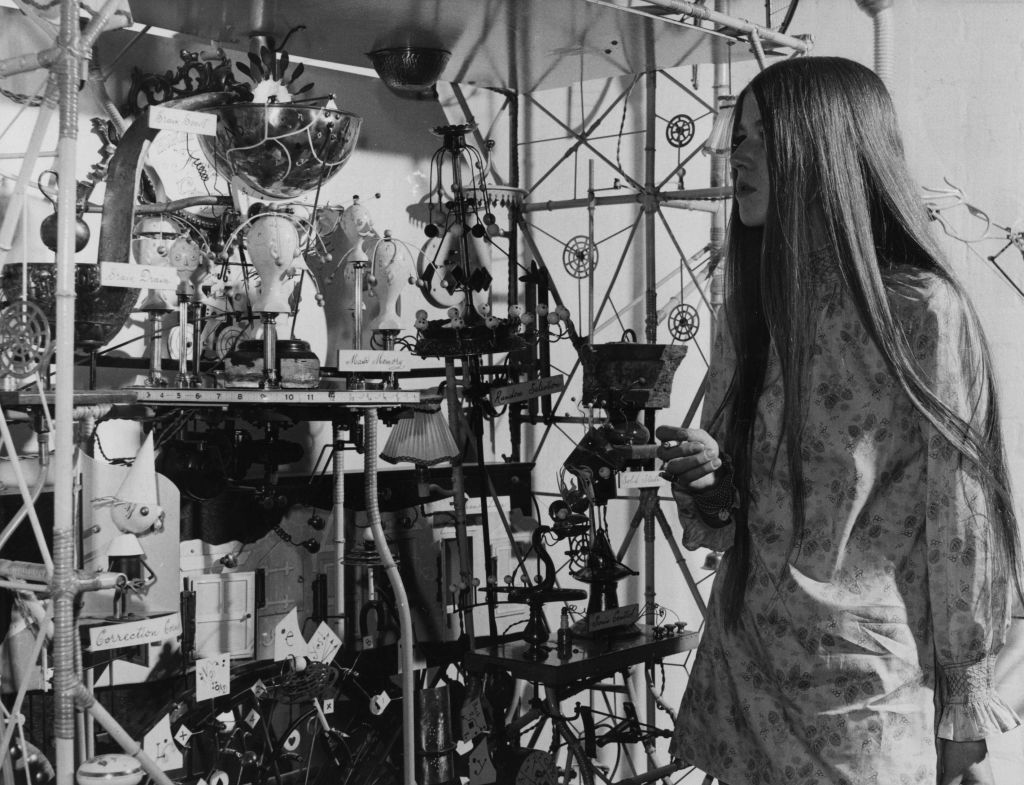
A visitor at the Cybernetic Serendipity exhibition looking at the Honeywell-Emmet computer ‘Forget-me-not.’ (Fox Photos / Getty Images)
In 1968, the year in which audiences first witnessed HAL 9000’s rebellion in 2001: A Space Odyssey, the Institute of Contemporary Arts (ICA) in London hosted an exhibition entitled Cybernetic Serendipity. Curated by Jasia Reichardt, Cybernetic Serendipity was a project of an experimental nature, focusing on the relation between art and new technologies.
Visitors to the ICA were invited to explore different facets of “computer art”: anthropomorphic robots and automated mechanisms stood among geometric sculptures and technical drawings. At times, it must have been hard to understand what you were looking at. The exhibition was a complex assemblage of artistic techniques and electronic machinery, as attested by the long list of acknowledgements: Reichardt thanked representatives of IBM, various art schools, Imperial College, the classical music publisher Boosey & Hawkes, Bell Telephone Laboratories, the National Physical Laboratory, and one “Rt. Hon. Anthony Wedgwood Benn. Minister of Technology, London,” who spoke at the opening.