Jacques Delors’s “Social Europe” Was the Prisoner of Pro-Austerity Dogmas
Last week saw the death of Jacques Delors, a leading architect of the European Union at the turn of the 1990s. Delors promised the EU would be a “social Europe” — a dream fatally undermined by the budget-cutting dogmas on which it was built.
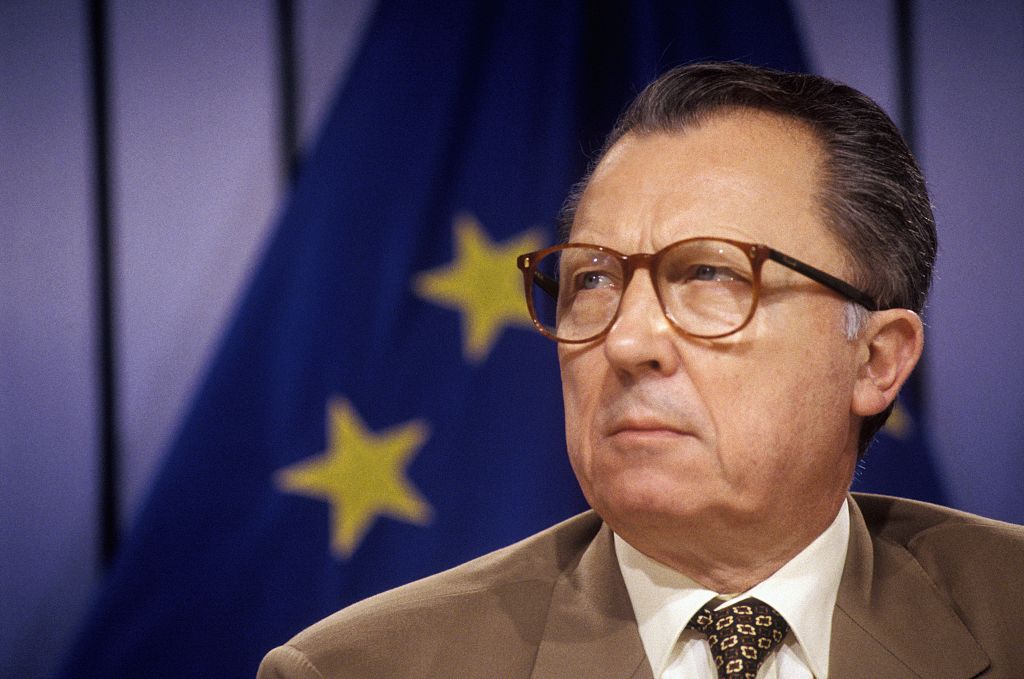
Former president of the European Commission Jacques Delors, in Brussels, Belgium, on June 10, 1993. (Jean-Michel Turpin / Gamma-Rapho via Getty Images)
The European Union that emerged in the early 1990s is often called a “synthesis” achieved by the longtime Commission president Jacques Delors — what historian Laurent Warlouzet aptly termed an “evolving compromise between French dirigisme and German ordoliberalism.” Since Delors’s death on December 27, commentary has mostly cast him as the standard-bearer of a “social Europe” — even if it is widely admitted that this project was stunted from the outset.
The blame is largely attached to the vetoes put up by member states and the obstacles created by Europe’s reliance on seeking agreements among its governments. Yet Warlouzet’s definition allows a better focus on the characteristics — and structural weaknesses — of the renewed social pact envisaged by Delors, himself a grandee of France’s Parti Socialiste. From this standpoint, Delors was not so much the defeated champion of a social Europe as the sponsor of a failed, politically subaltern attempt at managing an ordoliberal economic constitution in a “socialist” way.
This calls into question a classic reading of the opposition between Delors and Margaret Thatcher in this crucial moment of advancing European integration. The story usually takes its cue from his address to the British Trades Union Congress (TUC) in 1988, considered an expression of the irreconcilability between Thatcher’s neoliberal, Euroskeptic vision and Delors’s project for a strongly “socially”-hued EU, which won the affections of TUC delegates.