Ivory Perry, the Forgotten Civil Rights Hell-Raiser
Activists are often held up as exemplars of personal morality — but in every social struggle, ordinary people with complex lives rise up as leaders. Ivory Perry was one of these who waged a relentless war for racial and economic justice.
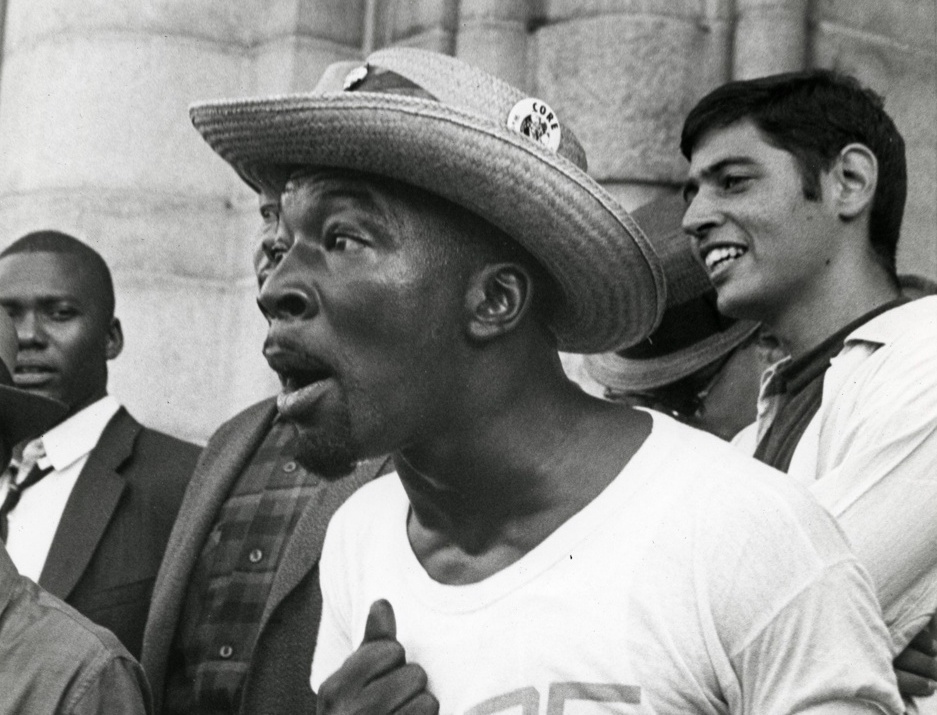
Ivory Perry addressing a civil rights demonstration in front of the St. Louis police headquarters on September 16, 1965. (St. Louis Post-Dispatch / Missouri Historical Society)
At every inflection point in social struggle, ordinary people emerge on the front lines of protests. Some are celebrated for generations as heroes, martyrs, and icons. But more often these leaders, uninsulated by economic and cultural privilege, pay an enormous price for bravery, and are forgotten by subsequent generations. Among the elderly poor, one occasionally finds a once-fearless activist, now living in modest obscurity, with only old war stories to show for it.
One forgotten fighter is Ivory Perry, who was in and out of homelessness in St. Louis over the years during which George Lipsitz interviewed him for his biography A Life in the Struggle: Ivory Perry and the Culture of Opposition.
For Lipsitz, the problem with traditional protest scholarship is that activists are required to be exemplars of bourgeois morality, “striving to make the public realm conform to the standards of their private lives.” In reality, organic leaders like Perry are often both politically effective and personally complex. Perry was born to a sharecropper in the Jim Crow South. Like many poor black men of Perry’s background, he acquired a long arrest record — and not just for his political activism, though that too. In addition to homelessness, a dishonorable discharge, and incarceration, Perry experienced depression, drug use, and psychiatric issues that ultimately ended his life in tragedy.