In Italy’s Main Shipyard, Anti-Islam Policy Divides Workers
In Monfalcone, in northeastern Italy, the far-right mayor has banned public Muslim prayer. Home to Europe’s largest shipyard, the town is a crucible of Italy’s rising migrant workforce — and the racist backlash against it.
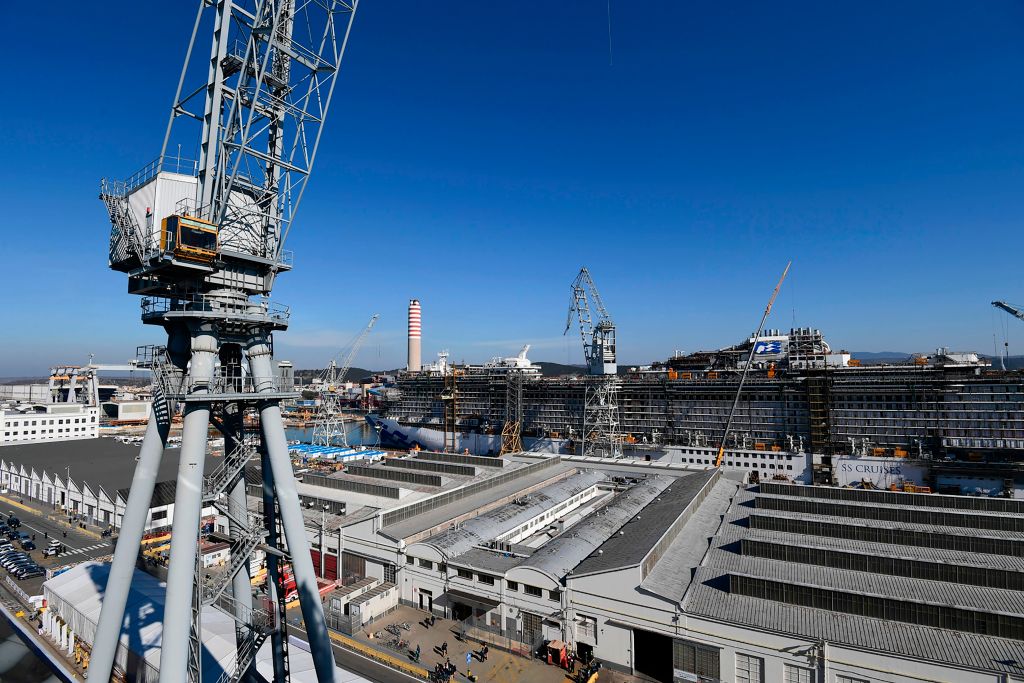
A general view of the Fincantieri’s shipyard in Monfalcone, Italy, in February 2019. (Photo by Miguel Medina / AFP via Getty Images)
Holding her delayed end-of-year press conference on January 4, Italian prime minister Giorgia Meloni was asked about the “Monfalcone affair.” TV reporter Elisa Saltarelli sought Meloni’s opinion on the supposed “Islamization” of the northeastern Italian town, as denounced by Mayor Anna Maria Cisint, a member of Matteo Salvini’s far-right Lega party.
Monfalcone, a historic center of shipbuilding that recently surpassed thirty thousand residents, made national headlines after Cisint’s decision to prevent Muslim worshippers from praying in either of the town’s Islamic cultural centers. This can be seen as the culmination of recent developments in which institutional racism has increasingly shaped local politics. But the policies enacted have also made Monfalcone a special vantage point on the contradictions of the far right in office — claiming to defend the Italian native workforce from Muslims even as it undermines job stability generally.
From Migrant Work to a Transformed City
Monfalcone is home to Europe’s largest shipyard, one of eight domestic plants of Fincantieri, a multinational in which the Italian state holds a majority share. The shipyard, mainly devoted to building cruise ships, employs sixteen hundred people, but most production is carried out by the thousands of blue-collar workers employed through various levels of contracting-out.