Political Economy, Not Culture, Explains the Arab Spring
The Arab Spring was an inspiring explosion of democratic energy that ended tragically in autocracy and violence. Understanding the protests’ ultimate failure requires concrete analysis of political and economic factors, not superficial cultural explanations.
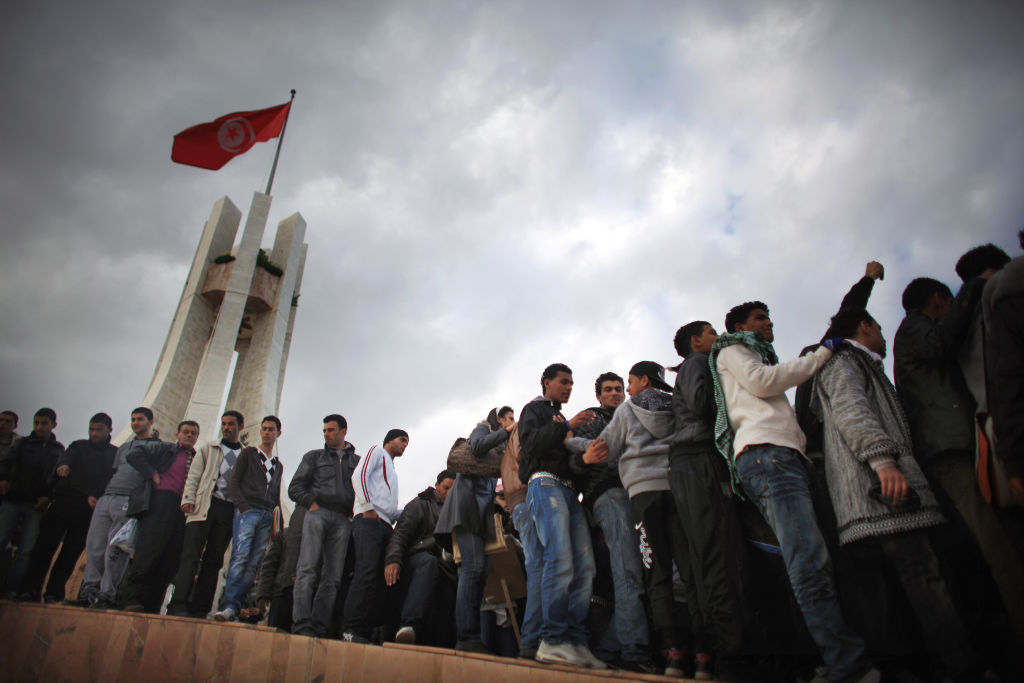
Protesters climb on to the City Hall Monument near the prime minister’s office on January 24, 2011 in Tunis, Tunisia. (Christopher Furlong / Getty Images)
A full decade after the Arab Spring uprisings, and a few years after their successor events elsewhere in the Middle East, they are mostly remembered for their sad outcomes of civil war and the return to authoritarian states often worse than those ousted. In the early 2010s, many were enthusiastic about the prospect of the Arab Spring ending autocratic rule and bringing about democracies and representative governments. Optimists on the Left even dreamed of revolutionary new governments whose prime concern would be social and economic development for their populations, including major roles for marginalized people, youth, and women.
Since then, journalists have published detailed recollections and analyses, and students have written their dissertations on the subject. As the situation turned sour everywhere except Tunisia, interest waned and the Tunisian model was increasingly presented as the only success, despite its many difficulties and compromises. By the end of the decade, new publications either asserted the failure of the movements or else attempted to extract the remaining positive lessons for the future. The revival of uprisings in 2019 — in Algeria, Lebanon, Iraq, and Sudan in particular — were praised by supporters as having drawn the appropriate teachings from the mistakes of the earlier part of the decade.
By 2023, Sudan had joined Syria, Yemen, and Libya as a country at war. None of the opposing armed factions in any of these countries would claim to be the heirs of the revolutionary youth movements of a decade ago. The main foreign interventions in all three, either open or covert, are from the leading states of the Gulf Cooperation Council (GCC) — Saudi Arabia and the United Arab Emirates — alongside Turkey. The main northern powers, the United States and Europe, claim mediating roles, hoping to bring or return these various crises to negotiations that would lead to a form of peace and stability that would not threaten their interests or dominant neoliberal policies in general.