America Broke Iraq Up Into Sectarian Pieces
Ghaith Abdul-Ahad's A Stranger in Your Own City is a powerful account of the invasion and occupation of Iraq and its catastrophic effects on the Iraqi people. Every American should read it.
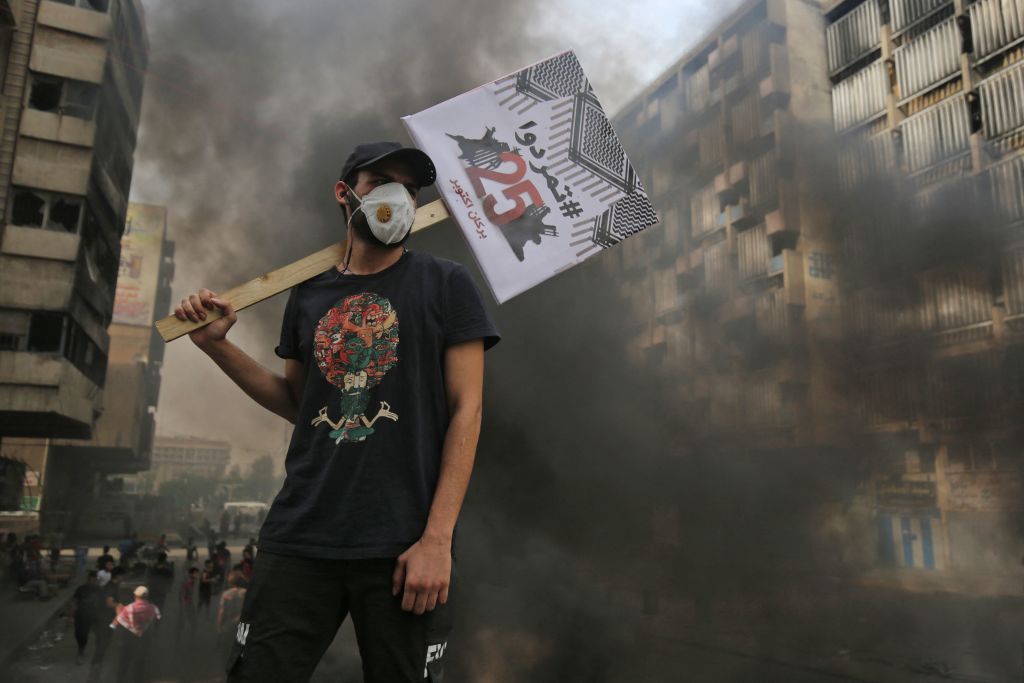
An Iraqi protester during a demonstration in October, 2020, on the first anniversary of the Tishreen uprising. (Ahmad al-Rubaye / AFP via Getty Images)
In April 2003, as US forces marched through Baghdad, a small group of Iraqis gathered and tried to pull down one of the main statues of Saddam Hussein in the city. Around them gathered a few Iraqis and many more foreign journalists. As the statue resisted their efforts, the spectators grew increasingly impatient. Finally, an American marine used a crane in an armored vehicle to bring the statue down, briefly covering it with an American flag.
Ghaith Abdul-Ahad was among those Iraqis watching this now infamous spectacle. As he recounts in A Stranger in Your Own City, he didn’t think that the marine should have intervened at all, which would “at least allow the façade of liberation to last for a day.” But he then reconsiders: “Maybe in all the declarations and justifications of the war by leaders and commanders who spoke of liberation and democracy, the act of that marine was the most honest.” That day and that image of the falling statue came to signify the start of a new era in Iraqi and Middle East history.
Twenty years later, Ryan Crocker, US ambassador to Iraq (2007–9), addressed the US role in the failed state-building effort and recounted that, prior to the invasion, there was only one functioning state institution in Iraq: the foreign ministry. “Beyond that it was a wasteland.” He went on to address one of the most commonly criticized American policies in Iraq: the dismantling of the Iraqi army. “We did not disband the Iraqi army; the Iraqi army disbanded itself, effectively. . . . [The question then was] do we reconstitute the Iraqi army, as it was Saddam’s army, effectively?” For him, the answer was a clear no. It would only repeat the British mistake a century earlier of maintaining the Ottoman Empire’s structures and institutionalizing a Sunni-dominated army.