Unearthing the Often Overlooked Religious Foundations of European Socialism
The diverse mosaic of European socialism engaged both reformists and revolutionaries, often driven by not just intellect but also profound religious conviction. Together, these elements shaped the democratic socialist tradition.
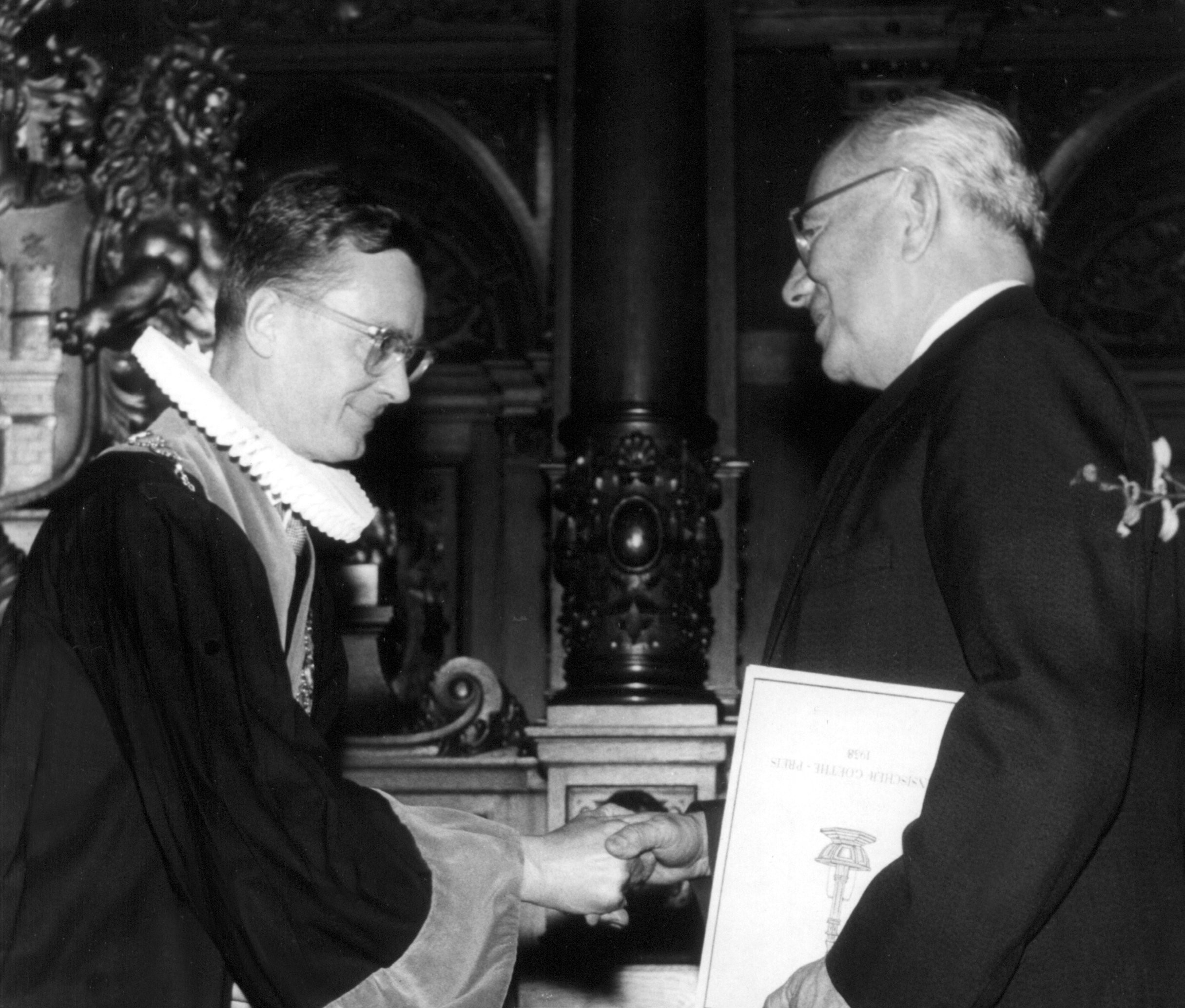
The rector of the University of Hamburg, Karl Schiller (L), presenting the Hansische Goethe Prize to the socialist theologian and philosopher Paul Tillich on July 1, 1958 during a celebration in the ballroom of the Hamburg City Hall. (Heidtmann / picture alliance via Getty Images)
Few tricks of the unsophisticated intellect are more curious than the naïve psychology of the business man, who ascribes his achievements to his own unaided efforts, in bland unconsciousness of a social order without whose continuous support and vigilant protection he would be as a lamb bleating in the desert.
Despite being a major political force in the nineteenth and twentieth centuries, the Left lacks a universally recognized “canon” of thinkers. This is especially true for democratic socialist and social democratic intellectuals, often viewed more as reformers, wonks, and tinkerers rather than as theorists or visionaries. As political philosopher Elizabeth Anderson has pointedly observed, it is “telling that in the history of political thought, no social democrat has been canonized, despite the huge influence of social democracy in many wealthy countries.”
In his magisterial Social Democracy in the Making: Political And Religious Roots of European Socialism, theologian Gary Dorrien shows that this absence of canonized figures is not due to a shortage of worthy candidates. Dorrien, who also authored an excellent book on American democratic socialism, highlights struggles faced by democratic socialist and social democratic intellectuals. They had to work against repression, uncertainty, and more than a little infighting while challenging the ideological dominance of bourgeois capitalism and working to integrate their ideas into the mainstream.