How Britain Became America’s Stooge
As Britain lost the ability to maintain its empire, the US took on the role of managing the global order. In Someone Else’s Empire, Tom Stevenson shows how American dominance, aided and abetted by Britain, has caused untold suffering across the world.
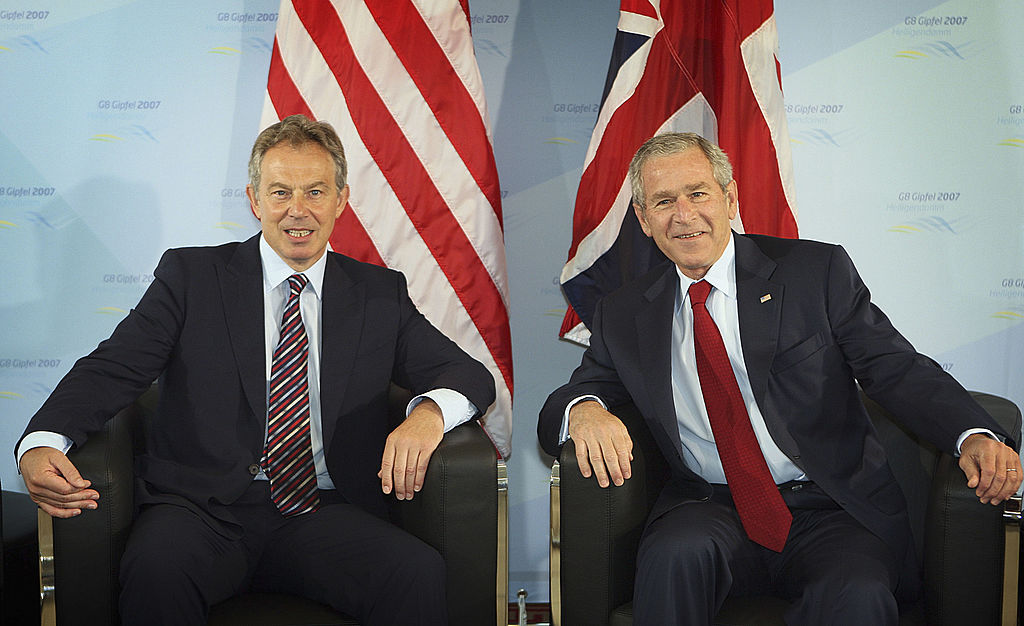
British prime minister Tony Blair holds a bilateral meeting with US president George W. Bush on June 7, 2007 in Heiligendamm, Germany. (Peter Macdiarmid / Getty Images)
Minor nations are not in need of grand strategies — those are the prerogative of major powers. It is no surprise, then, that as the United Kingdom ceded its status as a great power to the United States as World War II came to a close, the former engaged in a fundamental reorientation of its international outlook. Dean Acheson, the US secretary of state under President Harry Truman, was largely responsible for creating a euphemistic language that could protect British pride and Western hegemony. The declining empire need not, Acheson wrote to an American ambassador, be viewed as having been cast aside; rather, it had assumed the position of “lieutenant.” This new role entailed helping the American foreign policy establishment secure what it viewed as its country’s key geostrategic interests: the maintenance of Eurasia as a landmass on which the United States wielded the most significant influence; hegemony over the Pacific and Northeast Asia; and control over the Persian Gulf and its supplies of petroleum.
Allied victory and the containment of the Soviet Union secured the first of these aims; nuclear strikes on Japan the second; and Britain’s gradual handover of power to the United States in the Middle East guaranteed the third. In Someone Else’s Empire: British Illusions and American Hegemony, Tom Stevenson, a writer for the London Review of Books, explains the United Kingdom’s role in enforcing American dominance as part of an attempt to retain some global relevance amid decline. The fear of British elites was, Stevenson suggests, that their country was at risk of becoming a “greater Sweden” — prosperous but geopolitically irrelevant.
Almost eight decades on from the close of World War II, fealty to the United States remains part of Britain’s DNA. On leaving office, a disgraced Boris Johnson offered three pieces of advice to his would-be successor: “Stay close to the Americans; stick up for freedom for the Ukrainians; stick up for freedom and democracy.” Atlanticism is such a defining feature of politics across the political spectrum in the UK that no British prime minister since World War II has ever seriously questioned the fact that they ought to reflexively follow the United States’ lead.