I Live in Gaza. Israel’s Horrific Bombing Campaign Is Like Nothing I’ve Ever Seen Before.
In a harrowing dispatch from Gaza, Palestinian human rights activist and Gaza City resident Raji Sourani gives an account of daily life amid Israeli air strikes that are killing entire families. Despite it all, Palestinians in Gaza are clinging to hope.
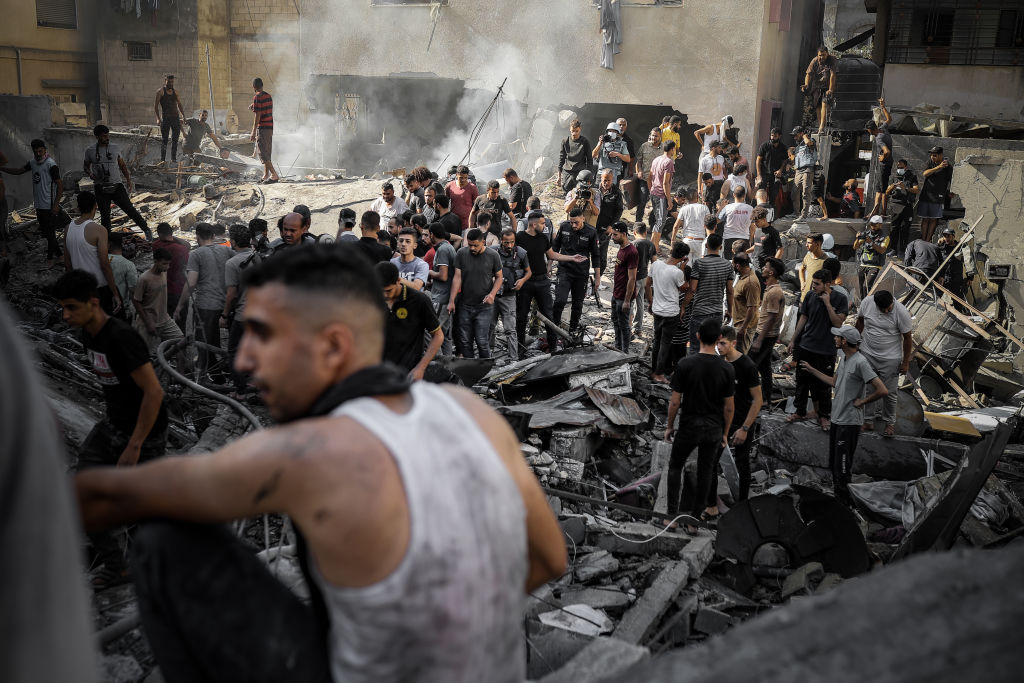
Aftermath of an attack on a building in Khan Yunis, Gaza, November 6, 2023. (Belal Khaled / Anadolu via Getty Images)
Once again, I found myself being rescued from a destroyed house. The first time this happened was when a bomb struck my family home in Tel al Hawa, a middle-class neighborhood in Gaza City. I was with my wife Amal and my adult son. In response to the nearby bombings that were violently shaking our house, Basal asked us to stay hidden in a corridor, ensuring that we would remain together in the event of a direct hit. A bomb struck nearby, destroying much of my family home and the small but beautiful garden I cherished outside. After that, we moved to another home, closer to the heart of Gaza City, only for it to succumb to the relentless bombing as well.
I have never experienced anything like this bombing. They are using airstrikes from F-16s, gunboats, Apache helicopters, and F-35s to instill terror in the minds and hearts of the people, leaving us with the sense that our only remaining option is to lose our lives and the lives of our dear ones. I am especially concerned for my family because I fear that human rights defenders will be a target just as journalists have been a target.
For the past three hours, the house has been shaking incessantly, and I can’t help but imagine the next bomb hitting this house. We have not slept for five days because of the bombing. During the day I try to walk around the city. The destruction is incredible. I cannot believe my eyes: entire families dead, shelters reduced to rubble, once towering residential buildings erased from existence, and the destruction of mosques churches, ambulances, journalists, bakeries, marketplaces, and United Nations Relief and Works Agency (UNRWA) schools.