The Left Can Form a New Government in Spain
Spain’s king has asked conservative leader Alberto Núñez Feijóo to try to form a government. Most MPs oppose him — and recent deals between the Socialists, left-wing Sumar and Catalan parties show that the broad left has every chance of staying in office.
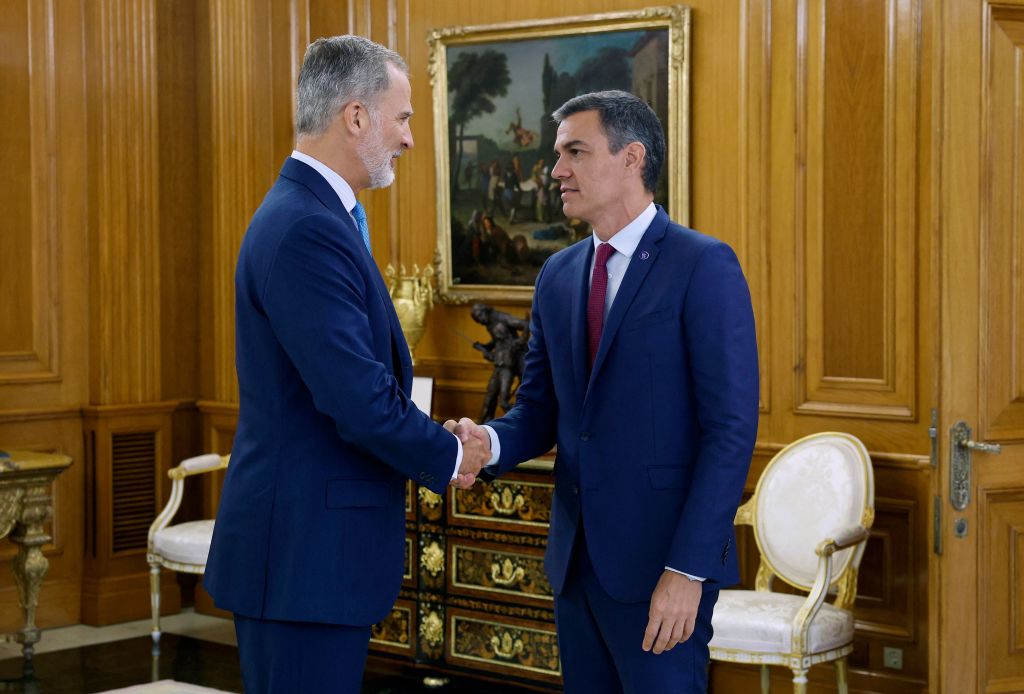
Spanish king Felipe VI receives acting prime minister Pedro Sanchez as part of the round of consultations with political representatives before proposing a candidate for the investiture, at the Zarzuela Palace in Madrid on August 22, 2023. (Chema Moya / Pool / AFP via Getty Images)
While all of Spain was busy celebrating the national team’s epic triumph in the women’s soccer World Cup, the country’s tormented political situation was also becoming clearer. In the corridors of power, something has shifted during these heatwave-stricken mid-August weeks. This, even if the final outcome is not yet written in stone — and unexpected turns could be just around the corner.
The general election this July 23 had, against all odds, brought a defeat for the combined forces of the Right. Half of Europe breathed a sigh of relief. The conservative Partido Popular (PP) came in first place as expected, but its 137-strong group of MPs is still short of an absolute majority in the 350-member Congress, even if we add in far-right Vox’s 33 legislators. Still, the situation remains complex. Given widespread predictions of looming defeat, the incumbent prime minister Pedro Sánchez (leader of the Partido Socialista Obrero Español, PSOE) may consider himself the effective political winner of July’s snap vote. Yet the 121 MPs elected for his party and the 31 for Sumar, the left-wing coalition led by Labor Minister Yolanda Díaz, remain just as far from the “magic” number of 176 seats.
In the last parliament, too, these left-wing forces governed as a minority, with the outside support of various nationalist and regionalist parties. But now, in addition to Esquerra Republicana de Catalunya (ERC, 7 seats), EH Bildu (6 seats), the Partido Nacionalista Vasco (PNV, 5 seats), and the Bloque Nacionalista Galego (BNG, 1 seat), Sánchez also needs the votes of Junts per Catalunya (JxCAT, 7 seats), the independentist party led by former Catalan president Carles Puigdemont from self-exile in Belgium. And JxCAT, it should be remembered, is not only a right-wing party with intransigent separatist positions, but has consistently voted against the government for the past four years. In short, it’s clear what the solution is to the current parliamentary gridlock — but not so obvious how it can be made to happen.