Rowland Brown’s Brutal Portraits of the Life of Crime
The gritty 1930s crime dramas of Rowland Brown offer contemporary movie watchers something they won’t easily get elsewhere: an adult ability to look directly at an infinitely corrupt world without flinching.
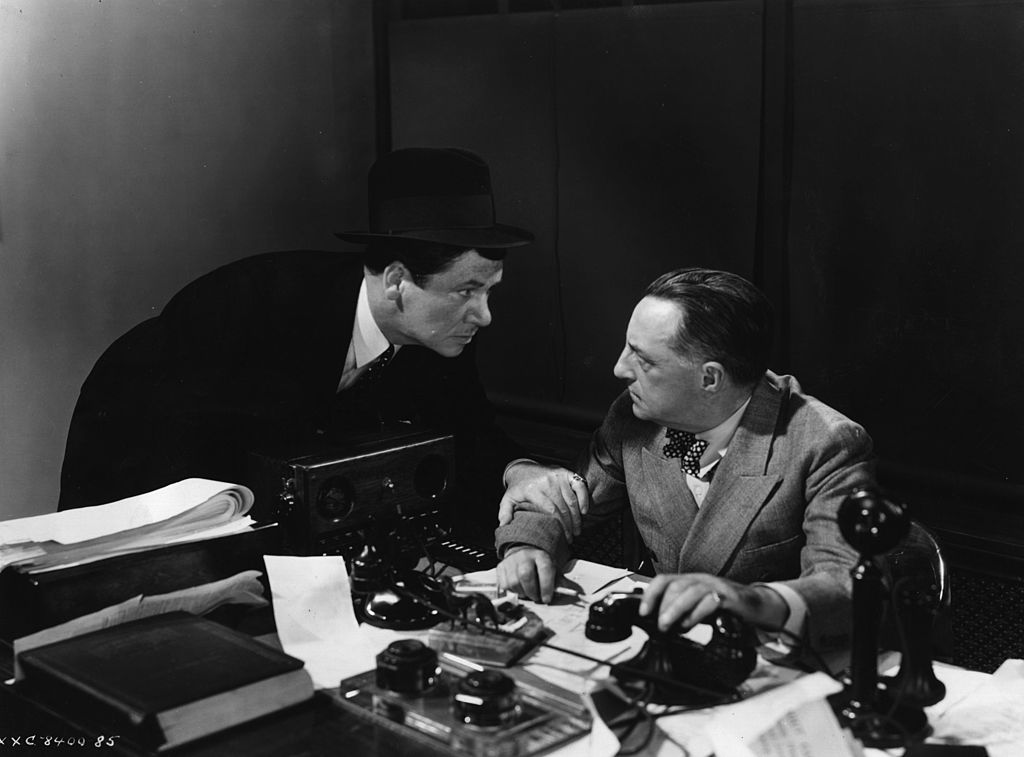
Actor George Bancroft leans urgently over a desk in a scene from the film Blood Money, directed by Rowland Brown for 20th Century Fox. (Hulton Archive / Getty Images)
There’s a current Criterion Channel series called Rowland Brown’s 1930s Underworld that’s worth looking at in terms of what Criterion calls a three-film series of “brutal, anticapitalist crime dramas” by the relatively little-known screenwriter-director of Quick Millions, Hell’s Highway, and The Devil Is a Sissy. They’re described as “some of the grittiest, most subversive and straight-up shocking films of the pre-Code era,” reliant on Brown’s “insider’s view of the underworld.” It seems that he had a short film career because of his refusal to compromise with producers’ demands, leading to a fistfight with one — possibly Frank Davis, the producer of Brown’s last American directorial effort, The Devil Is a Sissy (though he went on as a screenwriter). He was fired and replaced by W. S. Van Dyke.
It seems that Brown was either a hothead, always spoiling for a fight, or was that one honest man Diogenes was hunting for. Either way, he had a sharply curtailed directing career.
Even in an era of colorful characters making it big in Hollywood, when gangsters loomed large as controlling forces in the entertainment industry (in addition to being socially popular), he stood out as a lurid figure. Brown was rumored to be an ex-prizefighter, an ex-bootlegger, an alcoholic, a friend to well-known gangsters, and a communist. He walked out on projects repeatedly, refusing to tolerate interference with his vision of cinematic art grounded in a harsh reality of which he claimed to have firsthand experience.