Kamala Harris Poured Some Old Wine Into New Bottles on Her Tour of Africa
Media reports presented Kamala Harris’s recent trip to Africa as a historic departure for US policy toward the continent. Beneath the hype, however, the Biden administration is carrying on with the same militarized, self-serving approach as its predecessors.
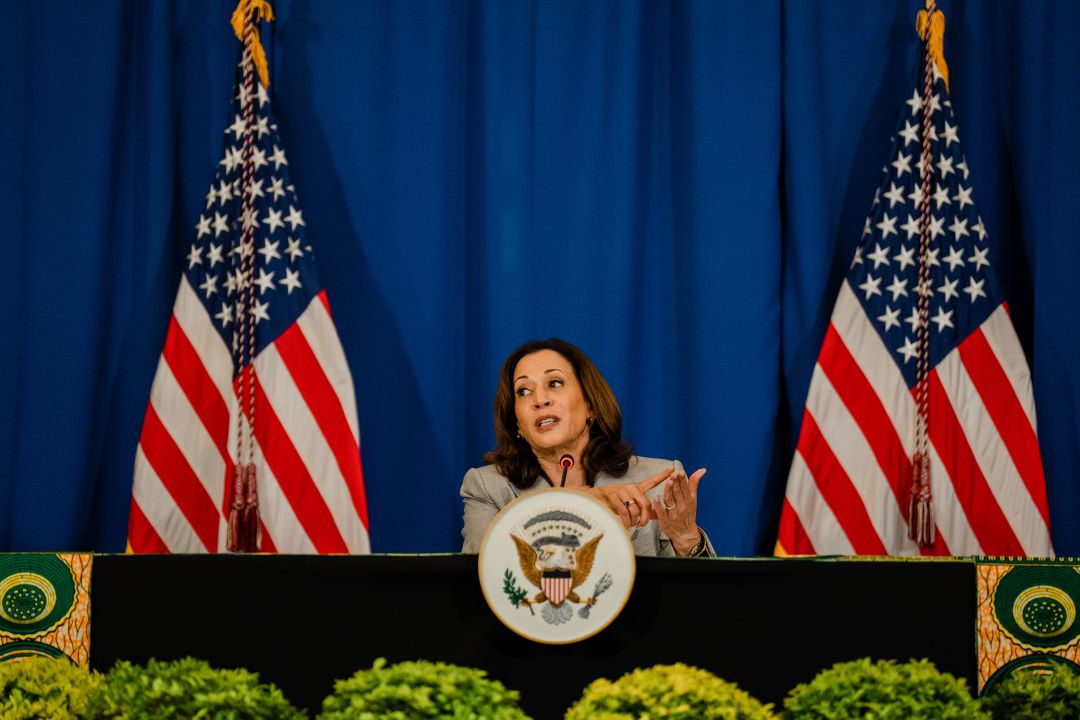
Vice President Kamala Harris delivers remarks during a meeting with business and philanthropic leaders at the InterContinental Hotel on Saturday, April 1, 2023, in Lusaka, Zambia. (Kent Nishimura / Los Angeles Times via Getty Images)
As global political and economic crises pit the United States against Russia and China, African people and resources have once more become the target of foreign interest. The new Cold War has brought high-level delegations from all three countries to the continent with promises of trade, aid, and investment in exchange for strategic resources and political loyalty. In the case of the United States, Vice President Kamala Harris’s recent trip (Ghana, Tanzania, and Zambia) was preceded by visits from the first lady (Namibia and Kenya), secretary of state (Ethiopia and Niger), secretary of the treasury (Senegal, Zambia, and South Africa), and UN ambassador (Ghana, Mozambique, and Kenya). President Joe Biden is expected to call on the continent by the end of the year.
Harris’s mission was to convince her African interlocutors that the United States is concerned about Africa for its own sake, not only because of the growing influence of China and Russia in the world’s second-most populous, resource-rich continent. She built on the message articulated at the US-Africa Leaders Summit hosted by the Biden administration in December 2022, which emphasized public and private economic investment, the granting of preferential trade agreements, and access to more affordable financing.
Having long prioritized counterterrorism as its main concern on the continent, the US has a lot of catching up to do. China has surpassed it as Africa’s most important trading partner, the former’s $250-billion commerce in 2021 dwarfing US-Africa trade worth $64 billion the same year. The continent is a major source of the minerals needed to produce electric vehicles, laptops, and smartphones, and for the clean energy technologies that combat climate change.