Building a Community of Disabled Workers Changed My Relationship with My Union
Unions aren’t just for fighting for better pay and benefits. They can also be tools for disabled solidarity.
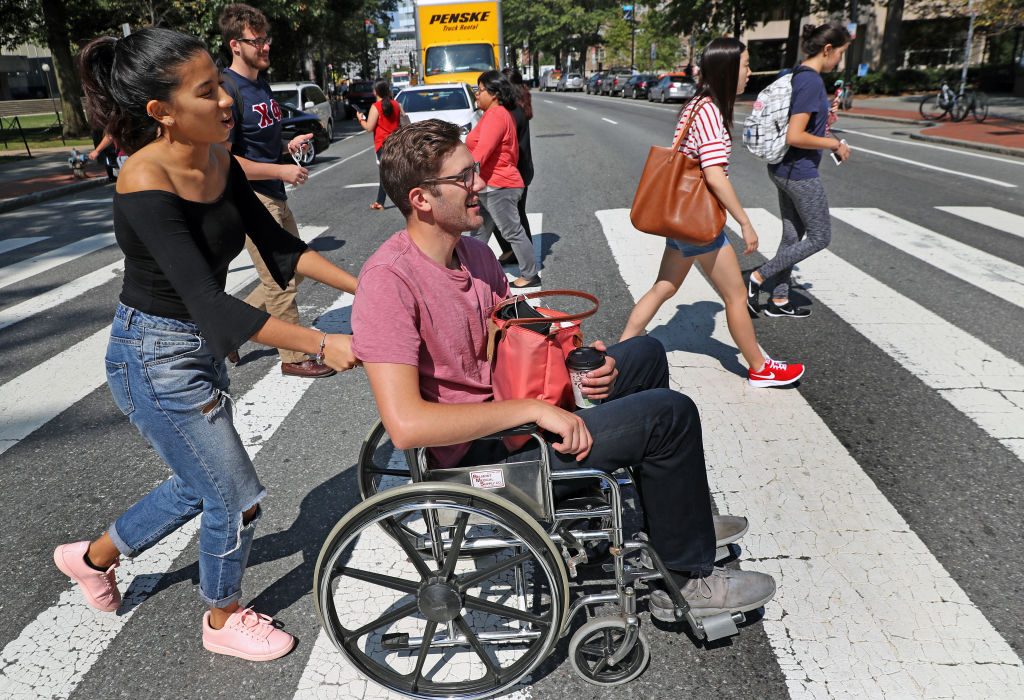
Student at Michigan Institute of Technology is pushed in a wheelchair by classmate. (David L. Ryan / the Boston Globe via Getty Images)
Before I started graduate school, if you asked me how I felt about unions, I would have enthusiastically told you how much I loved them. Having been a teacher in both unionized and nonunionized workplaces, there was no convincing me otherwise: unions are essential for ensuring workers’ rights. As I started graduate school in 2020, I was excited to find colleagues who were as invested in and committed to unions as I was. By spring 2021, I was an active member of our growing organizing committee.
Together, we read about rank-and-file unionism, spoke to as many graduate students across Boston University (BU)’s sprawling campuses as we could, and built a democratic worker-led movement that was committed to improving the lives of graduate workers. It was our issue-based campaign about COVID-19 safety at the height of the Omicron surge, however, that deeply changed my relationship with my union and the larger labor movement.
I am disabled. My disabled identity is core to how I understand, move, and experience a world that is built for nondisabled people. As a worker, existing in this world means most jobs assume that those with disabilities are not a part of their workforce, which too often results in deeply hurtful comments and actions that position disability as shameful or something to overcome and fix. It also fosters isolation and an overwhelming feeling of not really belonging.