How University of California Strikers Snuck Past Security and Gave the Bosses Hell
Like something out of a heist movie, the biggest strike of last year ended with a carefully orchestrated direct action involving spycraft and disguises. The mission: to disrupt a meeting of University of California regents and force the administration’s hand.
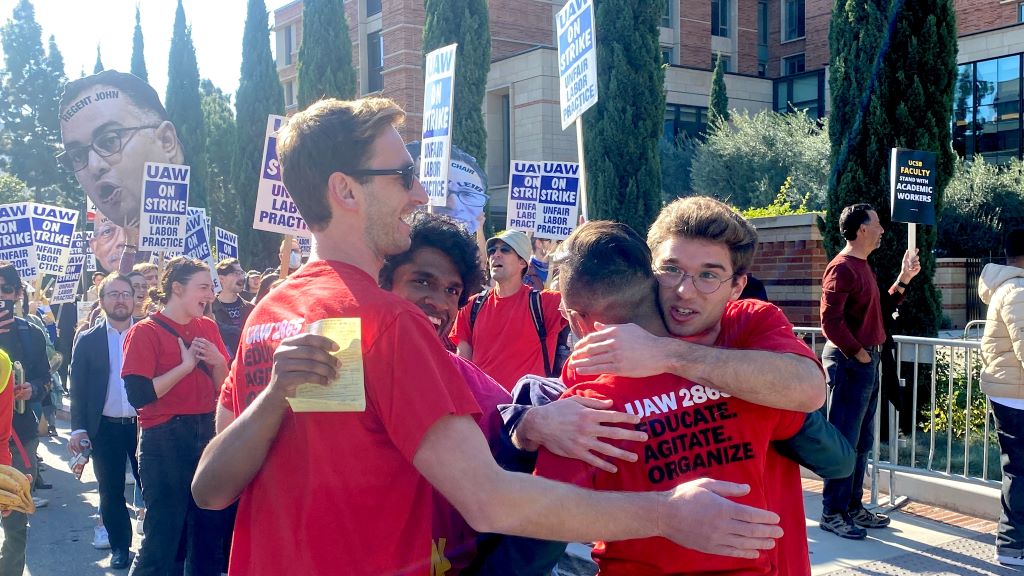
The first group of arrestees celebrating right after being released and meeting picketers outside during University of California strike action in Los Angeles, December 14, 2022. (Shota Vashakmadze)
By early December 2022, striking members of United Auto Workers (UAW) 2865 and Student Researchers United–UAW had brought University of California operations to a halt. What began with a majority work stoppage and high-participation pickets had expanded into an array of disruptive tactics. Picketers diverted deliveries before dawn and orchestrated strategic building takeovers that shut down campus research and teaching. The effects were immediate: our public campaign garnered astounding local and international support, while our strike actions made business as usual impossible for the university. Yet despite this impact, the university’s bargaining team still refused to make any significant movement toward our demands.
After weeks of attempting to break this deadlock, members were eager to further escalate our tactics and provoke a direct response from the university, heeding the advice of labor strategist Jane McAlevey. Opinions varied about what shape this escalation should take, but as conversations on the picket line turned into conversations across campuses, the university’s Board of Regents emerged as a clear target. In a series of disruptions designed to directly confront their intransigence, we would leverage the mass action of a high-participation strike and the direct actions of small organizing teams engaging in civil disobedience. This campaign would culminate with a disruption of the quarterly Board of Regents meeting scheduled on December 14 at the Luskin Center, UCLA’s $162 million conference hotel.
Amid the intense pressure of thousands rallying outside the building and waves of disruption to the meeting inside, university president Michael Drake sidestepped negotiators and finally conveyed a serious offer: 55–80 percent raises for teaching assistants, tutors, and readers, and 25–80 percent raises for student researchers phased in over the two-and-a-half-year contract. After dozens of actions and scores of planned arrests, this offer came as a response to not only the high-stakes disruptions themselves, but to the high level of organization our union had demonstrated in planning, executing, and sustaining the escalation campaign. In short, while the targeted disruptions each had an impact, the larger campaign also conveyed that, until a real offer was on the table, we would not stop. President Drake made these concerns explicit when delivering the offer, imploring the voluntary mediator that our workers halt the actions and leave the regents alone.