Unnecessary Traffic Stops by Police Make Public Safety Worse
All too often in America, stops for minor traffic offenses turn into deadly episodes of police violence.
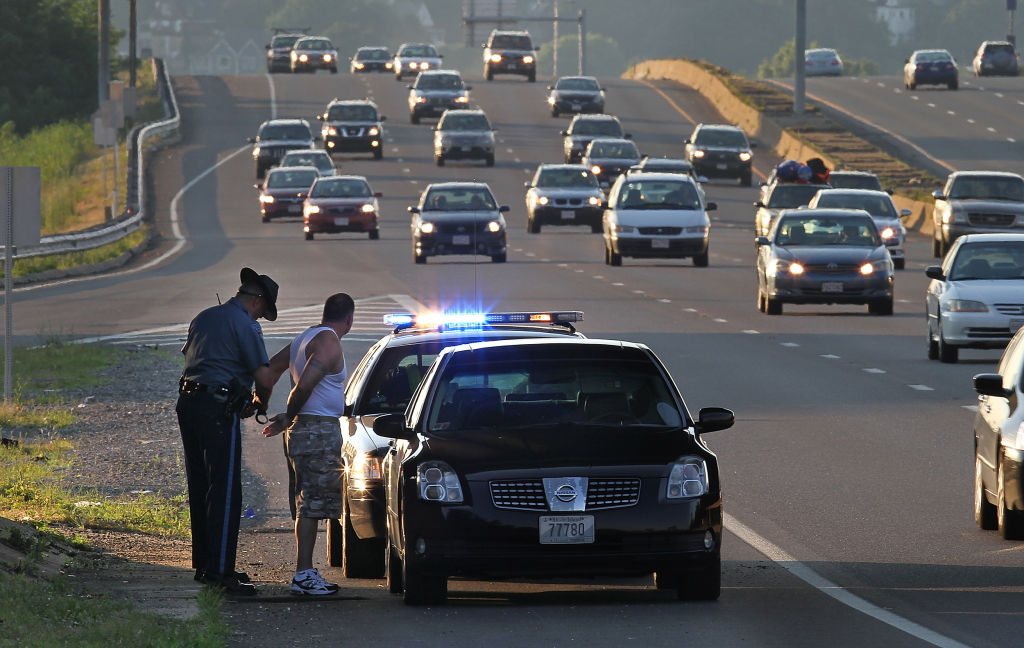
A Massachusetts state police officer performs a traffic stop on I-93. (Matthew West / MediaNews Group / Boston Herald via Getty Images)
Tyre Nichols was just two minutes away from his house when a group of Memphis police officers from the city’s so-called Scorpion unit pulled his car over. When Nichols was taken out of his vehicle, his protest was simple. “I didn’t do anything,” he can be heard saying in police body camera footage.
Less than an hour later, Nichols was en route to the hospital, having suffered a police beating that would ultimately claim his life. In the aftermath of Nichols’s death, the Memphis Police Department disbanded the Scorpion unit that was designed to target crime in the city’s poorest neighborhoods.
It is also, now, considering limiting how and why police can make traffic stops — a familiar municipal response to a brutal episode of police violence in a country where, according to data from Mapping Police Violence, police have killed more than eight hundred people following traffic stops since 2017. The victims of that violence have, like the victims of all police violence in the United States, been disproportionately black. In the aftermath of particularly high-profile police killings, like that of Patrick Lyoya in Grand Rapids, Michigan, Daunte Wright in Brooklyn Center, Minnesota, and Nichols in Memphis, media outlets like the New York Times and the BBC have run stories asking the same basic question: What is it about traffic stops that causes them to turn deadly?