The Revolt in Iran Is Rallying Its Diverse Working Class
The Jina revolution in Iran has seen powerful solidarity between women demanding freedom, oil worker unions, and minorities. Far from the elite reformism of diaspora opposition leaders, the revolt in Iran expresses the radicalism of a diverse working class.
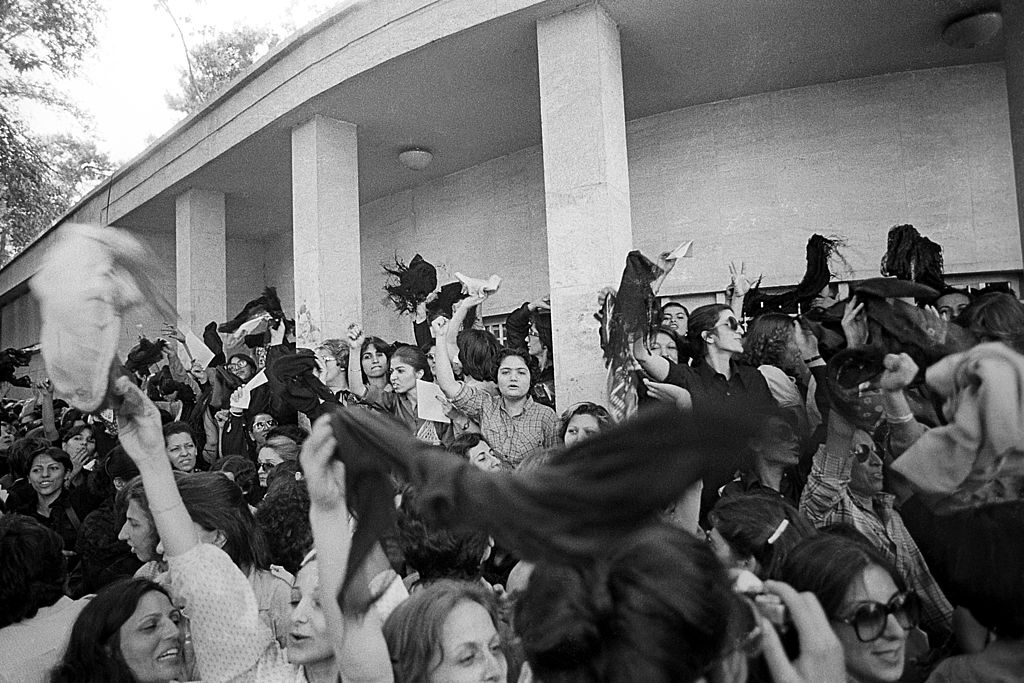
A group of women protest against wearing the veil, while spinning their veils in the air, outside the prime minister’s offices, July 6, 1980, Tehran, Iran. (Kaveh Kazemi / Getty Images)
Protesting crowds, clapping and chanting azadi, azadi, azadi, surround a police car, pushing it until the vehicle tips over. A girl with a covered face, her hair in a tight ponytail, climbs on the car and holds up a black scarf she has set alight. Amid the flames, the garment turns red and disappears, as the crowd continues to chant the word for “freedom.”
In a statement on International Women’s Day, the Council for Organizing Contact Oil Workers’ Strikes wrote in solidarity with women burning their veils in cities all over Iran. They spoke of the unity of their cause: “we all know that for the regime, religion, gendered discrimination and violence, under the banner of the compulsory veil, are tools for the depredation and oppression of not only women, but also us workers and all the people who live in the vast country of Iran. Compulsory veiling must be dismantled — and we protest any form of discrimination and inequality.”
The Women, Life, Freedom revolution, ignited by the brutal state murder of Kurdish woman Jina (Mahsa) Amini last September, has been a political high point, bringing together a variety of popular struggles against the government. Also known as the Jina revolution, it has become the most remarkable challenge to the Islamic Republic since its formation in 1979. For the first time, the political demands of not only women, but the working class, ethnic and religious minority groups, and LGBTQ individuals have been made visible. This has also impacted the demands of the Left and the relations among the different movements of which it is composed.