We Can Only Go Beyond Communism by Coming to Terms With Its History
Thirty years ago today, the Soviet Union collapsed. Twentieth-century communism should be understood in all its complexity, as revolution and regime, a spur to anti-colonialism and an alternative form of social democracy.
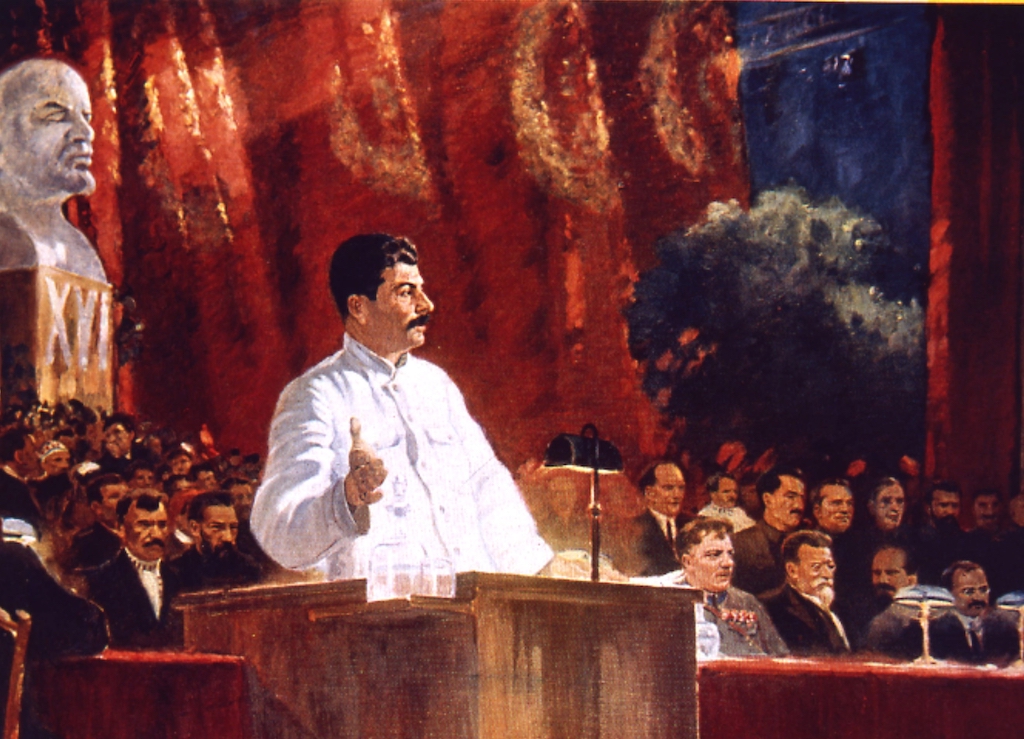
Joseph Stalin addressing the Sixteenth Congress of the Russian Communist Party, 1930. (Universal History Archive / Getty Images)
The legacy of the October Revolution is torn between two antipodal interpretations. The rise to power of the Bolsheviks appeared, on the one hand, as the announcement of a global socialist transformation; on the other hand, as the event that set the stage for an epoch of totalitarianism. The most radical versions of these opposed interpretations — official communism and Cold War anti-communism — also converge insofar as, for both of them, the Communist Party was a kind of demiurgic historical force.
Several decades after its exhaustion, the communist experience does not need to be defended, idealized, or demonized. It deserves to be critically understood as a whole, as a dialectical totality shaped by internal tensions and contradictions, presenting multiple dimensions in a vast spectrum of shades, from redemptive élans to totalitarian violence, from participatory democracy and collective deliberation to blind oppression and mass extermination, from the most utopian imagination to the most bureaucratic domination — sometimes shifting from one to the other in a short span of time.
Like many other “isms” of our political and philosophical lexicon, communism is a polysemic and ultimately “ambiguous” word. Its ambiguity does not lie exclusively in the discrepancy that separates the communist idea from its historical embodiments. It lies in the extreme diversity of its expressions. Not only because Russian, Chinese, and Italian communism were different, but also because in the long run many communist movements underwent deep changes, despite keeping their leaders and their ideological references.