Economists’ Obsession With “Efficiency” Is Just an Endorsement of Greed
The global economy is “efficient” alright: it efficiently funnels wealth to the top while leaving most of humanity behind.
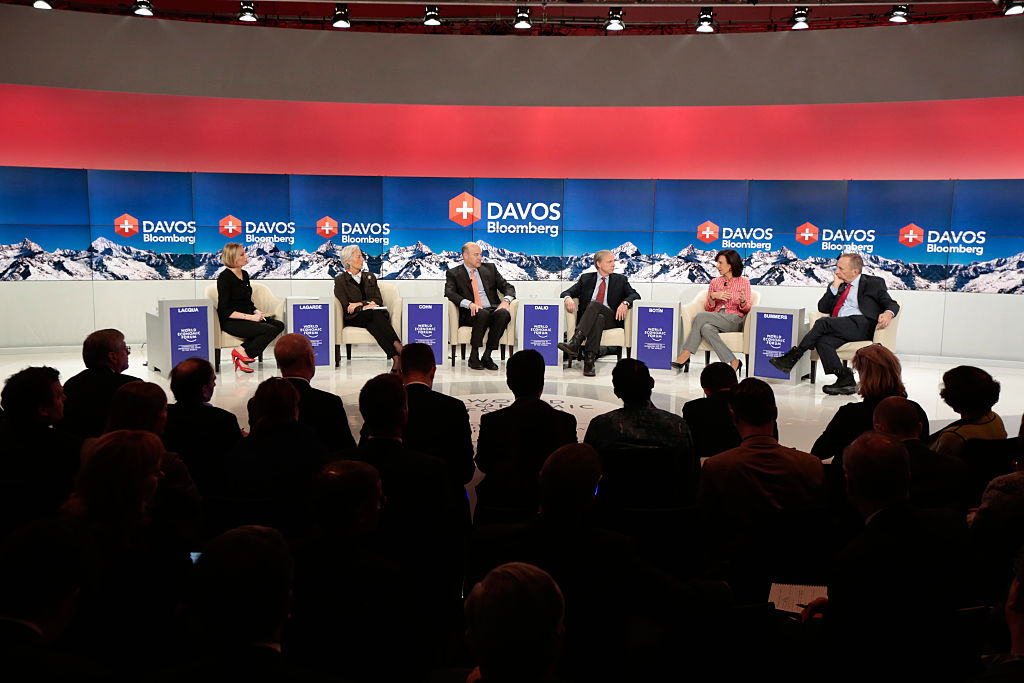
Prominent figures in the world of finance and economics, including Christine Lagarde, Gary D. Cohn, Ray Dalio, and Lawrence Summers, on a panel at the World Economic Forum in Davos, Switzerland, January 22, 2015. (Jason Alden / Bloomberg via Getty Images)
When discussing markets, “efficiency” is a trick word. In everyday use or in disciplines like engineering, efficiency has a positive meaning, typically implying wise allocation of resources. But in economics the word is what translators call a “false friend,” a term you think you recognize but which others aren’t using in a way that matches your definition. Markets are frequently said to be “efficient” when they are in fact wasteful, chaotic, unethical, and harmful to the people they’re supposed to serve — as long as they swiftly deliver profit to the top.
Thankfully, the mix-up is becoming more visible to some influential economy watchers. In her book Homecoming: The Path to Prosperity in a Post-Global World, journalist Rana Foroohar hopes that “Panglossian ideas about the efficiency of unregulated markets will begin to fade.” She observes that industrial agriculture has an almost universal reputation for being efficient, when in fact its so-called efficiency “has come at great cost to everything, from our health to our food security to working conditions . . . not to mention the treatment of animals, and of course the disastrous consequences of it all for our environment.” What passes for efficiency often comes at the expense of resilience, Foroohar writes, and as a result severe system-wide fragilities have been introduced into the global economy, which guarantee supply-chain issues whenever there’s a disruption like war or a pandemic.
Foroohar is not alone in her observations. Sociologist Elizabeth Popp Berman’s book Thinking Like an Economist: How Efficiency Replaced Equality in US Public Policy recounts the rise of an “economic style of reasoning” in the policy-making of both Democrats and Republicans — let’s call it econ-mode. In this process, efficiency was enthroned as “the cardinal virtue” of policy, becoming a substitute for the idea of public interest. Cost-benefit analysis became mandatory; where once pollution could be considered just plain wrong, econ-mode could justify it if the benefits could be made to look greater than the costs. Ethical reasoning came to be considered “economically illiterate.” Berman writes that econ-mode “does not allow for commitments to absolute principles.” And since “claims about rights, justice, or liberty [shouldn’t be] weighing their costs,” we must be alert to the risks of efficiency-only arguments.