Canada Loves to Shower Fossil Fuel Companies With Public Money
Between 2018 and 2020, Canada ranked as the world’s top subsidizer of the fossil fuel industry. Now the province of Alberta is trying to outdo the nation by paying oil and gas producers to fulfill their legal obligation to clean up their own mess.
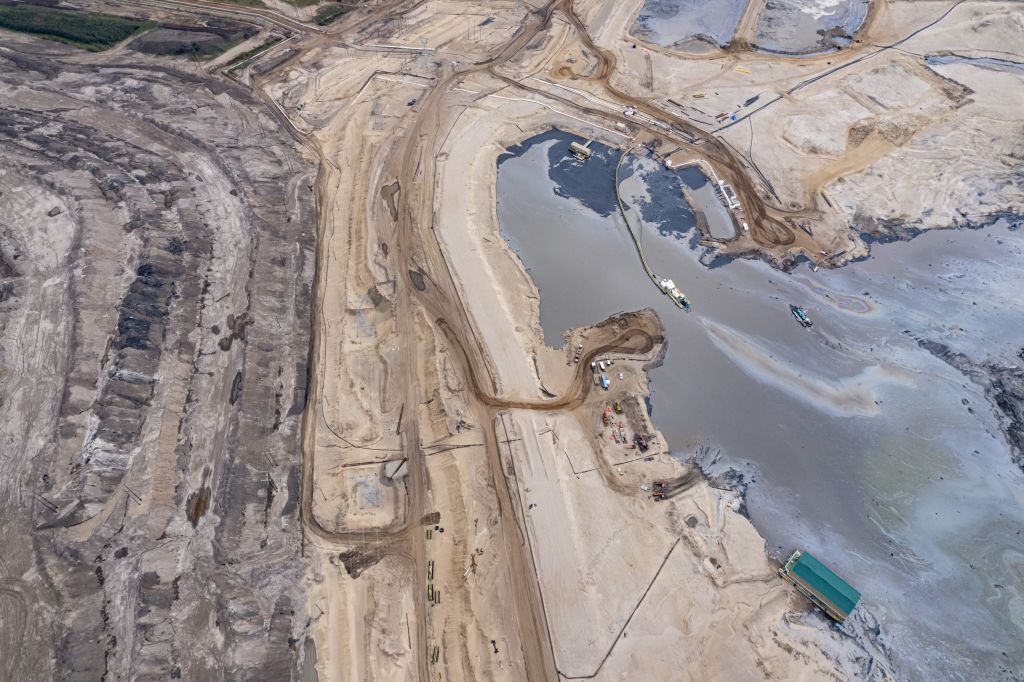
At Fort McKay, Alberta, in the heart of Canada’s boreal forest, the pines and people were long ago cleared out to make way for huge open-pit mines dedicated to the excavation of oil sands. (ED JONES / AFP via Getty Images)
Alberta premier Danielle Smith has introduced a plan to reward oil and gas companies — which have been producing and profiting at record levels — for cleaning up the environmental mess their projects have left behind, which they’re already required to do by law. What’s more, Smith lobbied the government to adopt this proposal as recently as last year, when she was still a corporate lobbyist.
This means that in the very recent past, when she was on the other side of the revolving door between the private sector and government, Smith was representing the interests of the very companies she’s now seeking to subsidize. Smith’s initial proposal was rejected by then energy minister Sonya Savage. Savage deemed the proposal beyond the pale, despite being a former oil and gas lobbyist herself. In the interim, Smith replaced Savage with Peter Guthrie, a legislator who supports her hairbrained proposal, resulting in the potential advance of a $100 million pilot. Smith revealed on February 24 that the program’s implementation rollout will be delayed until the fall, making the provincial election scheduled for May in part a referendum on this subsidy to big oil and gas companies.
To drill for oil in Alberta, companies have to pay royalties to the provincial government, which, on paper, owns the resources. During the austerity bonanza of the 1990s, this rate was greatly reduced at the urging of industry. Despite efforts to change rates in 2007 and 2015, they haven’t been increased since. The so-called R-Star program would reduce these rates even further if companies fulfill their environmental obligations under the long-standing “polluter pay” principle.