Abraham Lincoln Is a Hero of the Left
From Karl Marx to Eugene Debs to 1930s American Communists, leftists have regarded Lincoln as a prolabor hero who played a crucial role in vanquishing chattel slavery. We should celebrate him today as part of the great radical democratic tradition.
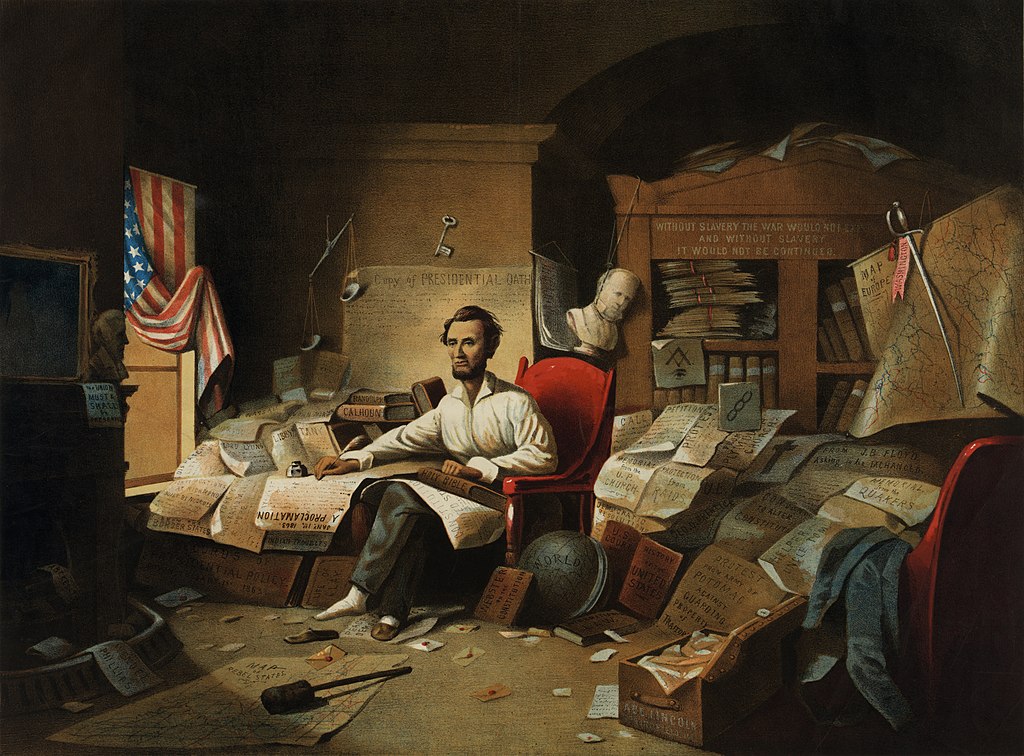
A print based on David Gilmour Blythe’s painting of Abraham Lincoln writing the Emancipation Proclamation. (Library of Congress via Wikimedia Commons)
Eugene Debs knew he had enormous shoes to fill — the type of expectations that could only be met with history and myth. As early as 1894, while head of the short-lived American Railway Union, admirers began to compare the embattled labor leader to another Midwesterner, Abraham Lincoln. Hearing Debs speak that summer, former abolitionist John Swinton saw in the Indiana native a “new western leader in the struggle for labor’s emancipation.” Like Lincoln, Debs was a “foe of slavery” who championed working people, and his Socialists represented the “logical sequence” in an emancipatory politics that began with the early Republican Party. A growing body of followers agreed, and the names “Lincoln” and “Debs” soon appeared side-by-side in the press as part of a new cultural memory within the labor left.
Debs leaned hard into the analogy. He and other Socialists consistently reached back to the previous century to frame socialism as a homegrown political tradition and draw lessons from the Civil War era — from John Brown, Wendell Phillips, and, perhaps especially, Lincoln. Leading a vigil at Lincoln’s Tomb in the fall of 1906, Debs proclaimed that as long as capitalist domination and the slavery of wages persisted, Lincoln’s work remained unfinished. “Slave power,” he declared from the mausoleum terrace, “which loathed and despised Lincoln, was no more heartless than the power of capitalism, which to-day holds the workingmen of the Nation in bondage.” Although most Gilded Age and Progressive Era Socialists agreed that the fight against “wage slavery” required a “new emancipator,” the original emancipator was never far from their minds.
Published four years later, first in the Chicago Daily Socialist and then in pamphlet form, party activist Burke McCarty’s Little Sermons in Socialism by Abraham Lincoln exemplified the leftist affinity for the sixteenth president. “We do not claim that Abraham Lincoln was a Socialist, for the word had not been coined in his day,” McCarty explained. “We do not claim that he would, if he had lived, been a Socialist today, for we do not know this.” What McCarty did claim is that Lincoln was a product of the laboring classes and that, for the entirety of his political career, his sympathies remained with working people. Although he was not a revolutionary per se, McCarty admitted, Lincoln nevertheless grasped the “central concept” of socialism: the primacy of labor over capital, and of liberty before property.