Taiwan’s History Shows Why We Need a Global Democratic Order
Taiwan has been subject to the machinations of great powers for much of its history. A better international order would ensure that all nations, big and small, have an equal voice in the global arena.
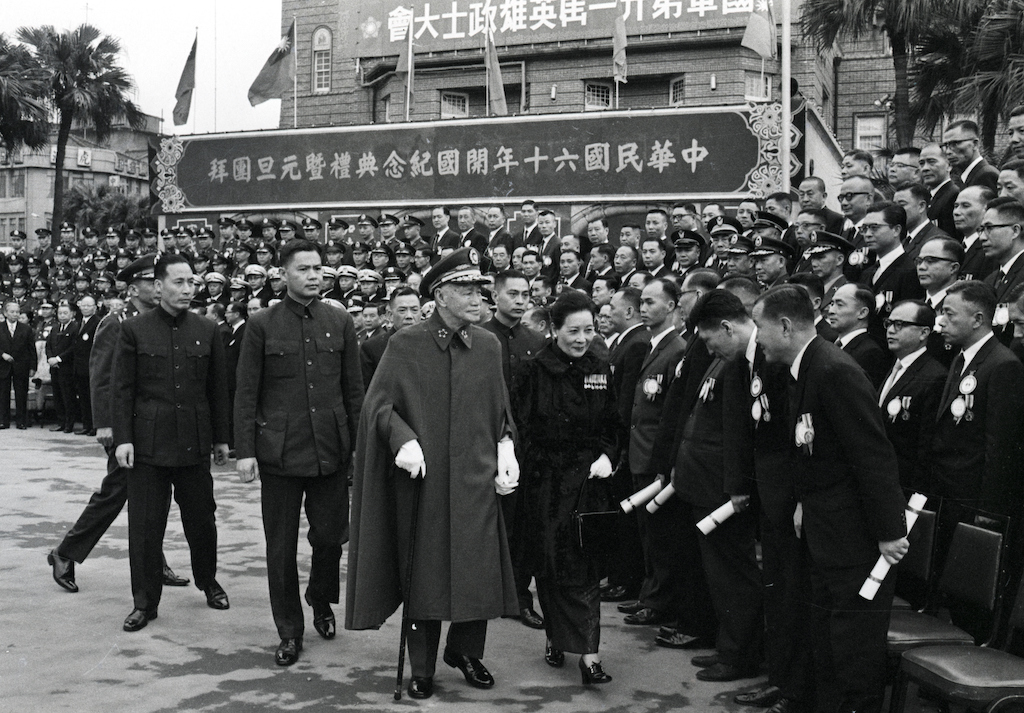
Chiang Kai-shek and his wife walk past government officials, military leaders, and servicemen in Taipei, Taiwan, after attending the rally marking the 60th anniversary of the Republic of China. (Getty Images)
Taiwan. The Republic of China. Chinese Taipei. Taiwan, Province of China. Formosa. All of these names refer more or less to the same place, though that’s not immediately obvious. What gives? Why is Taiwan only sometimes known as “Taiwan”?
Taiwan’s international status, or lack thereof, traces back to its occupation under the Chinese Nationalist government, and to a decades-long international political conflict that played out in the United Nations and in private agreements among great powers.
Taiwan Before “Taiwan”
Beginning in the seventeenth century, Taiwan was often a part of larger empires. European empires, like the Dutch and Spanish, briefly claimed and administered parts of the island, taking lands from Indigenous Taiwanese and encouraging migration of Chinese laborers to the island. Under the Qing, the last of China’s imperial dynasties, Taiwan was administered as a frontier territory — first a prefecture, then a province. In 1895, the Japanese took control of the island as a prize of the First Sino-Japanese War. Japan sought to turn Taiwan into a model colony for the rest of its empire, while ascribing second-class status to Taiwanese citizens. For a few months before the Japanese secured control of Taiwan, there was a short-lived “Republic of Formosa” (borrowing the name given to Taiwan by Portuguese sailors, who called it Ihla Formosa or “beautiful island”) declared by remnant Qing officials who resisted the handover of Taiwan to Japan. Aside from those few months in 1895, Taiwan was in effect a colonial holding.