In the Late 1800s, the Knights of Labor Tried to Build a Working-Class Internationalism
Too often, the US labor movement has favored narrow nationalism over cross-border solidarity. But in the late 19th century, the US-based Knights of Labor preached a working-class internationalism that sought to organize workers throughout the globe.
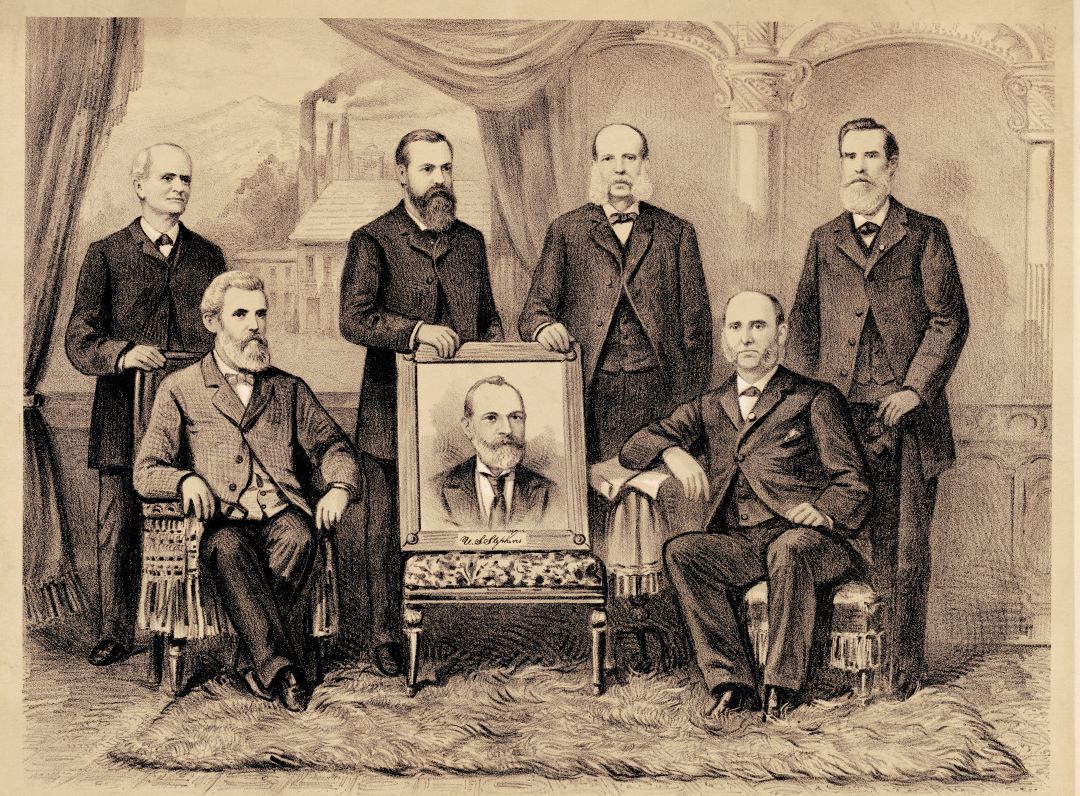
Print shows a group portrait of the founders of the Knights of Labor. Left to right: William Cook, James S. Wright, R. C. Macauley, James M. Hilsee, Robert W. Keen, and Joseph Kennedy. The framed portrait in the center of the image is of Uriah Stephens, the founder of the Knights of Labor, who died in 1882. (HUM Images / Universal Images Group via Getty Images)
The US labor movement and international solidarity have not often gone together. For much of the twentieth century, American labor leaders showed scant interest in the world outside North America. When they did, they frequently served more faithfully as ambassadors for their governments than their own movements, as when officials of the American Federation of Labor (AFL) urged the workers of Russia and other Allied countries to keep fighting World War I or when their successors pursued the Cold War policies of the State Department and the CIA in Latin America.
But there have always been other traditions and organizations, sometimes only dimly remembered, that strove for international solidarity with workers elsewhere. One of them was the late-nineteenth-century Knights of Labor, the first truly national organization of the US working class. It later became a broad international movement, with branches on four continents, and with dreams of what its founder, Uriah Stephens, foresaw as “an organization that will cover the globe” that “will include men and women of every craft, creed, and color.”
A Brief History of the Knights
Stephens and six other Philadelphian tailors founded the Knights as a secret society in 1869. They practiced a Masonic ritual, chalked announcements of meetings in code on public walls, and slowly moved in on the spaces left by the wreckage of trade unions in the depression of the 1870s. By 1886, they boasted nearly a million members — men and women, white and black, working in all branches of wage labor, from coal mines to textile mills and sugar plantations.