How Julius Evola Became the Internet’s Favorite Fascist
The fascist writer Julius Evola is loved by monologuing YouTubers, Greece’s far-right Golden Dawn party, and Steve Bannon. The hallmark of his work is a rejection of modernity, and his popularity is owed to the persistence of antidemocratic ideas on the Right.
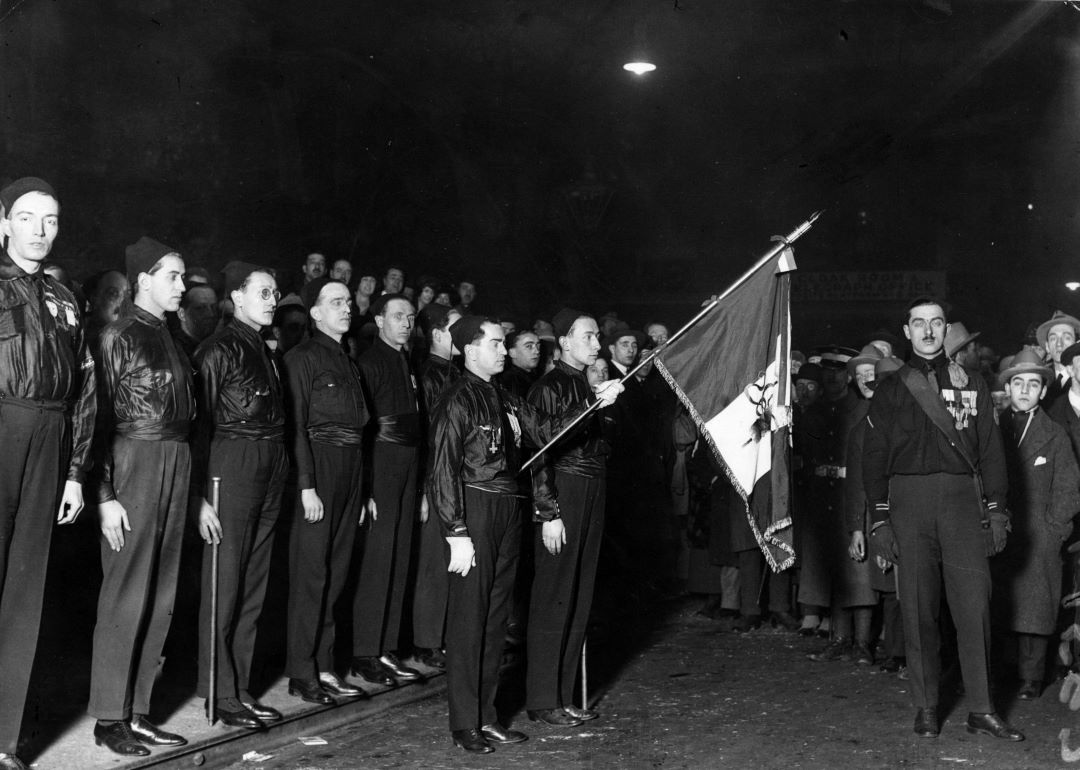
Commander D’Amelio Mario and the fascist guard prepare for the arrival of Benito Mussolini, 1922. (Topical Press Agency / Getty Images)
At one point in Donna Tartt’s The Secret History, our protagonist, a shiftless Californian in search of class and culture at a sequestered, elite East Coast College, talks about the feeling he gets when he studies Ancient Greek late into the night. Breaking from the reverie, he says that in this he sees, briefly, the world with “5th century eyes,” a world “disconcertingly sluggish and alien, as if it were not their home.”
I thought about this line a lot as I sat doing the emails and admin that make up so much of contemporary life and listening to nasal American crypto-fascist men stumble over the words of Julius Evola on YouTube. Wouldn’t we all like to see the world with fifth-century eyes? To have rituals that bind us to eternity, to spans deeper and truths larger than ourselves, and to not have to commute and wait for things to load and feel our lives to be small, disconnected slivers?
A Made-Up Tradition
If there is an intellectual movement that holds such an attainment close to its heart, it is Traditionalism, a once obscure school of twentieth-century thought among whose key thinkers is the oft-discussed Evola. Born in Italy in 1898, he was raised Catholic — a belief system he was to reject early in life — and later fought as a young man in World War I. After the war’s end, he became briefly involved in the Italian modernist art movement Futurism, and then, after forming a friendship with the French and Romanian poet and artist Tristan Tzara and developing a close affinity for Dada, he first met Benito Mussolini. Evola’s interest in art waned early, however, and by the age of twenty-four he had stopped painting entirely. In the late 1920s, he turned to writing, establishing the philosophy, a mix of politics and occultism, that would be his life’s work.