We Should Go Beyond Liberalism, Not Abandon It
The eminent philosopher Raymond Geuss wants us to think about ways of being that exist entirely outside of liberalism. But the most feasible egalitarian project is not one that rejects liberalism, but one that goes beyond it — through democratic socialism.
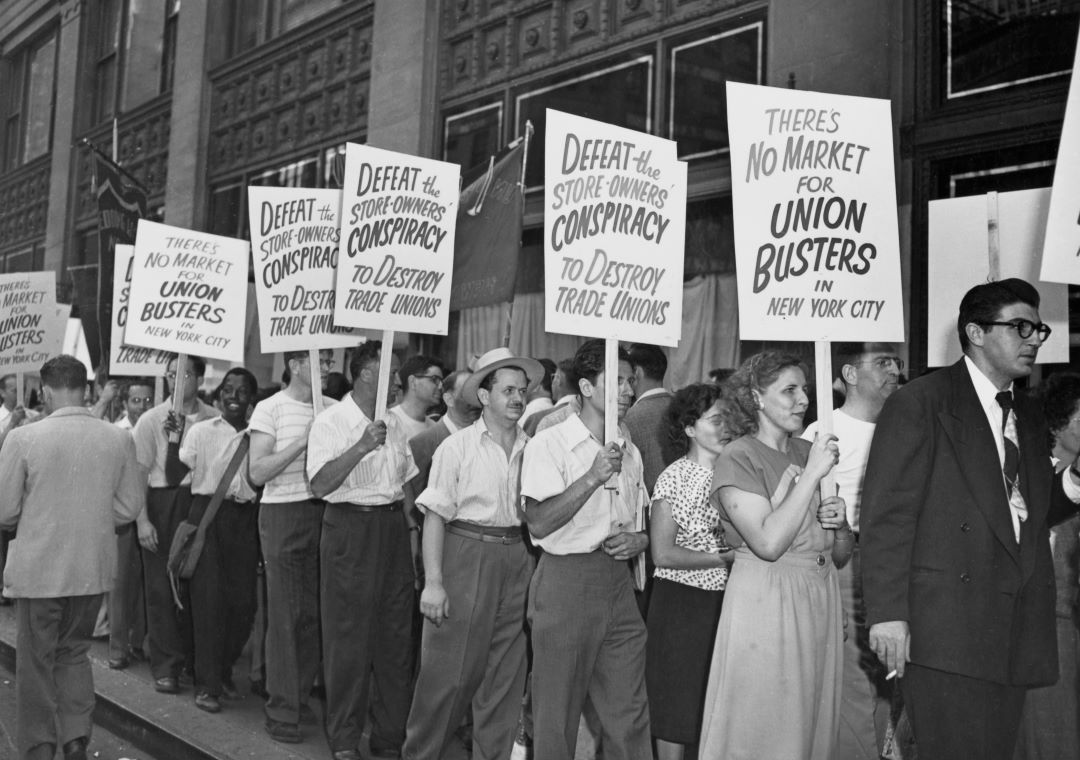
Picket in protest at a congressional probe of purported Communist influence in department store unions, at Gimbels department store in New York City, New York, July 1948. (European / FPG / Archive Photos / Hulton Archive / Getty Images)
“A liberal is a man too broadminded to take his own side in a quarrel.”
Robert Frost
I came to my own liberalism grudgingly and with about a million qualifications. Raised in a Roman Catholic family in a conservative town in Ontario and schooled at an artsy college where the local social democratic party was considered too square, my influences from either end kindled a skepticism of liberal nostrums.
In college, I learned about John Rawls, John Stuart Mill, Mary Wollstonecraft, and other liberal icons. But my early heroes were writers like Martin Heidegger, Søren Kierkegaard, Karl Marx, and Michel Foucault. Though there wasn’t much that linked these figures together politically, they just seemed more interesting, less conformist, less — if I’m being honest — dull. How could all the carefully worded arguments in the world for an “overlapping consensus” compare to “God is dead!” (Nietzsche) or one day “man [will] be erased, like a face drawn in sand at the edge of the sea” (Foucault)? They couldn’t. And the fact that they probably never will is something that no liberal, especially of the dogged centrist variety, will ever fully understand.