In Mexico, Workers Are Struggling for Independent Unionism
For a century, the official labor movement in Mexico has been a racket of company unions and protection contracts for bosses. Now that there’s a genuine push to grow independent unionism, President Andrés Manuel Lopéz Obrador must get behind it.
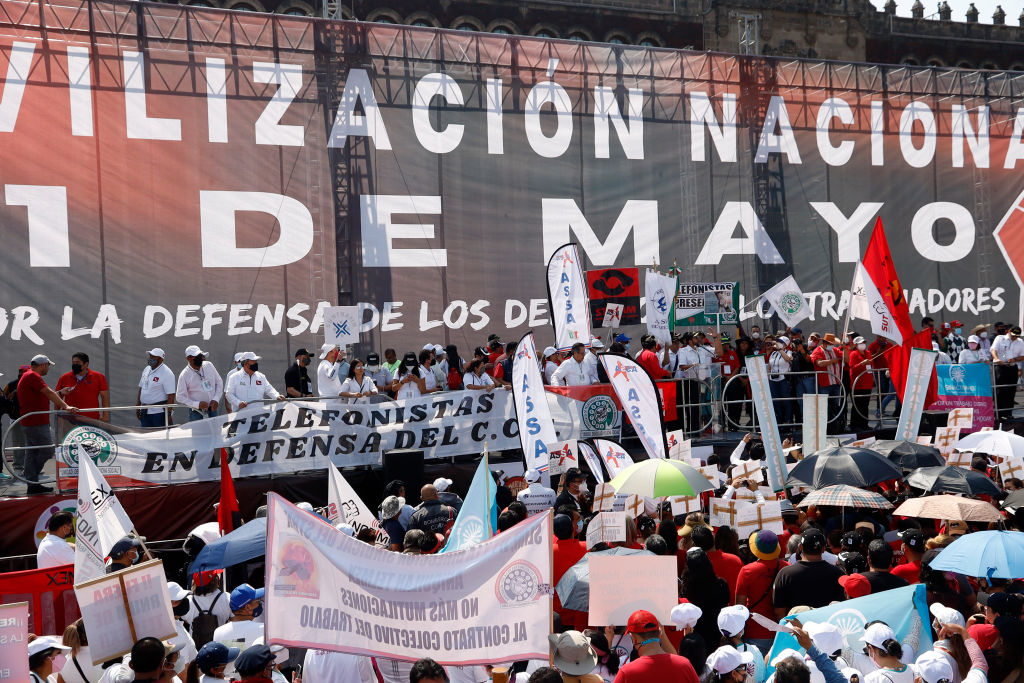
Union workers take part in a demonstration for International Labor Day in Mexico City, May 1, 2022. (Luis Barron / Eyepix Group / Future Publishing via Getty Images)
Modern Mexico was built on the back of labor struggle. In 1906, a miners’ strike at a US-owned copper mine in Cananea, Sonora, was brutally repressed by the rural police of dictator Porfirio Díaz, together with US Rangers dispatched from Arizona. The following year, a strike at a French-owned textile mill in Río Blanco, Veracruz was put down with similar ruthlessness. These actions helped spark the Mexican Revolution of 1910, which, in turn, caused important labor protections to be enshrined in the Constitution of 1917.
A generation later, in 1938, the refusal of multinational oil companies to settle with striking workers, despite a ruling by the Federal Conciliation and Arbitration Board (JFCA) and a failed appeal to the Supreme Court, led to the expropriation of the oil industry by President Lázaro Cárdenas. The willingness of the petroleum workers’ union to allow the president to call the negotiating shots, however, was a sign of things to come. Inspired by the in-vogue corporatism of the 1930s, the emerging hegemon of the Institutional Revolutionary Party (PRI) was busy grouping workers into the worker, campesino, and popular sectors, each with its own confederation and all of them fully subservient to the ruling party. The era of union simulation had begun.
The Era of Simulation
Over the following decades, the PRI machine domesticated official unionism into a racket of company unions and protection contracts. Employment and wage details were worked out between company and union bosses, who ruled with iron fists and often for life. Attempts at forming independent organizations were stymied by chummy labor boards, paid goons, or the force or law, most spectacularly in the case of the rail workers’ strike of 1959, which sent leaders Demetrio Vallejo and Valentín Campa to languish for over a decade in the political-prisoner gulag known as the “Black Palace” of Lecumberri.